


Blog
Why lab accuracy matters in drug testing for compliance


TL;DR:
- Lab accuracy depends on strict validation of parameters like accuracy, precision, and specificity.
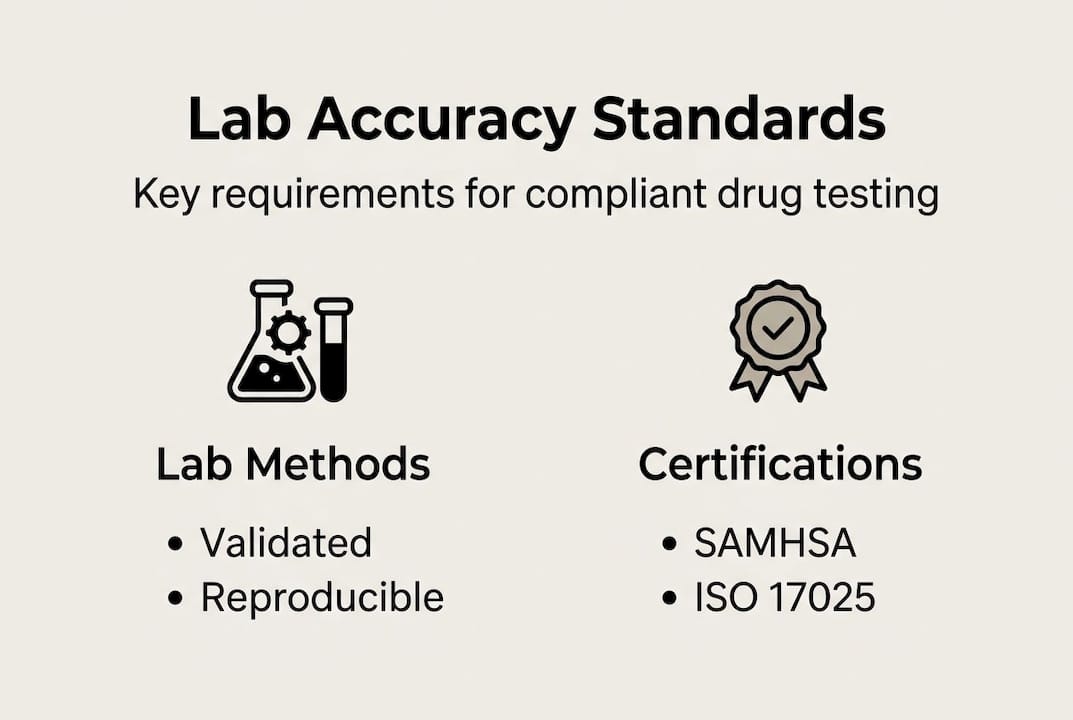
- Certification standards like SAMHSA and ISO 17025 ensure labs meet rigorous testing requirements.
- Ongoing vigilance and proficiency testing are essential to maintain reliability beyond initial certification.
False negatives in drug testing don’t just skew numbers. They influence hiring decisions, patient safety protocols, and federal compliance outcomes in ways that can expose your organization to serious legal and regulatory risk. Diluted urine alone can cause up to 18% false negatives in standard screenings. For drug testing coordinators and procurement managers, understanding what drives lab accuracy is not optional. This article breaks down how accuracy is defined and validated, which certifications actually matter, where errors still occur in certified labs, and what procurement practices give you defensible, reliable results every time.
Key Takeaways
| Point | Details |
|---|---|
| Validated lab methods | Reliable labs follow strict accuracy validation per ICH and ISO/Eurochem standards for defensible results. |
| Certification is essential | Choose SAMHSA or ISO 17025-certified labs to ensure ongoing proficiency and regulatory compliance. |
| Monitor for common errors | Watch for diluted specimens and require validity checks like creatinine and specific gravity to avoid false negatives. |
| Proactive procurement | Always request validation and proficiency data from suppliers and review them periodically to maintain testing integrity. |
| Use compliant supplies | Procure testing supplies that support accuracy, including secure cups, temperature strips, and multi-panel options. |
The science behind lab accuracy in drug testing
Lab accuracy is not a vague concept. In drug testing, it has a precise scientific definition and a set of measurable parameters that every validated method must satisfy before it can be used in a compliance setting.
Accuracy refers to how close a measured result is to the true concentration of a substance. Precision describes how consistently a method produces the same result under repeated conditions. Specificity (also called selectivity) means the method correctly identifies the target substance without interference from other compounds. These three parameters form the foundation of any reliable drug testing method.
Additional parameters that labs must validate include:
- Linearity and range: The method must produce proportional results across the relevant concentration range.
- Limit of detection (LOD): The lowest concentration the method can detect.
- Limit of quantitation (LOQ): The lowest concentration the method can measure with acceptable precision.
- Robustness: The method must perform consistently even with minor variations in conditions like temperature or reagent batch.
When labs validate accuracy, they test at reference concentrations typically set at 80%, 100%, and 120% of the target value. Per ICH Q2 and related guidelines, results must fall within 3 to 5% of the true value at each level to be considered acceptable. That is a tight window, and it demands rigorous laboratory controls.
Global standards like ICH Q2, Eurachem, and ISO 17025 define how validation must be conducted and documented. These are not optional frameworks. For procurement managers, they are the baseline for evaluating whether a lab’s data is defensible in a compliance action.
| Parameter | Definition | Acceptable threshold |
|---|---|---|
| Accuracy | Closeness to true value | Within 3 to 5% of reference |
| Precision | Repeatability of results | CV below 5% typically |
| Specificity | No cross-reactivity with other compounds | No false positives from interferences |
| LOD/LOQ | Minimum detectable/quantifiable concentration | Method-specific, must be documented |
You can review drug testing terminology to build a shared vocabulary with your lab partners, and compare how these parameters differ across testing methods when selecting the right approach for your program.
Pro Tip: Always request a lab’s method validation report before signing a contract. If they cannot produce one, that is a red flag regardless of what certifications they display.
Certification and regulatory standards for accurate testing
Certification is the external verification that a lab’s accuracy claims hold up under independent scrutiny. For drug testing coordinators working in federal, healthcare, or corporate environments, understanding what each certification actually requires is essential to making defensible procurement decisions.
SAMHSA certification is the gold standard for federal workplace drug testing in the United States. SAMHSA-certified labs must pass rigorous proficiency testing, submit to on-site inspections, and maintain strict cutoff compliance. For example, the initial THC cutoff is 50 ng/mL, while confirmation testing drops to 15 ng/mL, ensuring that borderline positives are properly verified rather than dismissed.
ISO 17025 is the international standard for testing and calibration laboratories. ISO 17025 labs must use validated methods, maintain ongoing proficiency testing participation, and document all nonconformities with corrective actions. This standard applies globally and is particularly relevant for labs serving clinical or forensic markets.
| Certifying body | Scope | Key requirements |
|---|---|---|
| SAMHSA | Federal workplace testing | Proficiency testing, on-site inspection, cutoff compliance |
| ISO 17025 | Broad lab accreditation | Method validation, PT participation, corrective action records |
| FDA (510k cleared) | Point-of-care test devices | Analytical performance data, cleared claims |
| CLIA | Clinical lab testing | Personnel standards, quality control, proficiency testing |
To verify a lab’s standing, you can check the official SAMHSA lab list directly. Do not rely solely on a certificate provided by the lab.
Here are the steps procurement staff should follow to verify credentials:
- Search the SAMHSA certified lab list or ISO accreditation registry directly.
- Request the lab’s most recent proficiency testing summary.
- Ask for documentation of any corrective actions taken in the past 12 months.
- Confirm the lab’s scope of accreditation covers the specific panels you require.
- Review their chain-of-custody procedures and specimen handling protocols.
Understanding industry compliance standards helps you apply this verification process consistently, and pairing it with a clear drug screening workflow ensures accuracy from collection through reporting. For a deeper look at supply-side accuracy factors, see our guide on ensuring accurate drug screening.
Common sources of lab inaccuracy and error prevention
Even certified labs produce inaccurate results. Certification sets a minimum standard. It does not eliminate every source of error, and knowing where failures occur is what separates reactive programs from proactive ones.
Specimen dilution is the most documented source of false negatives. Up to 18% of dilute-negative results are confirmed positive when lower cutoffs are applied. This is especially common with cannabinoids and cocaine metabolites, where donors may intentionally or inadvertently dilute their sample by overhydrating before collection.
A specimen is considered dilute when creatinine falls between 2 and 20 mg/dL and specific gravity is between 1.0010 and 1.0030. Substituted specimens show creatinine below 2 mg/dL and specific gravity below 1.0010 or above 1.0200. Both conditions require the collector to flag the specimen for validity testing before any drug result is reported.
Adulteration is another significant issue. Donors may add household chemicals, oxidizing agents, or commercial adulterants to the specimen to interfere with immunoassay reagents. Without adulterant testing built into the collection process, these specimens may return false negatives that appear entirely normal.
Prescription medications also create complexity. Certain antihistamines, antidepressants, and antibiotics can cross-react with immunoassay panels, producing false positives that require confirmation testing to resolve. Labs without rigorous confirmation protocols may report these as positive results without further investigation.
The most frequent sources of lab error include:
- Diluted or substituted specimens not flagged at collection
- Improper specimen labeling or chain-of-custody gaps
- Inadequate method validation for specific drug panels
- Misinterpretation of confirmation test results by reviewers
- Failure to perform validity testing on all urine submissions
Pro Tip: Require validity testing (creatinine, specific gravity, and pH) on every urine submission as a non-negotiable part of your collection protocol. This single step catches the majority of specimen integrity issues before they reach the lab.
For program-level guidance, our workplace safety guide and workflow compliance guide walk through how to integrate these controls into your existing procedures.
Best practices for procurement and compliance reliability
Knowing where errors occur is only useful if you act on that knowledge. The following practices give procurement managers and coordinators a structured approach to maintaining accuracy across every phase of their drug testing program.
How to vet a lab before contracting:
- Confirm active SAMHSA certification or ISO 17025 accreditation directly from the issuing body, not from the lab’s marketing materials.
- Request the lab’s full method validation documentation for every panel you plan to use.
- Review the last four quarters of proficiency testing results and ask specifically about any failures and how they were resolved.
- Verify the lab’s NVLAP (National Voluntary Laboratory Accreditation Program) status if forensic or legal defensibility is required.
- Confirm turnaround time guarantees and what happens when specimens are flagged for validity issues.
Once you have selected a certified lab, the quality of your supplies directly affects the accuracy of the results they process. Procuring only from certified, validated sources is a requirement, not a preference, for programs subject to federal oversight.
Essential supply features that support accuracy include:
- Sealed, tamper-evident collection cups with integrated temperature strips
- Multi-panel test cups that cover your required drug classes in a single collection
- Built-in adulterant check strips for oxidants, pH, creatinine, and specific gravity
- Lot-specific quality control documentation from the manufacturer
- FDA 510k clearance or CLIA waiver status for point-of-care devices
Review the drug testing supplies checklist to audit your current supply chain against these criteria, and use the multi-panel testing guide to match panel configurations to your program requirements.
Monitor lab performance on an ongoing basis. Set a calendar reminder to request updated PT results and certification status every six months. If a lab reports an unresolved nonconformity, pause testing with that provider until corrective action is documented and verified.
What most coordinators overlook about lab accuracy
Most procurement managers check the certification box and move on. That is understandable. Certifications are visible, auditable, and easy to document for compliance reviews. But in practice, the coordinators who run the tightest programs do something different. They treat certification as the starting point, not the finish line.
The real differentiator is ongoing vigilance. Certified labs can and do produce inaccurate results when proficiency testing participation lapses, when method updates are not revalidated, or when staff turnover disrupts established protocols. A certificate on the wall tells you a lab met a standard at a point in time. It does not tell you what happened last quarter.
Edge cases are where programs fail. A diluted specimen that slips through without validity testing, a confirmation method that has not been revalidated after a reagent change, a complaint that was closed without a root cause analysis. These are the moments that create liability.
Pro Tip: Call your lab directly and ask for their two most recent proficiency test scores and the corrective actions taken for any failures. That single conversation will tell you more about their actual reliability than any certificate.
A compliance-first culture means building in the assumption that no single result is infallible. Pair that mindset with strong harm reduction practices and you create a program that is both accurate and defensible.
Choose reliable drug testing supplies for true accuracy
Once you know what true lab accuracy requires, your supplies need to match that standard. At Buy Test Cup, we offer certified drug test cups and testing strips designed for compliance-driven programs in healthcare, government, and corporate settings. Every product in our catalog is selected for regulatory alignment, including CLIA waived and FDA cleared options. Use our accuracy essentials guide to audit your current supply chain and identify any gaps before your next testing cycle. Bulk pricing and same-day shipping mean you never have to compromise on quality to meet a deadline.
![CTA image for Buy Test Cup drug testing supplies]
Frequently asked questions
What is considered accurate in drug testing labs?
Accurate lab results fall within 15 to 20% of the true value at the LOQ and are validated at multiple concentration levels per ICH Q2 and ISO 17025 standards. Any lab unable to document this performance should not be used for compliance testing.
How can procurement ensure a lab remains accurate over time?
Request recent proficiency test results every quarter and verify active certification status through SAMHSA or an ISO accreditation registry. Proficiency testing is required quarterly for certification maintenance, so gaps in participation are a direct warning sign.
What are the most common causes of inaccurate drug test results?
Diluted specimens are the leading cause, with up to 18% of dilute negatives confirmed positive at lower cutoffs, particularly for cannabinoids and cocaine metabolites.
Why is SAMHSA or ISO 17025 certification important for drug testing labs?
Certification confirms the lab meets validated method standards, participates in regular proficiency testing, and can produce results that hold up in compliance actions or legal proceedings.
What action should be taken if a lab fails a proficiency test?
Labs must resolve all nonconformities before resuming certified testing, and procurement managers should pause testing with that provider until documented corrective action is confirmed.