


Blog
Drug Testing Standards 2026: What Compliance Pros Must Know


TL;DR:
- The 2026 federal drug testing standards emphasize regulatory stability and a staged transition to oral fluid testing, with procedural updates posing the main audit risks. Employers must adapt policies to new terminology, ensure proper documentation, and prepare for oral fluid testing once labs are certified, especially when observed urine collection is unfeasible. Failure points often stem from administrative lapses, so disciplined policy updates, consistent training, and accurate recordkeeping are critical for compliance success.
The biggest misconception among compliance professionals is that drug testing standards 2026 brings another wave of sweeping overhauls requiring complete program rebuilds. The reality is more nuanced. This year is defined by regulatory stability in federal panels alongside a pivotal, staged transition toward oral fluid testing. If you manage a DOT-regulated program or oversee workplace safety protocols, understanding exactly where the rules have changed, where they have held steady, and where operational gaps will cost you during an audit is the difference between a compliant program and a finding that lands on your desk in the worst possible way.
Federal drug testing standards and regulatory updates in 2026
The foundational federal framework has not shifted as dramatically as some anticipated. HHS maintains the same analytes and cutoffs established early in 2025 without revisions. That means your urine and oral fluid test panels are operating under the same thresholds. What compliance teams need to focus on instead are the procedural updates that carry real audit risk.
The most significant procedural change came from DOT’s finalized rule on directly observed urine collections. Effective June 10, 2026, DOT mandates directly observed collection when oral fluid testing is unavailable. This was not a punitive measure. The agency formalized this procedure as an interim standard to maintain testing integrity while the oral fluid certification process for labs catches up.
There is also a terminology shift worth noting in your written policies. Executive Order alignment has pushed agencies to update language from “gender” to “sex” in specific procedural references. If your policy documents reference the older terminology in the context of observed collections, this is a clean-up item you need to address now.
Key procedural points your team should document for 2026 compliance:
- Directly observed urine collection is now the default when oral fluid testing remains unavailable at your site
- An 18-month grace period applies to employers transitioning once oral fluid labs receive full HHS certification
- The DOJ/DEA rescheduling of marijuana to Schedule III does not alter federal workplace testing rules. Marijuana remains prohibited in safety-sensitive roles regardless of reclassification
- Employers must verify collection site capability for both urine and oral fluid procedures as certification timelines evolve
Pro Tip: Update your policy and collector training documentation to reflect the “sex” terminology change now. Auditors reviewing observed collection protocols will flag outdated language as a procedural gap, even if your actual collection practices are correct.
Random testing rates every compliance officer must know
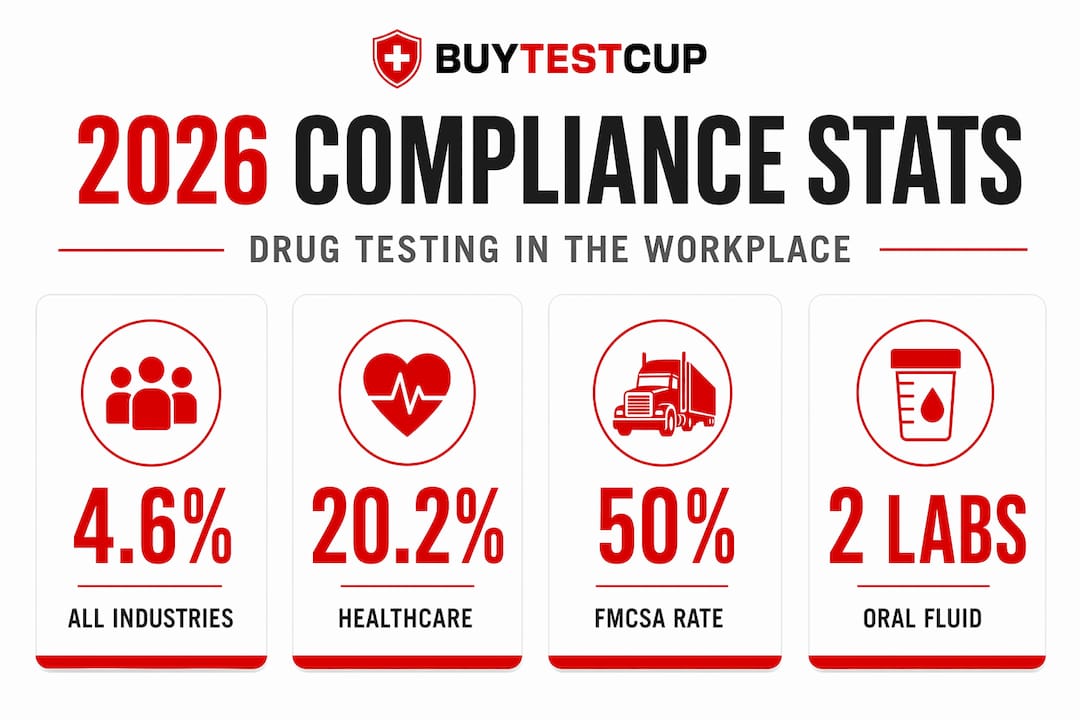
For FMCSA-regulated employers, the numbers have not changed but the enforcement attention around how you execute them has intensified. The minimum annual random drug testing rate for FMCSA-covered employers is 50% for drugs and 10% for alcohol. These are not targets. They are floors.
The more important compliance requirement is distribution. Testing must be spread evenly throughout the calendar year, not front-loaded in Q1 and forgotten. An employer who conducts 60% of their annual random tests before March and trails off through the summer is statistically exposed and will likely face findings if audited.
| Regulatory Agency | Minimum Random Drug Rate | Minimum Random Alcohol Rate |
|---|---|---|
| FMCSA | 50% | 10% |
| FAA | 25% | 10% |
| PHMSA | 50% | 25% |
| FTA | 50% | 10% |
| FRA | 50% (covered service) | 25% |
Small employers are the most vulnerable to rate compliance failures. Running your own random pool with five drivers means a single selection error or missed test cycle can drop you below the 50% threshold. Joining a consortium pools your employees with others, giving the selection algorithm the sample size it needs to generate statistically valid selections throughout the year.
Pro Tip: Document every random selection draw separately, including the date, method used, and names selected. If you use a third-party administrator or consortium, retain their selection documentation in your own files. Auditors want to see your records, not just confirmation that someone else did the work.
Transitioning to oral fluid testing in 2026
Oral fluid testing represents the most discussed development in the future of drug testing. The scientific case for it is strong. Oral fluid samples are harder to adulterate, collected under direct observation without the privacy concerns of urine collection, and industry experts consistently advocate for oral fluid and hair testing as more defensible, science-based alternatives.

The operational reality is more complicated. The reason most employers cannot switch today is straightforward. Oral fluid testing requires two HHS-certified labs to be operational before federal DOT-regulated testing can proceed under the new methodology. As of mid-2026, that certification threshold has not been met. Until it is, directly observed urine collection remains the compliant interim standard.
There is a specific operational scenario that compliance professionals need to plan for now. If a same-sex observer cannot be provided for a directly observed urine collection, oral fluid testing becomes mandatory upon its availability. This means your collection sites need to be ready to pivot, not scrambling to figure out logistics when the certification deadline arrives.
Here is what a practical preparation checklist looks like for the oral fluid transition:
- Confirm your collection site partner has oral fluid collection capability or a firm timeline for adding it
- Review your collector certification to verify training covers oral fluid specimen procedures
- Update your chain of custody documentation to accommodate both specimen types
- Identify which positions in your workforce would be prioritized for oral fluid testing once available
- Brief supervisors and HR on the difference between observed urine collection procedures and oral swab collection to prevent process errors at the site level
The drug screening regulations 2026 do not require employers to rush into oral fluid testing before labs are certified. What they do require is that your program is ready when the switch becomes operationally viable.
State-level changes reshaping workplace policy
Federal compliance is your foundation, but state law is increasingly where policy design gets complicated. Maine offers the clearest 2026 case study in how state legislation can require a fundamental rethink of disciplinary procedures.
Maine’s revised substance use testing law, effective July 29, 2026, mandates that employers provide employees with a 12-week opportunity for rehabilitation after a first confirmed positive result before taking disciplinary action. That is not a suggestion. It is a statutory requirement that directly conflicts with the zero-tolerance disciplinary approach many safety-sensitive employers have relied on for years.
For compliance officers operating in multiple states, this creates a policy design problem that is easy to underestimate. Your federal DOT policy may permit immediate removal from safety-sensitive duties following a positive result, and it does. But Maine now requires you to offer rehab before final discipline, which means your multi-state policy framework needs layered language that satisfies both.
The best practices for managing this kind of state-federal tension come down to three things. First, your written policy must clearly distinguish between removal from safety-sensitive function (which happens immediately after a positive) and final employment disciplinary action (which in Maine now requires the rehabilitation window). Second, your employee communications need to explain these distinctions plainly so workers understand their rights without creating legal ambiguity. Third, this is exactly the kind of policy update you want documented as a 2026 revision with a dated sign-off.
For more guidance on structuring policies that address these nuances, the drug testing policy examples from Buytestcup offer a practical starting point for compliance teams updating their documentation this year.
Practical compliance strategies and common program pitfalls
Most DOT audit failures in 2026 trace back to program management problems, not testing failures. Many audit findings reflect administrative and procedural failures rather than employers who simply did not test enough. That distinction matters because it means your risk is concentrated in the systems you build around testing, not just the tests themselves.
Here are the compliance priorities that protect programs under audit:
-
Write and maintain a compliant, dated policy. Your policy must cover all required elements: covered positions, testing occasions, consequences, and the return-to-duty process. A policy that has not been updated since 2023 is a liability in 2026.
-
Include contractors. Federal requirements mandate that contractors be included in testing programs and clearly documented policies addressing the full workforce. This is consistently one of the top findings in PHMSA and FMCSA audits.
-
Train supervisors formally and document it. Reasonable suspicion testing is only defensible if the supervisor who made the call received formal training and documented their observations contemporaneously. Verbal recollections do not hold up under audit scrutiny.
-
Use a scientifically valid random selection method. Random means random. Supervisor-generated lists or gut-feel selections are not compliant. Your method must produce equal probability of selection for every covered employee in every draw cycle.
-
Maintain complete Clearinghouse reporting. FMCSA Clearinghouse compliance is not optional for CDL holders. Missed queries or late violation reports are among the fastest ways to accumulate audit findings in 2026.
Workplace drug positivity rates in the U.S. hover around 4.6% overall, with the healthcare sector reporting 20.2% positivity. That data matters for calibrating your program intensity and making the case internally for program investment. Defensibility and scientific robustness are increasingly central to drug testing programs that must withstand legal and regulatory scrutiny, which means your recordkeeping and method documentation need to be as solid as the tests themselves.
My perspective on where compliance professionals should focus
What I have learned from watching programs succeed and fail during regulatory transitions is this: the biggest risk is not the rule change you miss. It is the administrative drift that happens when your team assumes the program is running itself.
I have seen employers lose audits not because they lacked the right test cups or missed a rate target by a few points. They lost because their policy was three years out of date, their supervisors had never completed reasonable suspicion training, or their contractors were invisible in the random pool. These are not technology failures. They are management failures, and they are entirely preventable.
My honest take on oral fluid testing is that compliance professionals should prepare now and be patient. The science is sound, and the 2026 drug testing guidelines are structured to make the transition orderly. But operationalizing it before the lab certification infrastructure is in place is how programs create new problems trying to solve old ones.
The most effective compliance posture I have seen combines proactive policy updates, disciplined random pool management, and a commitment to training that does not stop at onboarding. Treat compliance as a recurring operational audit of your own program, not a regulatory checkbox. That mindset is what separates programs that pass from programs that explain themselves.
— matthew
Stock your program with compliant testing supplies from Buytestcup
When your compliance framework is solid, your testing supplies need to match. Buytestcup carries the full range of federally compatible products that workplace safety and compliance programs rely on: multi-panel drug test cups meeting CLIA waived standards, oral fluid collection swabs ready for the oral fluid transition, adulterant testing kits, and specimen collection accessories built for chain-of-custody workflows.
Whether you are managing a DOT-regulated fleet, running a clinic’s compliance program, or sourcing for a government agency, Buytestcup offers bulk pricing, same-day shipping on in-stock items, and free bulk shipping on large orders. Every product in the catalog is selected to support programs that need to hold up under audit, not just produce a result. You can also review the drug testing supplies checklist to make sure your program has what it needs for 2026 compliance before your next collection cycle.
FAQ
What changed in federal drug testing panels for 2026?
HHS maintained the same urine and oral fluid analytes and cutoffs from 2025 without revisions. The primary procedural change is DOT’s finalized rule requiring directly observed urine collection when oral fluid testing is unavailable.
What is the FMCSA random drug testing rate for 2026?
FMCSA-regulated employers must maintain a minimum 50% annual random drug testing rate and a 10% alcohol testing rate, distributed evenly throughout the calendar year to satisfy compliance requirements.
Can employers switch to oral fluid testing now?
Not under federal DOT-regulated programs. Two HHS-certified oral fluid labs must be operational before the switch is permitted. Directly observed urine collection is the current interim standard, with an 18-month grace period once labs are certified.
Does marijuana rescheduling affect DOT drug testing?
No. Despite the DOJ/DEA moving marijuana to Schedule III, federal workplace drug testing rules remain unchanged. Marijuana stays prohibited for all safety-sensitive positions regulated by DOT agencies.
What does Maine’s 2026 drug testing law require from employers?
Effective July 29, 2026, Maine employers must provide a 12-week rehabilitation opportunity after a first confirmed positive result before taking disciplinary action. Removal from safety-sensitive duty can still occur immediately, but final discipline must wait.