


Blog
Step-by-step drug test workflow guide for compliance 2026


Drug testing workflows determine whether your organization maintains compliance, delivers accurate results, and protects legal defensibility. Government agencies, clinics, and workplaces require systematic processes that prevent errors, safeguard chain of custody, and meet evolving regulatory standards. This guide delivers a complete step-by-step workflow covering preparation, collection, testing, verification, and documentation to help you achieve consistent compliance and accuracy in every screening scenario.
Key takeaways
| Point | Details |
|---|---|
| Systematic workflow ensures compliance | Following structured steps prevents chain of custody breaks and regulatory violations. |
| Preparation establishes testing integrity | Proper supplies, environment setup, and documentation form the foundation for accurate results. |
| Collection protocols prevent tampering | Temperature verification, observation, and handling procedures maintain specimen integrity. |
| Verification and documentation protect legal defensibility | Thorough record-keeping and result confirmation support compliance audits and legal challenges. |
Preparing for drug testing: essential tools and prerequisites
Successful drug testing begins long before specimen collection. Your preparation phase establishes the foundation for accurate results and regulatory compliance. Proper preparation with drug testing supplies correlates directly with testing accuracy and compliance, making this phase non-negotiable for professional programs.
Your testing environment requires specific supplies and conditions. Essential materials include multi-panel drug test cups or strips calibrated for your target substances, specimen collection containers with tamper-evident seals, temperature strips for immediate validity checks, chain of custody forms pre-printed with sequential numbering, personal protective equipment including gloves and face shields, secure storage containers for specimens awaiting transport, and calibration solutions for equipment verification. Each item serves a distinct compliance function that protects result integrity.
Environmental setup demands equal attention to physical supplies. Designate a private collection area that prevents unauthorized access and maintains donor dignity. Install proper lighting to enable visual inspection of specimens and test results. Ensure running water access remains controlled to prevent sample dilution. Maintain ambient temperature between 68-72°F to preserve specimen stability. Secure all cleaning supplies and potential adulterants outside the collection area. These environmental controls eliminate common tampering opportunities that compromise test validity.
Documentation preparation prevents downstream compliance failures. Pre-stage chain of custody forms with complete organizational information, testing panel specifications, and collector credentials. Verify that all documentation includes proper legal disclaimers and consent language. Prepare backup forms in case of errors during completion. Create a systematic filing system that enables rapid retrieval during audits. Documentation failures account for more compliance violations than testing errors, making this preparation step critical for legal defensibility.
Pro Tip: Create a pre-testing checklist laminated for reuse that collectors verify before each testing session. This simple tool prevents supply shortages and environmental oversights that delay testing or compromise compliance.
Consider these preparation elements in your drug testing supplies checklist:
- Verify expiration dates on all testing supplies monthly
- Maintain backup inventory of high-use items to prevent workflow interruptions
- Calibrate temperature monitoring equipment quarterly
- Review and update chain of custody forms to reflect regulatory changes
- Train all collectors on proper supply handling and storage protocols
| Supply Category | Primary Function | Compliance Impact |
|---|---|---|
| Test cups/strips | Substance detection | Determines result accuracy |
| Temperature strips | Validity verification | Prevents specimen substitution |
| Chain of custody forms | Legal documentation | Establishes defensible record |
| PPE | Collector safety | Meets occupational health standards |
| Secure storage | Specimen integrity | Maintains evidentiary value |
Step-by-step drug sample collection and handling process
Specimen collection represents the most vulnerable phase for compliance failures and result contamination. Strict adherence to collection protocols reduces false positives and maintains chain of custody compliance. Your systematic approach during this phase determines whether results withstand legal scrutiny and regulatory audits.
Follow this proven collection sequence for urine specimens:
- Verify donor identity using government-issued photo identification and compare to chain of custody documentation
- Explain the collection process and obtain signed consent acknowledging testing procedures and consequences
- Instruct the donor to remove outer garments and secure personal belongings outside the collection area
- Provide the sealed specimen cup and verify the tamper-evident seal remains intact before opening
- Direct the donor to provide at least 45 milliliters of urine directly into the collection cup without assistance
- Receive the specimen within four minutes of collection and immediately verify temperature reads between 90-100°F
- Inspect the specimen visually for unusual color, clarity, or foreign materials indicating potential adulteration
- Seal the specimen container with tamper-evident tape while the donor observes the sealing process
- Complete chain of custody documentation with donor and collector signatures, date, time, and specimen identification number
- Transfer the specimen to secure storage maintaining temperature control until laboratory transport
Temperature verification serves as your primary tampering detection mechanism. Specimens outside the 90-100°F range within four minutes of collection indicate substitution or dilution attempts. Document temperature readings immediately on chain of custody forms. If temperature falls outside acceptable range, initiate observed collection protocols and document the deviation with detailed notes explaining circumstances and corrective actions taken.
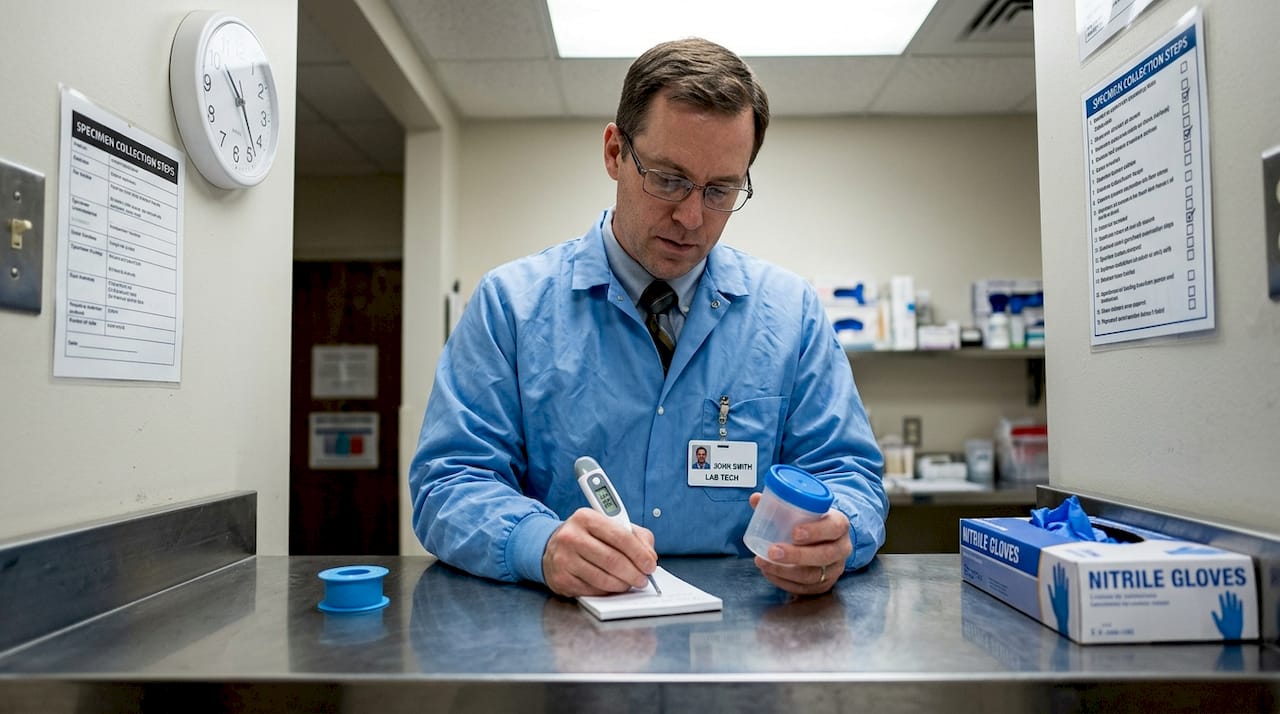
Labeling and documentation during collection prevent specimen mix-ups that invalidate entire testing batches. Apply specimen labels containing unique identification numbers before the donor leaves the collection area. Verify that identification numbers on specimen containers match chain of custody forms exactly. Record any unusual circumstances including donor behavior, collection difficulties, or environmental disruptions. These contemporaneous notes provide critical context if results face legal challenges.
Pro Tip: Use a timer visible to both collector and donor during the collection process. This transparency eliminates disputes about collection timeframes and ensures temperature verification occurs within the required four-minute window.
Handling procedures after collection determine specimen integrity until testing occurs. Store specimens in locked, temperature-controlled containers that prevent unauthorized access. Maintain specimens between 36-46°F if testing delays exceed two hours. Transport specimens to testing locations using insulated containers with temperature monitoring. Document every person who handles specimens in the chain of custody record. These handling protocols preserve evidentiary value and prevent contamination that produces unreliable results.
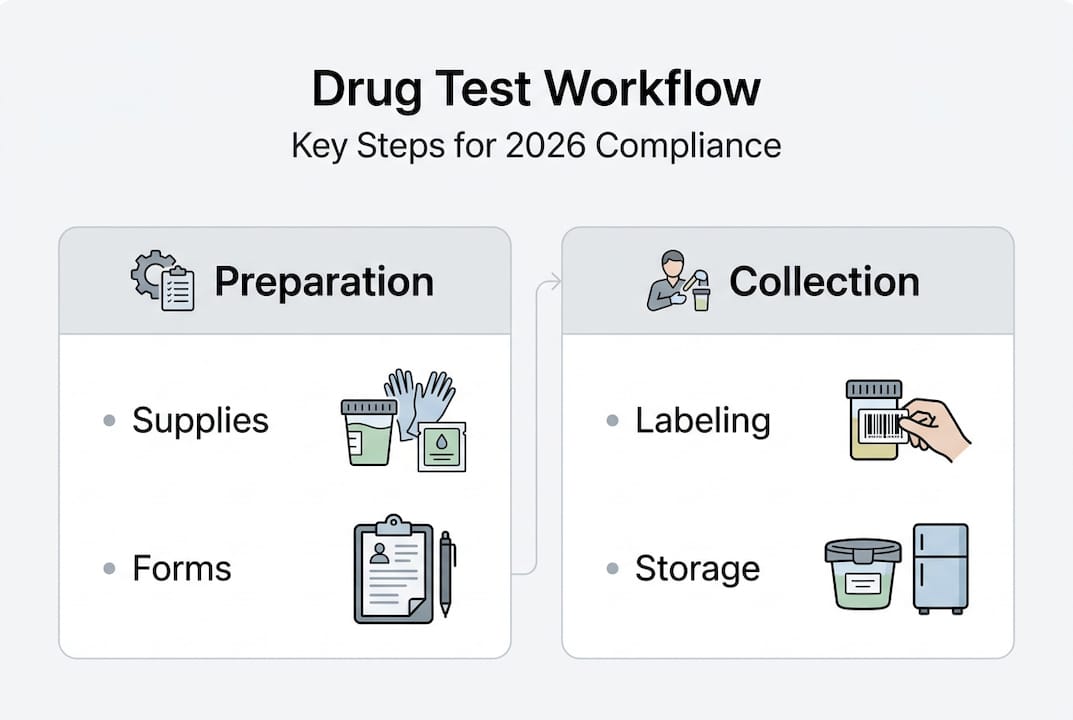
For comprehensive collection protocols, reference the urine drug testing guidance that details procedures for various specimen types and testing scenarios.
Performing testing and interpreting preliminary results accurately
Onsite testing delivers immediate results that guide workplace decisions and compliance actions. Accurate onsite testing combined with interpretation protocols increases detection accuracy and reduces errors. Your testing execution and result interpretation determine whether preliminary findings provide reliable decision support or require confirmatory laboratory analysis.
Test execution varies by product type but follows consistent quality principles. For drug test cups, ensure specimens reach the minimum fill line before inserting the test panel. Read results at exactly the time specified in manufacturer instructions, typically five minutes for immunoassay tests. For dip strips, immerse strips to the maximum line for the precise duration specified, usually 10-15 seconds, then place on a non-absorbent surface for result development. Timing accuracy directly impacts result validity, making stopwatches or timers essential testing tools.
Result interpretation requires understanding three possible outcomes. Negative results show distinct colored lines in both control and test regions, indicating substance concentrations below cutoff thresholds. Positive results display a colored line only in the control region, with no line or a faint line in the test region, suggesting substance presence above cutoff levels. Invalid results show no control line or display unusual patterns, requiring immediate retesting with a new device. Never interpret results outside the specified reading window, as color development continues and produces false readings.
Multi-panel drug tests screen for multiple substances simultaneously, offering efficiency advantages for comprehensive programs:
- 5-panel tests detect marijuana, cocaine, amphetamines, opiates, and PCP
- 10-panel tests add benzodiazepines, barbiturates, methadone, propoxyphene, and methaqualone
- 12-panel tests include MDMA and oxycodone for expanded opioid detection
- Custom panels address specific organizational concerns or regional substance trends
Panel selection should reflect your risk assessment, regulatory requirements, and substance abuse patterns in your population. Government agencies typically mandate specific panels, while private employers enjoy greater flexibility in panel design.
| Test Type | Advantages | Limitations | Best Use Cases |
| — | — | — |
| Drug test cups | Integrated collection and testing, reduced handling | Higher cost per test | High-volume programs, DOT compliance |
| Dip strips | Lower cost, flexible panel selection | Requires separate collection, more handling | Budget-conscious programs, targeted testing |
| Oral swabs | Non-invasive, observed collection | Shorter detection windows | Reasonable suspicion, post-accident |
| Lab-based testing | Highest accuracy, legal defensibility | Longer turnaround, higher cost | Confirmatory testing, pre-employment |
Confirmatory testing protocols activate when preliminary results indicate positive findings. Never take adverse employment actions based solely on preliminary positive results. Send specimens with positive preliminary results to certified laboratories for confirmatory testing using gas chromatography-mass spectrometry or liquid chromatography-tandem mass spectrometry. These advanced methods eliminate false positives caused by cross-reactivity with legitimate medications or dietary substances. Document the confirmatory testing process thoroughly, including laboratory credentials, chain of custody during transport, and result turnaround commitments.
For detailed testing procedures that ensure accurate results, follow the drug screening workflow guide covering various testing scenarios and substance panels.
Verification, documentation, and compliance best practices
Result verification and documentation transform raw test data into legally defensible records that withstand regulatory scrutiny. Robust documentation and verification processes are vital for legal defensibility and regulatory compliance. Your verification protocols and record-keeping systems determine whether your testing program survives audits and legal challenges.
Verify every test result through a systematic quality control process. For negative results, confirm that control lines appeared properly and that reading occurred within the specified time window. Review chain of custody documentation for completeness, including all required signatures, dates, and specimen identification numbers. Cross-reference donor identification information between custody forms and organizational records. Document the verification process with reviewer signatures and timestamps. These verification steps catch documentation errors before they become compliance violations.
Positive result verification demands heightened scrutiny and additional procedural safeguards. Photograph test devices showing positive results before disposal to create visual documentation. Verify that positive results triggered proper confirmatory testing protocols. Review Medical Review Officer reports for alternative explanations including legitimate medication use. Ensure that donors received notification of positive results and appeal rights according to organizational policies and legal requirements. Document every communication regarding positive results with detailed notes including dates, times, participants, and discussion content.
Chain of custody documentation serves as the legal backbone of defensible testing programs. Every person who handles specimens must sign and date custody forms at the moment of transfer. Maintain unbroken custody chains from collection through final disposition. Store completed custody forms in secure, climate-controlled environments that prevent deterioration. Retain records for the period specified by applicable regulations, typically three to five years for workplace programs and longer for regulated industries. Implement digital backup systems that protect against physical record loss while maintaining security controls that prevent unauthorized access.
“Documentation failures, not testing errors, account for the majority of successful legal challenges to drug testing programs. Meticulous record-keeping practices provide the foundation for compliance and legal defensibility in every testing scenario.”
Common compliance pitfalls undermine even well-intentioned testing programs:
- Incomplete chain of custody forms missing required signatures or specimen identification
- Delayed documentation completion that relies on memory rather than contemporaneous recording
- Inconsistent application of testing protocols across different donors or circumstances
- Inadequate training documentation for collectors and testing personnel
- Missing quality control records for testing supplies and equipment calibration
- Failure to update policies and procedures to reflect regulatory changes
- Inadequate security controls for specimen storage and record retention
Legal and regulatory considerations vary by jurisdiction and industry. Federal agencies must comply with Department of Health and Human Services mandatory guidelines for workplace testing. Transportation industry employers follow Department of Transportation regulations specifying testing circumstances, procedures, and substances. State and local governments may impose additional requirements including donor notification periods, appeal processes, and record retention standards. Private employers face fewer mandates but must navigate disability accommodation laws, privacy protections, and collective bargaining agreements. Consult legal counsel to ensure your program addresses all applicable requirements.
For comprehensive compliance guidance, review the drug testing program workflow compliance resource addressing regulatory requirements and best practices.
Boost your drug testing workflow with quality supplies and guides
Optimizing your drug testing program requires reliable supplies and proven guidance that streamline compliance while improving accuracy. Buy Test Cup provides comprehensive solutions for government agencies, clinics, and workplace programs seeking to enhance testing efficiency and regulatory adherence. Our extensive catalog includes drug test cups engineered for accuracy and ease of use, from basic 5-panel configurations to comprehensive 12-panel options addressing diverse substance screening needs. Every product meets rigorous quality standards and includes detailed instructions that simplify collector training and ensure consistent application.
Professionals benefit from our specialized resources including the drug testing supplies checklist that prevents costly supply gaps and the drug testing program workflow compliance guide addressing regulatory requirements across industries. These tools help you build systematic processes that withstand audits while delivering reliable results your organization trusts for critical decisions.
Frequently asked questions
What are the critical chain of custody steps in drug testing?
Chain of custody requires unbroken documentation of every person handling specimens from collection through final disposition. Collectors must obtain donor signatures at collection, document specimen sealing, record transfers between handlers with signatures and timestamps, and maintain secure storage with access logs. Each break in this chain compromises legal defensibility and may invalidate results in contested proceedings. For detailed protocols, consult the compliance drug testing guide covering documentation requirements.
How can I prevent sample adulteration during collection?
Adulteration prevention combines environmental controls, temperature verification, and observation protocols. Secure all water sources and cleaning supplies outside collection areas to eliminate dilution opportunities. Verify specimen temperature between 90-100°F within four minutes of collection to detect substitution attempts. Use observed collections for reasonable suspicion or previous adulteration cases. Visual inspection identifies unusual specimen characteristics suggesting contamination. Reference the employee drug testing checklist for comprehensive prevention strategies.
What should I look for when interpreting preliminary test results?
Valid negative results display distinct colored lines in both control and test regions, regardless of line intensity differences. Positive results show a control line but no test line or only a faint test line. Invalid results lack control lines or display unusual patterns requiring immediate retesting with new devices. Never interpret results outside manufacturer-specified reading windows, typically five minutes for immunoassay tests. Always confirm preliminary positive results through laboratory testing before taking adverse actions. Learn more about interpretation at accurate drug screening for compliance.
How frequently should drug testing workflows be reviewed for compliance updates?
Conduct comprehensive workflow reviews annually at minimum, with additional reviews triggered by regulatory changes, legal challenges, or program audits. Subscribe to regulatory agency notifications to receive immediate updates affecting testing requirements. Document all workflow modifications with effective dates and training records showing personnel received updated instruction. Quarterly internal audits identify compliance gaps before external reviews. Staying current with evolving standards prevents costly violations and ensures legal defensibility. Access current requirements through the compliance drug testing guide updated for 2026 regulations.