


Blog
Bulk Testing Workflow: 5 Steps for Reliable Compliance

TL;DR:
- Accurate bulk drug testing requires certified materials, documented processes, and airtight recordkeeping.
- Follow a strict step-by-step workflow including specimen collection, initial screening, GC/MS confirmation, and MRO review.
- Proper training, reliable supplies, and thorough documentation help prevent false positives and chain-of-custody errors.
A single chain-of-custody break or an unconfirmed false positive can expose your organization to regulatory penalties, legal disputes, and damaged credibility. For government agencies, clinics, and workplaces running bulk drug testing programs, the margin for procedural error is essentially zero. Getting your workflow right means more than just collecting specimens. It means having certified materials, documented processes, qualified staff, and airtight recordkeeping from start to finish. This guide covers everything you need to prepare, execute, troubleshoot, and report bulk drug testing in a way that holds up under federal inspection.
Key Takeaways
| Point | Details |
|---|---|
| Federal compliance essentials | Follow SAMHSA and DOT guidelines to avoid legal and operational risk in bulk testing. |
| Workflow accuracy | Use step-by-step protocols and confirmatory lab tests for reliable results and defensible outcomes. |
| Error prevention | Regular audits and proper staff training drastically reduce workflow failures and false positives. |
| Audit-ready reporting | Keep detailed records and benchmark against DOT/FMCSA data to demonstrate best practices. |
Key requirements and tools for bulk testing workflow success
Before you start bulk testing, it’s critical to ensure you have the right setup. A workflow built on incomplete materials or uncertified supplies is a liability waiting to surface.
Core drugs covered under federal guidelines
SAMHSA mandates testing for five core substances using urine or oral fluid specimens: marijuana (THC), cocaine, opiates, amphetamines, and phencyclidine (PCP), along with specimen validity testing to detect adulteration. If your program falls under federal jurisdiction, these five are non-negotiable, and your panels must reflect that.
Here’s a quick reference for panel coverage in federally regulated programs:
| Drug class | Common panel abbreviation | Specimen type |
|---|---|---|
| Marijuana (THC) | THC | Urine, oral fluid |
| Cocaine | COC | Urine, oral fluid |
| Opiates | OPI/OPI2000 | Urine, oral fluid |
| Amphetamines | AMP/MAMP | Urine, oral fluid |
| Phencyclidine (PCP) | PCP | Urine, oral fluid |
Essential materials for bulk testing
Running bulk events requires more than test cups. Your supply list should include:
- Multi-panel drug test cups with integrated specimen validity strips
- Tamper-evident specimen transport bags and secondary containers
- Chain-of-custody (COC) forms, pre-printed and serialized
- Barcode labels and scanners for specimen tracking
- Biohazard waste disposal bags and personal protective equipment
- Temperature strips to validate fresh specimen collection
For guidance on organizing your full supply list, the screening workflow guide covers what each item does and when it’s needed. You can also source compliant materials directly through bulk testing supplies designed for high-volume events.
Technology and lab requirements
For federally mandated programs, specimens must be analyzed at an HHS-certified laboratory. A Laboratory Information Management System (LIMS) tracks specimens from collection to result, reduces manual entry errors, and generates audit-ready reports automatically. Barcoding each specimen at collection and syncing that barcode with your LIMS creates a traceable digital log that satisfies federal guidelines for documentation.
Pro Tip: Before any mass testing event, verify the expiration date and lot certification on every test cup box. Expired reagents are a leading cause of avoidable invalid results, and discovering this mid-event is costly.
Step-by-step bulk testing workflow for regulatory compliance
With your materials in place, follow this stepwise process to maintain compliance at every stage.
-
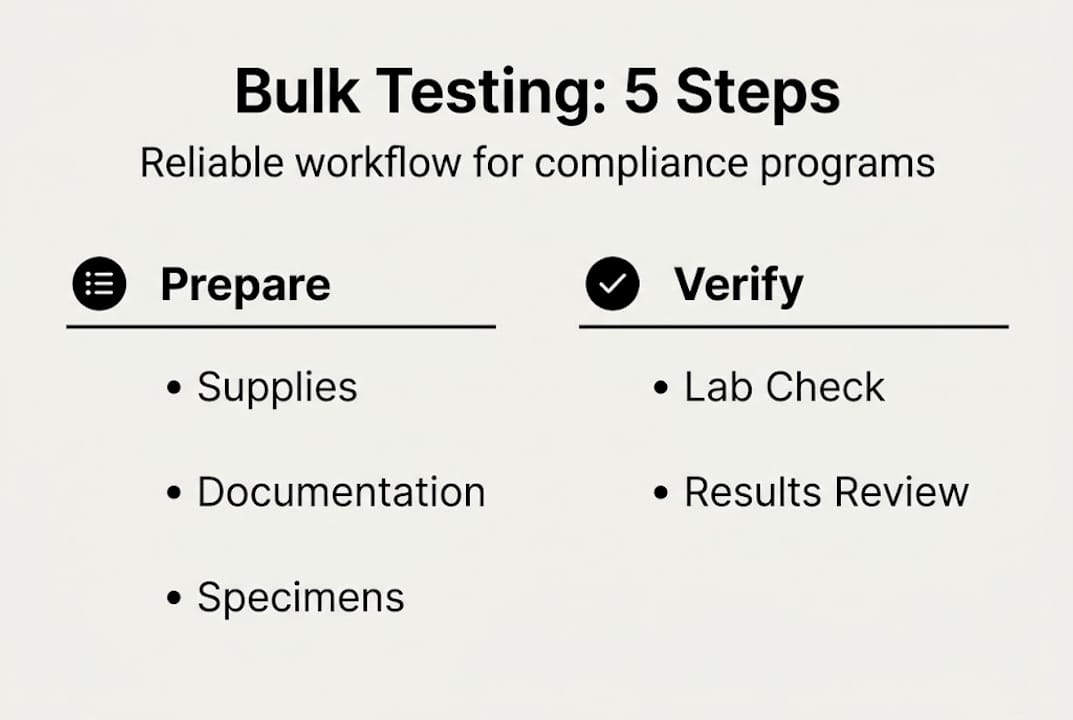
Pre-test notification and selection – Notify employees according to your program policy. Selection methods include random (using a third-party random number generator), reasonable suspicion, post-accident, return-to-duty (RTD), and follow-up. Document which method triggered each test and who authorized it.
-
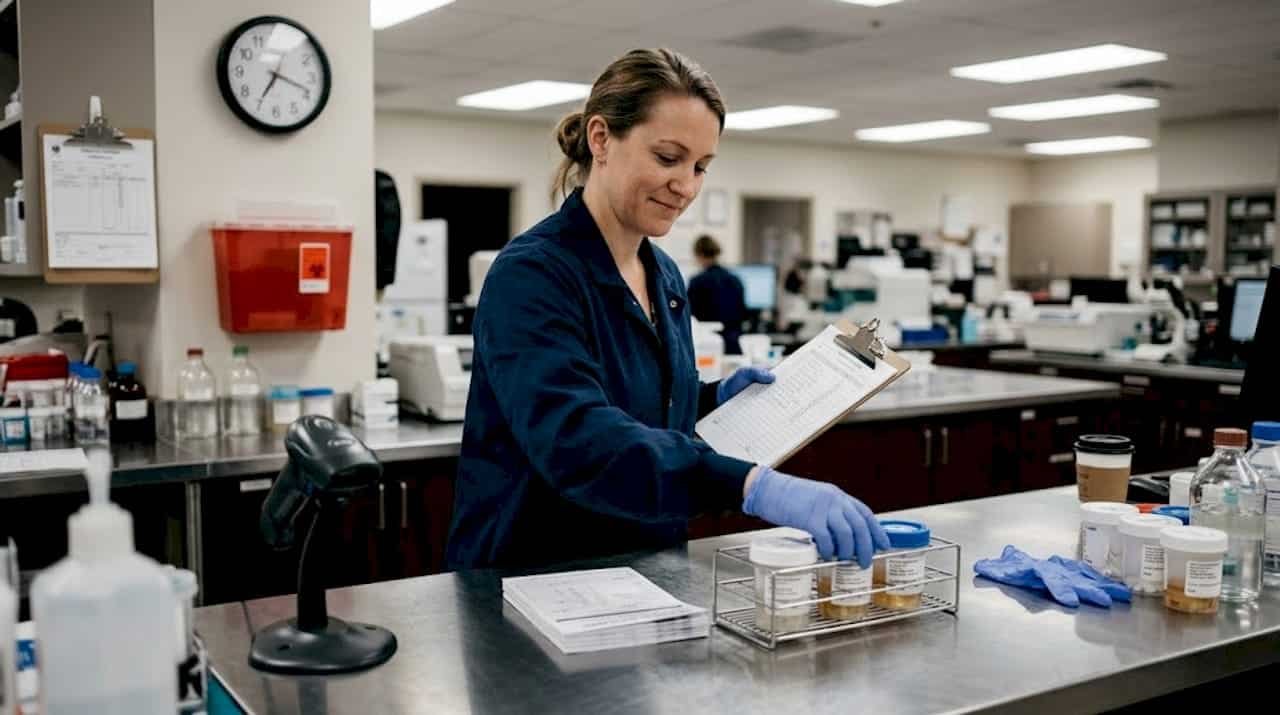
Specimen collection with chain-of-custody – A trained collector observes the process, checks photo ID, completes the COC form, and seals the specimen with a tamper-evident label. Both the collector and the donor sign the form. Any deviation here creates grounds for dispute.
-
On-site immunoassay screening – The test cup or dip strip produces an initial screening result. This is a presumptive result only. A negative immunoassay screen with no validity concerns typically closes the case. A non-negative triggers the next step.
-
Lab confirmation with GC/MS – Confirmatory GC/MS testing is required for all non-negatives in federal programs. Gas chromatography/mass spectrometry (GC/MS) identifies the specific compound and concentration, ruling out cross-reactivity from legal substances that can trigger immunoassay false positives.
-
MRO review and result reporting – A Medical Review Officer (MRO) reviews all confirmed positive results, interviews the donor, and makes the final determination. The MRO’s report goes to the designated employer representative. Maintain all records for a minimum of five years under DOT rules.
For a deeper look at each checkpoint, the step-by-step guide walks through documentation requirements in detail. The multi-panel compliance guide also explains how different panel configurations affect each stage.
Key distinction: On-site rapid tests deliver results in minutes and work well for large-volume initial screening. Lab-based confirmatory workflows add one to three business days but are legally required before any adverse employment action in federal programs. Rapid tests do not replace GC/MS confirmation. Running both in sequence is the compliant approach. The Drug-Free Workplace Program outlines exactly when each method applies.
Troubleshooting, edge cases, and reducing errors in bulk testing
Even with strong procedures, challenges can undermine your workflow. Knowing where failures happen lets you prevent them before they become compliance incidents.
Common sources of false positives
Immunoassay screens are sensitive by design, which makes them prone to cross-reactivity. Substances that commonly trigger false positives include:
- Ibuprofen and naproxen triggering opiate or cannabinoid panels
- Pseudoephedrine (found in cold medications) triggering amphetamine panels
- Quinolone antibiotics cross-reacting with opiate assays
- Faulty or degraded reagents in poorly stored test cups
- Specimen temperature outside the accepted range (90°F to 100°F), which may indicate substitution
According to documented testing failures, false positives from cross-reactivity and reagent issues can result in serious employment and legal consequences when programs skip GC/MS confirmation. Every non-negative must be treated as presumptive until the lab confirms it.
Chain-of-custody pitfalls
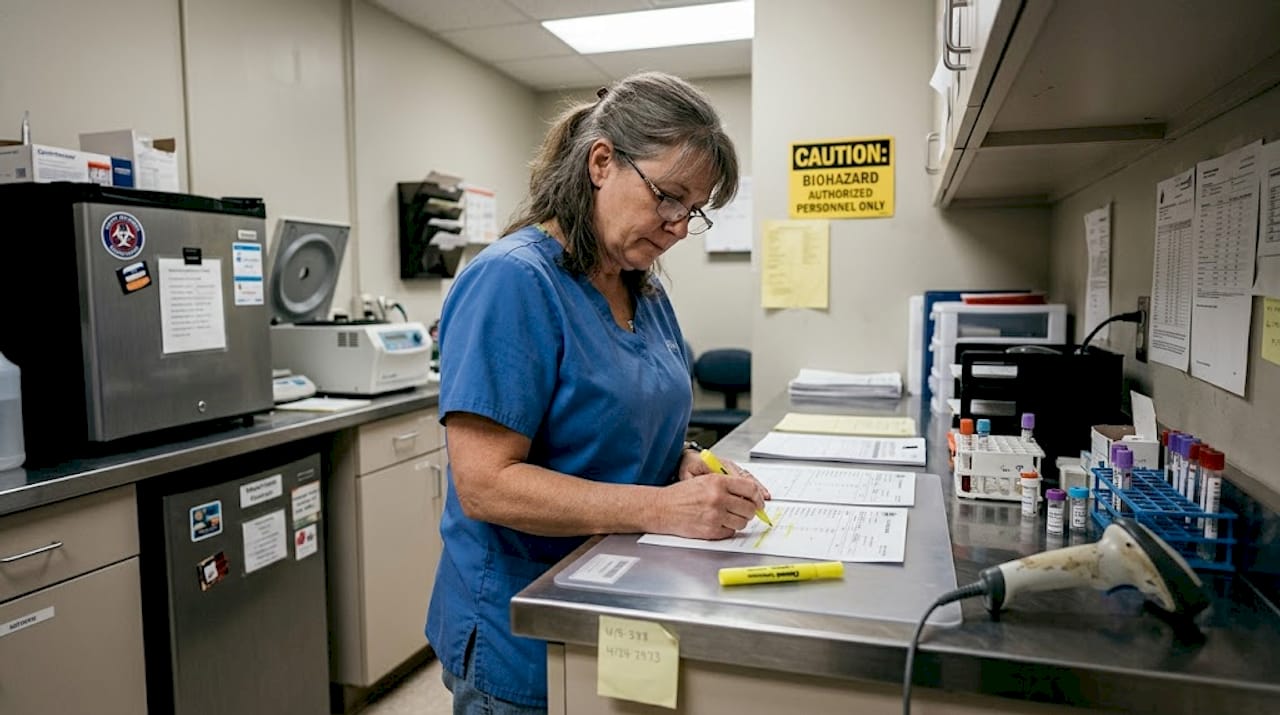
Chain-of-custody (COC) breaks are among the most damaging errors in bulk testing because they invalidate results regardless of the actual substance in the specimen. Common pitfalls include:
- Collector forgetting to witness the sealing of the specimen
- Missing donor or collector signatures on the COC form
- Specimen transported without tamper-evident packaging
- Lab receiving a specimen with a broken seal or mismatched barcode
For sourcing COC-compatible collection kits, the reliable supplies guide identifies kits that include integrated forms and tamper-evident seals.
Compliance note: Dilute and substituted specimens are not failures of the collection process. They are results that require MRO review and potentially a direct-observed recollection. Train your staff to flag these rather than dismiss them. The program compliance steps outline what actions dilute results trigger under federal rules.
Pro Tip: Schedule quarterly staff refreshers on COC procedures, not just annual training. Errors spike when high-volume events involve staff who handle collections infrequently.
Benchmarking, reporting, and audit strategies for B2B compliance
To ensure ongoing compliance, set up clear reporting and controls that hold up under inspection.
Why benchmarking matters
The FMCSA Clearinghouse recorded over 326,000 drug and alcohol violations in its March 2025 monthly report, illustrating just how active federal enforcement remains. If your program cannot produce accurate violation rates, RTD (return-to-duty) tracking, and test completion logs, you are not audit-ready.
Audit-ready reporting structure
Organize your compliance reports to satisfy DOT, GSA, and state agency inspections:
| Report category | Key data points | Retention period |
|---|---|---|
| Test logs | Date, donor ID, test type, result | 5 years (DOT) |
| Chain-of-custody forms | Collector, lab, MRO signatures | 5 years |
| MRO review records | Final determinations, interview notes | 5 years |
| RTD and follow-up tracking | Program completion dates, test results | Duration of employment + 2 years |
Audit checklist: core items to verify quarterly
- All test records match COC form serial numbers
- MRO reviews completed within required timeframes
- Random selection pool updated to reflect current workforce
- Lab certification still active for all testing facilities
- Staff training records current for all collectors and supervisors
- Supplies within expiration and lot-certified
For more detail on structuring panel-level compliance reports, the multi-panel reporting best practices guide covers how to map test results to regulatory categories. External compliance audit tips provide additional frameworks for self-assessment before official inspections.
Self-audits catch issues before regulators do. Run one every quarter, not just before a scheduled inspection.
What most guides miss: The overlooked gaps in bulk testing workflow
Most checklists stop at collection and result reporting. What they miss is often where programs fall apart.
Relying solely on rapid immunoassay results without a clear escalation path for non-negatives is the most common structural flaw we see. Organizations assume a negative screen closes the file. But what happens when a result is non-negative and the MRO review cycle is undefined? Specimens sit, deadlines pass, and audit trails break.
Digital recordkeeping is another weak point. Paper COC forms get lost, misfiled, or damaged during high-volume events. Organizations that have not migrated to electronic COC systems or LIMS integrations are managing compliance risk on paper, which is a real vulnerability during federal audits.
Cross-training is also undervalued. If your primary collector is unavailable during a post-accident test, who steps in? That backup staff member needs the same procedural knowledge. Programs that rely on one or two people for compliance-critical roles are fragile by design.
Our detailed workflow strategies address all three of these gaps with practical steps. Build MRO review windows into your workflow calendar. Schedule COC spot checks monthly, not annually. Treat cross-training as a compliance control, not a nice-to-have.
Streamline your bulk testing: Get compliant supplies and guidance
If you’re ready to optimize your workflow, reliable supplies and resources make all the difference. Buy Test Cup carries a full range of federally compliant bulk drug test cups, multi-panel kits, COC-compatible collection supplies, and specimen transport materials designed for government agencies, clinics, and workplace programs running high-volume testing. Better supplies reduce procedural risk at the source. Our bulk drug test cups are available in bulk quantities with same-day shipping on qualifying orders. Start with the drug testing supplies checklist to confirm you have everything your workflow requires before your next testing event.
Frequently asked questions
What are the core drugs required in federal bulk testing?
Federal guidelines require testing for marijuana, cocaine, opiates, amphetamines, and PCP using urine or oral fluid specimens. These five panels are mandatory for all federally regulated workplace programs.
How are false positives addressed in bulk testing workflows?
Medical Review Officers verify all positive results, and every non-negative must be confirmed by GC/MS before any adverse action is taken. Screening immunoassays alone are not sufficient for final determinations.
What is the required random testing rate for DOT-regulated employees?
The Department of Transportation mandates a 50% random rate annually for safety-sensitive employees. This rate is reviewed and may be adjusted based on industry violation data.
Why is chain-of-custody documentation critical in bulk testing?
Chain-of-custody breaks can lead to result invalidation and open organizations to legal disputes. Complete, signed documentation is the only way to defend a result under audit or challenge.