


Blog
Drug testing in government agencies: what works


TL;DR:
- Government drug testing, established by Executive Order 12564, enforces strict legal frameworks to ensure workplace safety. Different testing scenarios, including pre-employment, random, suspicion-based, or post-accident, each have specific procedures and legal thresholds to follow. Effective programs rely on proper documentation, expert review, clear communication, and combining testing with supportive measures to promote a healthier, compliant workforce.
Many compliance officers assume government drug testing is simply a background check formality. It is not. Executive Order 12564, signed in 1986, created a binding legal framework that mandates drug-free federal workplaces, defines specific testing scenarios, and establishes accountability for agency leadership. Understanding the full scope of this framework, including when testing is required, how specimens are processed, and what the data says about actual effectiveness, is essential for anyone making compliance decisions that affect public safety and workforce integrity.
Key Takeaways
| Point | Details |
|---|---|
| Compliance is mandated | Executive Order 12564 and HHS/SAMHSA guidelines require agencies to maintain drug-free workplaces. |
| Critical positions prioritized | Testing Designated Positions are chosen by risk, especially for safety- and security-sensitive roles. |
| Testing panels are defined | Urine and oral fluid tests check for marijuana, cocaine, opiates, amphetamines, and more. |
| Positive results follow procedure | False positives undergo review, and employees have rights to retest and provide evidence. |
| Testing is only part of the solution | Education, clarity, and support help agencies enhance workplace safety beyond just drug tests. |
Why drug testing matters in government settings
Most people understand that federal employees face drug testing. Fewer understand how specific and consequential that testing actually is.
“Drug testing in U.S. government agencies is mandated by Executive Order 12564, authorizing testing for applicants, random testing for Testing Designated Positions (TDPs), reasonable suspicion, incident or accident situations, and follow-up testing.”
This is not a single policy applied uniformly. Testing scenarios include:
- Pre-employment screening for any applicant entering a designated position
- Random testing for employees in roles classified as Testing Designated Positions
- Reasonable suspicion testing when supervisors observe behavioral or physical signs of impairment
- Post-incident or accident testing following workplace safety events
- Follow-up testing after an employee returns from a substance use treatment program
Each scenario carries different procedural requirements and legal thresholds. Treating them all the same is a compliance risk.
Beyond the legal mandate, the underlying rationale is straightforward. Government roles often involve sensitive information, public safety, law enforcement authority, or direct oversight of national infrastructure. A correctional officer, an air traffic controller, and a DEA analyst all work in contexts where impairment creates asymmetric risk. The consequences of a mistake reach far beyond the individual.

That said, the program is not without critics. Researchers and policy analysts who study drug testing efficacy point to legitimate concerns: cost-effectiveness, accuracy limitations, potential privacy invasion, and whether deterrence actually works in the long run. Proponents counter with safety imperatives and compliance obligations. Both perspectives deserve space in your decision-making process. The most effective compliance officers build programs that address the legal mandate while taking these tensions seriously.
Following drug testing compliance best practices from the start reduces both liability and friction when disputes arise later.
Core elements of government agency drug testing programs
Federal drug testing is not a freestanding policy. It operates within a structured framework governed by specific guidelines and roles.
Who gets tested: understanding TDPs
The SAMHSA Drug-Free Workplace guidance defines Testing Designated Positions as roles where impairment could directly threaten public safety or national security. TDPs typically include:
- Positions requiring Top Secret security clearances
- Roles with authorized firearm use
- Roles with direct public health or safety impact
- Positions involved in administering random drug testing programs themselves
Agency heads are responsible for determining which roles qualify based on a formal risk assessment. This determination is not automatic. It requires documentation, periodic review, and alignment with agency-specific mission requirements.
What the HHS and SAMHSA guidelines require
The Mandatory Guidelines for Federal Workplace Drug Testing issued by HHS and SAMHSA specify every technical detail of how testing must be conducted. This includes the required testing panels, acceptable analytes, and the exact cutoff concentrations for both initial screening and confirmatory testing.
| Testing stage | Method used | Standard applied |
|---|---|---|
| Initial screen | Immunoassay (urine or oral fluid) | HHS-defined cutoff concentrations |
| Confirmatory test | GC/MS or LC/MS/MS | Lower confirmatory cutoffs |
| Specimen types | Urine (primary) or oral fluid | Split sample collection required |
| Verification | Medical Review Officer (MRO) | Reviews all non-negative results |
The current federal testing panel covers marijuana (THC), cocaine, opiates, amphetamines, phencyclidine (PCP), and fentanyl. Fentanyl is a relatively recent addition, reflecting the current public health landscape.
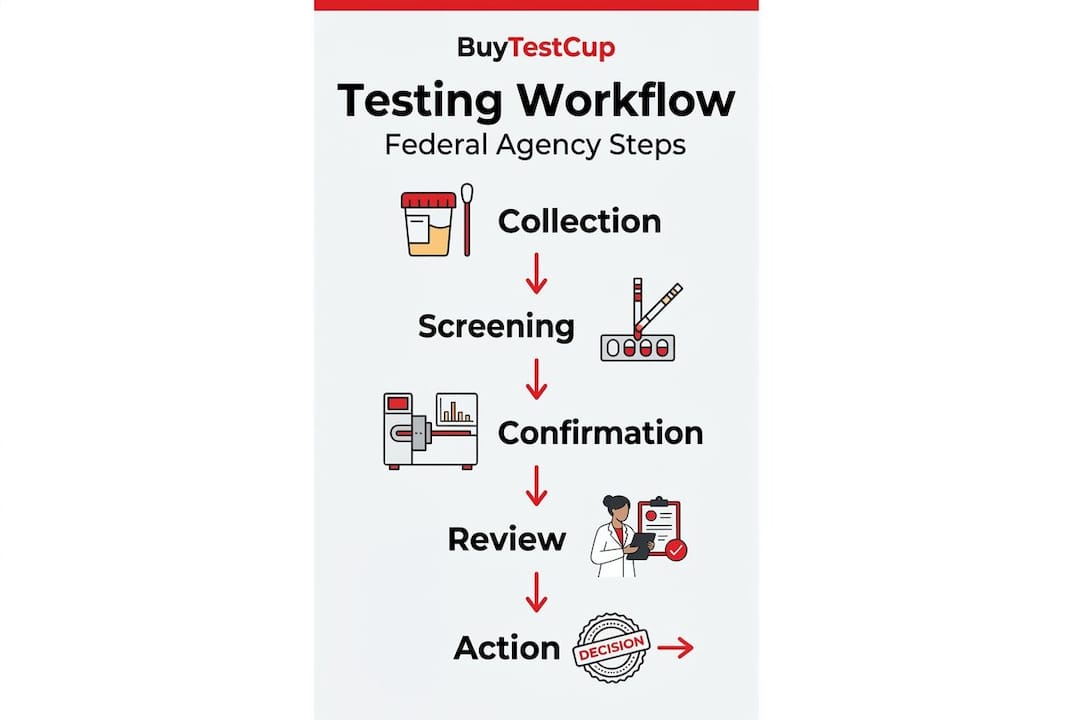
The core process, step by step
Understanding the sequence matters because a break anywhere in this chain can invalidate a result:
- Notification of the employee or applicant per agency policy
- Specimen collection at a certified collection site with documented chain of custody
- Transport to an HHS-certified laboratory for analysis
- Initial screening using immunoassay methods
- Confirmatory testing for any non-negative results using GC/MS or LC/MS/MS
- MRO review of all non-negative results before any action is taken
- Reporting to the agency with a final verified result
Pro Tip: Document chain of custody at every single handoff point, not just collection and receipt. In an audit or legal challenge, gaps in the middle of the chain are just as damaging as gaps at either end. Agencies using drug testing program standards aligned with HHS guidelines rarely face procedural challenges even when results are contested.
A well-structured program setup guide can help compliance teams map these steps against their current workflows before gaps become problems.
Testing methods, analytes, and interpreting results
The technical side of drug testing is where many compliance programs start to break down. Knowing what gets tested and how results are interpreted protects both the agency and the employee.
Federal testing panels in practice
The current federal panel covers six primary substance categories:
- Marijuana (THC): Most common positive result; metabolites can persist in urine for weeks in heavy users
- Cocaine: Shorter detection window; usually cleared within 2 to 4 days
- Opiates: Covers codeine, morphine, and heroin metabolites; detection window varies by dose and frequency
- Amphetamines: Includes methamphetamine and MDMA; typically detectable for 2 to 4 days
- PCP (phencyclidine): Longer detection window; less common but still tested
- Fentanyl: Added to reflect the current overdose crisis; requires specific immunoassay and confirmatory cutoffs
Handling non-negative results correctly
Tests are conducted at HHS-certified laboratories, and split samples provide a critical safeguard. When a result is non-negative, the employee retains the right to have the B specimen tested at a different certified lab. This procedural protection matters enormously for maintaining workforce trust.
False positives are a real risk, not a hypothetical one. Certain over-the-counter medications, supplements, and prescription drugs can trigger immunoassay screens for amphetamines, opiates, or other substances. When this happens, the process for ensuring accurate drug screening depends on:
- Chain of custody review to ensure specimen integrity was maintained
- MRO evaluation of the employee’s complete prescription history and any legitimate medical explanations
- Confirmatory testing via GC/MS or LC/MS/MS to distinguish true positives from cross-reactive substances
Security clearance cases involving false positives typically go through a “whole-person” adjudicative review. This means the agency considers the recency and frequency of use, the circumstances, and mitigating factors rather than applying automatic denial. That said, some agencies still treat any positive result as immediately disqualifying, which creates its own set of procedural and legal risks.
Pro Tip: Always request a full disclosure of prescription medications before testing. Building this into your intake process reduces the number of contested results that reach the MRO stage and significantly shortens resolution time.
The marijuana problem: state law versus federal mandate
This is the edge case that trips up the most agencies. More than 40 states have legalized marijuana for medical or recreational use. Employees are understandably confused. The federal rule is clear: a marijuana positive is federally disqualifying regardless of state law. State legality is simply irrelevant to federal employment decisions. Communicating this clearly to your workforce before testing begins prevents disputes that could have been avoided with better education upfront.
Program effectiveness, empirical data, and evolving debates
Compliance officers deserve an honest picture of what drug testing actually achieves, and where the evidence falls short.
“The 2024 National Survey on Drug Use and Health reports that 25.5% of Americans aged 12 and older used an illicit drug in the past year, with marijuana use at 22.3%. That is 73.6 million people.”
Against that backdrop, federal agency positive rates are notably lower. State-level welfare drug testing programs have reported positivity rates as low as 2.6%, which proponents cite as evidence of deterrence. Whether that gap reflects deterrence, population selection, program design, or underreporting is genuinely unknown. The empirical benchmarks for federal agency-specific programs simply do not exist in the published literature.
What researchers who study drug testing outcomes do tell us is important:
- Testing programs may reduce rates of use among populations that know they are subject to testing
- Cost-effectiveness varies significantly depending on program design, positivity rates, and administrative overhead
- Privacy concerns are consistently cited as a workforce trust issue, particularly in agencies that lack transparent communication about testing policies
- Punitive-only approaches tend to drive employees away from seeking help voluntarily, which can worsen underlying substance use problems
The debate around harm reduction approaches is increasingly relevant here. Agencies that combine testing with employee assistance programs (EAPs) and clear pathways to treatment report better outcomes than those that rely on enforcement alone. The data is not perfectly controlled, but the pattern is consistent enough to inform policy.
Education is the piece most agencies underinvest in. Employees who understand why testing exists, how results are handled, and what protections they have are far less likely to experience or generate disputes. That reduces administrative burden and improves program credibility at every level.
A pragmatic take: Drug testing’s true value and overlooked solutions
Here is something most compliance training will not tell you: a drug testing program that is technically compliant but organizationally blind creates more problems than it solves.
SAMHSA’s own analysis consistently shows that stable, high rates of drug use across the general population have not been moved by detection-focused programs alone. There is no strong empirical benchmark showing that federal testing programs, as currently designed, meaningfully reduce substance use rates among government employees over time. That is an uncomfortable truth, but it is a useful one.
The agencies that run the most effective programs share a few characteristics that have nothing to do with their testing technology. First, they treat the Medical Review Officer as a central figure, not a rubber stamp. The MRO review process is where false positives get caught, prescriptions get evaluated, and legitimate medical defenses get a fair hearing. Agencies that treat MRO review as a procedural checkbox rather than a substantive safeguard end up in disputes they should never have started.
Second, the best programs document everything, not because auditors might show up, but because documentation is what makes edge case management possible. When an employee challenges a result, when a false positive needs to be explained, or when a security clearance adjudication requires a timeline, documentation is the difference between resolution and prolonged legal exposure.
Third, and most importantly, effective programs take the “support” side of “support and accountability” seriously. Employees in positions where impairment creates real risk deserve clear communication, accessible EAP resources, and a culture where seeking help is not professionally fatal. That is not a soft objective. It is a risk management strategy. Agencies that create pathways for employees to address substance use problems before they become testing events maintain a healthier, more stable workforce.
The real value of drug testing is not catching people. It is creating an accountable environment where the rules are clear, the process is fair, and the consequences are proportional. That framing produces better programs, better workforce relationships, and ultimately better compliance outcomes than a pure enforcement model ever will.
Implement compliance-ready drug testing with the right tools
For government agencies and compliance teams ready to tighten their testing programs, having the right supplies is as important as having the right policies. Buy Test Cup provides a full range of products built for institutional use, from multi-panel drug testing cups that cover the federal analyte panel to bulk-ready 8-panel urine test cups designed for consistent, auditable specimen collection. Whether you are establishing a new program or standardizing an existing one, the right collection tools reduce collection errors, support chain-of-custody documentation, and keep programs running without supply disruptions. Explore program workflow tools and build a compliant, defensible testing program from the ground up.
Frequently asked questions
What substances are commonly screened in government drug tests?
Federal programs screen for marijuana, cocaine, opiates, amphetamines, PCP, and fentanyl, as specified in the HHS/SAMHSA Mandatory Guidelines using urine or oral fluid specimens.
Is a positive marijuana test still grounds for disqualification in federal agencies?
Yes. Federal law controls agency employment decisions, so a positive marijuana result is disqualifying regardless of whether the employee resides in a state where marijuana is legal.
What rights do employees have if they test positive?
Employees may request retesting of the B split sample at a separate HHS-certified laboratory, and split sample procedures guarantee that right for any confirmed non-negative result.
How do agencies decide which roles require random drug testing?
Agency heads formally designate Testing Designated Positions by assessing roles with Top Secret clearances, firearm authorization, or direct public health and safety responsibility, with documentation required for each designation.
Are instant or point-of-care tests allowed for federal agency employees?
No. Point-of-care or instant tests are not permitted in DOT-regulated settings; all specimens must be processed at an HHS-certified laboratory to meet federal standards.