


Blog
Bulk drug test supplies: Reliable compliance for agencies


Most purchasing managers assume bulk drug test orders are simply a cost-saving measure. In reality, consumables hold 34.5% of the global drug screening market because regulatory compliance demands consistent, standardized testing at scale. Government agencies and healthcare organizations face strict federal requirements that make bulk purchasing not just economical but operationally essential. This guide shows you how to select reliable bulk drug test supplies that meet SAMHSA, DOT, and OSHA standards while supporting uninterrupted substance abuse monitoring programs.
Key Takeaways
| Point | Details |
|---|---|
| Compliance assurance | Bulk drug test supplies simplify meeting federal and regulatory screening requirements. |
| Operational efficiency | Bulk ordering ensures consistent testing, reduces administrative effort, and supports large programs. |
| Panel selection impact | Choosing appropriate multi-panel, tamper-resistant supplies matches diverse monitoring needs. |
| Cost and support balance | Evaluate both price and supplier services to secure ongoing, reliable drug testing operations. |
Regulatory compliance: Why bulk supplies matter
Federal workplace programs impose specific testing standards that purchasing managers must navigate carefully. SAMHSA guidelines, DOT requirements, and OSHA regulations mandate FDA-cleared, CLIA-waived tests for valid workplace screening results. Bulk purchasing ensures every test in your inventory meets identical regulatory specifications, eliminating the risk of mixed compliance statuses across your supply chain.
When you order in bulk, you lock in regulatory certainty. A single large order of CLIA-waived 15 panel cups guarantees that every test administered over the next quarter carries the same FDA clearance and CLIA waiver. This uniformity simplifies audits, reduces administrative burden, and protects your organization from compliance gaps that could trigger penalties or legal challenges.
Regulatory bodies require documentation trails for every screening event. Bulk orders from a single certified supplier streamline this process by providing consistent lot numbers, expiration dates, and certification paperwork. Your compliance team can reference one purchase order instead of tracking dozens of smaller transactions with varying specifications.
Pro Tip: Before finalizing any bulk order, request written confirmation of FDA clearance and CLIA waiver status directly from your supplier. Verify these credentials against the FDA database to ensure your tests meet current federal standards for drug testing program compliance.
Key regulatory considerations for bulk purchases:
- SAMHSA panel requirements for federal workplace programs
- DOT-mandated testing protocols for transportation safety
- OSHA workplace safety standards for hazardous environments
- FDA clearance verification for all testing devices
- CLIA waiver confirmation for point-of-care screening
The regulatory landscape continues evolving, with federal guidelines updated in 2026 to address emerging substances and testing technologies. Bulk purchasing from compliant suppliers ensures you stay ahead of these changes without scrambling for last-minute replacements.
Meeting program demands: Efficiency and reliability in bulk
Once regulatory compliance is established, operational efficiency drives the need for bulk orders. Large government agencies and healthcare facilities conduct hundreds or thousands of tests monthly. Running out of supplies mid-program creates dangerous gaps in monitoring, exposes your organization to liability, and disrupts critical harm reduction efforts.
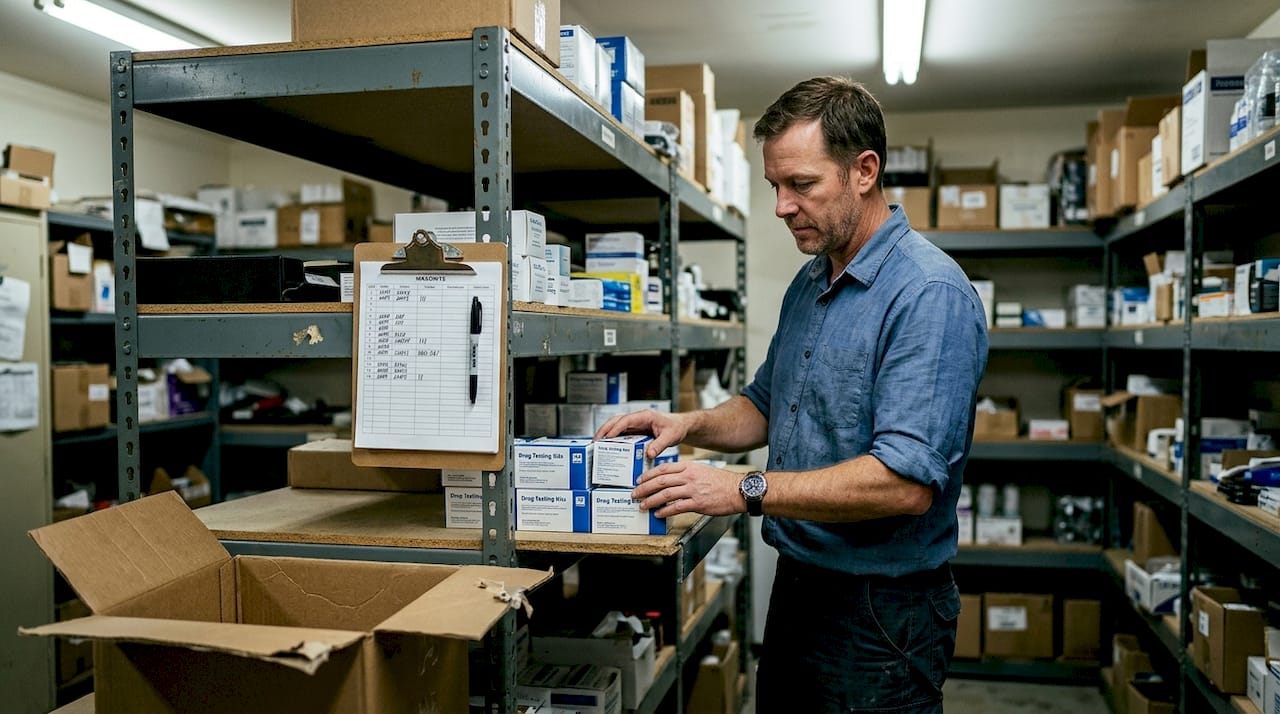
Bulk ordering transforms your supply chain from reactive to proactive. Instead of placing emergency orders when inventory runs low, you maintain a strategic reserve that supports consistent testing schedules. This stability is particularly crucial for agencies managing court-ordered monitoring, employee assistance programs, or patient treatment compliance.
The financial benefits extend beyond unit cost savings. Bulk purchases reduce shipping fees, minimize processing time for accounts payable, and free up staff from constant reordering tasks. Your team can focus on program delivery instead of supply chain management.
| Factor | Bulk Ordering | Individual Ordering |
|---|---|---|
| Lead time | 3-5 business days | 1-2 days per order |
| Error rate | 2-3% (single verification) | 8-12% (multiple orders) |
| Cost per test | $1.20-$2.50 | $3.50-$5.00 |
| Inventory stability | 90+ day supply | 7-14 day supply |
The global drug screening market reached $9.45B in 2024 and continues growing because organizations recognize these operational advantages. Consumables dominate market share precisely because repeat bulk purchases deliver predictable results at scale.
Pro Tip: Track your monthly testing volume for six months before placing your first bulk order. This baseline data helps you calculate optimal order quantities that prevent both shortages and excess inventory waste. Most agencies find a 90-day supply strikes the right balance between cost savings and shelf life management.
Bulk purchasing also standardizes your drug screening workflow across multiple locations. When every testing site uses identical supplies, you can develop unified training protocols, quality control procedures, and result interpretation guidelines. This consistency improves accuracy and reduces the learning curve for new staff members.
Agencies managing multiple programs benefit from consolidated purchasing power. A single bulk order can supply workplace testing, treatment monitoring, and harm reduction initiatives simultaneously. This approach simplifies budget forecasting and strengthens vendor relationships that support long-term program success. Reference our drug test workflow guide for implementation strategies.
Choosing the right panels and supplies for diverse needs
After understanding bulk logistics, choosing the correct supplies maximizes monitoring success and compliance. Multi-panel tests are essential for tackling complex substance use patterns that single-drug screens miss. Government agencies and healthcare organizations face polysubstance use scenarios that require comprehensive detection capabilities.
Bulk selection enables standardization across your entire testing program. When you commit to a specific panel configuration, every test administrator knows exactly which substances are being screened. This clarity prevents confusion, reduces training requirements, and ensures consistent monitoring protocols regardless of which staff member conducts the test.
Selecting the right supplies for your agency needs:
- Assess your monitoring requirements based on program mandates, population risk factors, and regulatory obligations
- Identify required substances by reviewing SAMHSA guidelines, DOT regulations, and local policy requirements
- Evaluate panel configurations that cover your substance list while minimizing unnecessary tests
- Consider tamper-resistant features like temperature strips, adulterant detection, and specimen validity testing
- Verify regulatory status for FDA clearance and CLIA waiver on your chosen panel configuration
- Calculate volume needs using historical testing data and projected program growth
- Request sample tests before committing to large bulk orders to verify quality and usability
| Panel Type | Substances Detected | Clinical Purpose | Cost Per Panel |
|---|---|---|---|
| 5-Panel | THC, Cocaine, Opiates, Amphetamines, PCP | Basic workplace screening | $1.20-$1.80 |
| 10-Panel | 5-panel + Benzodiazepines, Barbiturates, Methadone, Propoxyphene, Methaqualone | Comprehensive workplace and treatment | $2.00-$2.75 |
| 13-Panel | 10-panel + MDMA, Oxycodone, Buprenorphine | Enhanced opioid monitoring | $2.50-$3.25 |
| 15-Panel | 13-panel + Fentanyl, Tramadol | Advanced polysubstance detection | $3.00-$3.75 |
Federal guidelines mandate specific panels for government workplace programs, making panel selection a compliance issue rather than a preference. Bulk purchasing of SAMHSA-compliant panels ensures your entire inventory meets these requirements without exception.
Pro Tip: Invest in tamper-resistant designs with built-in adulterant detection to prevent specimen manipulation. Features like temperature strips, oxidant checks, and pH indicators catch common cheating methods without requiring separate validity tests. This integrated approach saves time and reduces the cost per screening event.
Your multi-panel testing strategy should align with the substances most prevalent in your monitored population. Healthcare facilities treating opioid use disorder need fentanyl and buprenorphine detection, while transportation agencies prioritize amphetamines and marijuana screening. Review our guide on how to select drug test kits for detailed panel comparisons.
Bulk orders of reliable bulk supplies with consistent panel configurations also simplify result tracking and data analysis. When every test captures the same substance profile, you can identify trends, measure program effectiveness, and adjust interventions based on solid evidence rather than fragmented data.
Key factors to consider when buying bulk drug test supplies
Before making a bulk order, consider these factors to ensure both compliance and operational efficiency. Product certifications form the foundation of any reliable bulk purchase. Every test must carry current FDA clearance and CLIA waiver status, verified through documentation you can present during audits or inspections.
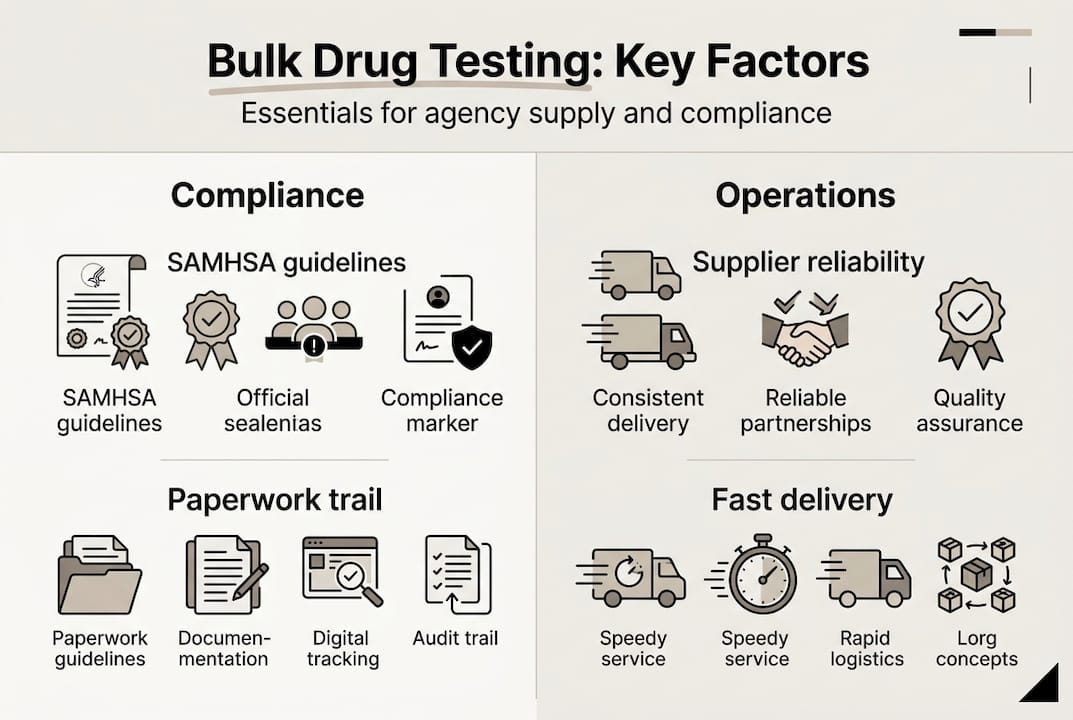
Supplier reliability matters as much as product quality. A vendor who ships incomplete orders, misses delivery deadlines, or provides inconsistent product batches undermines your entire testing program. Evaluate potential suppliers based on their track record with government and healthcare clients, not just their advertised prices.
Balancing upfront costs with ongoing support determines long-term program success. The cheapest bulk price means nothing if your supplier disappears when you need technical assistance, replacement inventory, or regulatory guidance. Factor in the total cost of ownership, including customer service quality, return policies, and supply chain stability.
Core factors for bulk purchasing decisions:
- Regulatory compliance with current FDA, CLIA, SAMHSA, DOT, and OSHA standards
- Product quality including accuracy rates, shelf life, and tamper-resistant features
- Pricing structure covering unit costs, volume discounts, and shipping fees
- Customer support for technical questions, order issues, and compliance guidance
- Logistics capabilities including delivery speed, inventory management, and emergency restocking
FDA-cleared, CLIA-waived tests are essential for regulatory compliance in federal workplace programs, making certification verification the most critical step in any bulk purchasing decision.
Your drug testing program workflow depends on supply chain predictability. Bulk orders should come with guaranteed delivery windows, lot number tracking, and clear expiration date management. These operational details prevent the chaos of expired inventory or last-minute scrambling for replacement supplies.
Scalability considerations become crucial as your program grows. A supplier who handles 500-test orders smoothly might struggle with 5,000-test volumes. Discuss your growth projections upfront and confirm your vendor can scale with your needs without sacrificing quality or delivery performance.
Documentation requirements for government purchasing often exceed commercial standards. Ensure your bulk supplier provides detailed invoices, certificates of analysis, regulatory compliance letters, and any other paperwork your procurement department needs. Missing documentation can delay payment processing and create audit headaches months after delivery. Learn how to choose test kits that meet your specific documentation needs.
Explore reliable bulk drug test supplies for your program
Having explored the key considerations, see how you can access trusted bulk drug testing supplies and resources. Buy Test Cup offers FDA-cleared, CLIA-waived solutions designed specifically for government agencies and healthcare organizations managing high-volume testing programs. Our catalog includes multi-panel, tamper-resistant cups and strips that meet SAMHSA, DOT, and OSHA requirements without compromise.
Browse our complete selection of drug test cups featuring 5-panel through 15-panel configurations with integrated adulterant detection and temperature strips. For programs requiring dip card flexibility, explore our testing strips that deliver the same regulatory compliance in a different format. Every product includes detailed certification documentation and technical specifications to support your procurement process.
We understand that bulk purchasing decisions require more than product catalogs. Access our comprehensive workflow guide for step-by-step implementation strategies that help you maximize the value of your bulk investment. From specimen collection protocols to result interpretation frameworks, we provide the operational support that turns supplies into successful programs.
Frequently asked questions
Are bulk drug test supplies always CLIA-waived and FDA-cleared?
No, you must verify each product’s regulatory status with the supplier before purchasing to ensure compliance. FDA clearance and CLIA waiver are product-specific designations that require documentation.
How does bulk purchasing help prevent supply shortages in high-volume testing?
Bulk buying ensures consistent availability, reducing the risk of running out during high demand periods. Consumables hold significant market share because organizations prioritize supply continuity.
What types of drug test panels should government and healthcare agencies prioritize?
Multi-panel, tamper-resistant tests aligned with SAMHSA and DOT guidelines are recommended for broad screening and compliance. Panel selection should match your specific monitoring requirements.
How can managers ensure their bulk purchases match program needs?
Assess panel coverage, regulatory status, and supplier reliability while using workflow guides to map supply needs. Regulatory compliance verification should precede any bulk commitment.