


Blog
Ensure compliance: The essential role of bulk drug testing

TL;DR:
- Many procurement officers treat bulk drug testing supplies as routine purchases, risking compliance failures.
- Strict adherence to federal testing standards, including panel configuration, cutoffs, and reporting terminology, is essential.
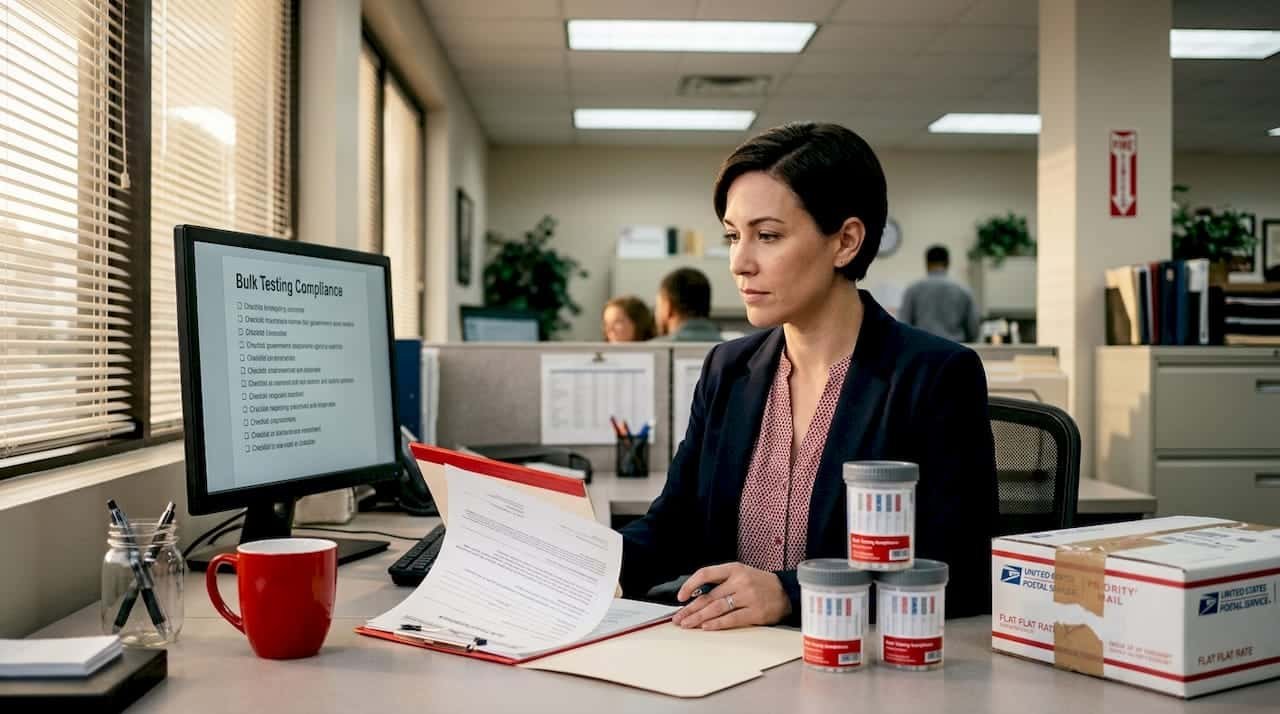
Many procurement officers treat bulk drug testing supply orders the way they handle office supplies — find the best price per unit, confirm quantity, and move on. That assumption can quietly undermine an entire compliance program. Federal requirements for workplace and healthcare drug testing specify exact analyte panels, cutoff thresholds, and reporting nomenclature, meaning a supply order that misses even one of these details can produce results that are legally unusable. This article walks through the regulatory framework, supply standards, logistics requirements, and a practical procurement framework to help agencies get it right every time.
Key Takeaways
| Point | Details |
|---|---|
| Compliance is non-negotiable | Procurement must follow regulatory standards for panels, cutoffs, and documentation to ensure valid results. |
| Supply alone is not enough | Proper sample handling, shipping approvals, and logistics are required for compliance, not just compliant test cups. |
| Certification and ongoing audits matter | Labs and agencies must support supplies with certification, quality records, and readiness for periodic inspection. |
| Documentation protects programs | Always request and archive lot quality and compliance documentation with each bulk supply order. |
| Choose proven partners | Partnering with established, compliance-tested vendors reduces risk and audit failures. |
Why bulk drug testing is critical for compliance
Compliance in drug testing is not a checkbox. It is a continuous obligation backed by federal regulation, and the supplies your agency uses are directly part of that obligation. When procurement teams view bulk supply orders as routine purchasing decisions, they expose the program to audit risk, rejected results, and potential legal liability.
The regulatory foundation starts with the U.S. Department of Health and Human Services (HHS) and the Substance Abuse and Mental Health Services Administration (SAMHSA). These agencies publish mandatory guidelines that define which drugs must be tested, what concentration levels (cutoffs) trigger a positive result, and how results must be labeled and reported. The drug testing standards that govern federal workplace programs are not optional guidance. They are enforceable rules, and your testing supplies must match them exactly.
“Bulk procurement of testing reagents, kits, and controls must be aligned to HHS/SAMHSA published panels and required nomenclature.”
Consider what that means in practice. If your agency orders a multi-panel test cup that screens for a drug class at a cutoff that differs from the published standard, every result from that lot is potentially invalid for compliance reporting. No amount of process documentation will fix a supply mismatch after the fact.
Key compliance requirements for federal workplace and healthcare drug testing programs include:
- Analyte panels: Supplies must screen for specific drug classes defined in the current HHS/SAMHSA panel, including opioids, amphetamines, marijuana metabolites, cocaine, and phencyclidine (PCP).
- Cutoff thresholds: Each analyte has a published nanogram-per-milliliter (ng/mL) cutoff. Test kits must be calibrated to those exact levels.
- Reporting nomenclature: Results must use the terminology specified in the guidelines so they can be understood consistently across labs, collection sites, and medical review officers (MROs).
- CLIA waiver status: Point-of-care tests used in clinics or on-site settings must carry a Clinical Laboratory Improvement Amendments (CLIA) waiver to be legally used outside a certified lab environment.
The benefits of bulk drug testing for agencies go far beyond cost savings. A compliant bulk supply chain ensures continuity, reduces administrative rework, and protects your program during federal audits. Getting the regulatory foundation right is where that value starts.
What makes a bulk drug testing supply compliant?
Once you accept that compliance is multi-dimensional, the next question is practical: how do you evaluate whether a specific supply order actually meets the standard? This is where many procurement officers run into trouble, because the compliance criteria extend well beyond the product label.
Federal guidelines specify that labs and Instrumented Initial Test Facilities (IITFs), which are facilities that use automated analyzers for initial drug screening, operate under certification frameworks that include performance testing and on-site inspections. That certification structure flows upstream to the supplies those labs and facilities use.
| Feature | Compliant supply | Non-compliant or risky supply |
|---|---|---|
| Panel configuration | Matches current HHS/SAMHSA published panel | Generic or outdated panel |
| Cutoff calibration | Exact regulatory ng/mL thresholds | Approximate or unlisted thresholds |
| Documentation | Lot certificate, QC records available | No lot documentation provided |
| CLIA waiver | Present for point-of-care products | Absent or expired |
| Analyte nomenclature | Matches federal reporting terms | Non-standard or trade terminology |
| Vendor audit trail | Vendor subject to inspections/quality audits | No audit history disclosed |
The table above makes clear that a compliant supply is not simply one that “tests for drugs.” It is one with a documented, verifiable match to current federal standards at every level of the product’s specification.
Here is a step-by-step process to verify compliance for any bulk order:
- Request the product’s panel configuration in writing. Confirm it lists every analyte, the cutoff for each, and that the terminology matches HHS/SAMHSA nomenclature.
- Ask for the lot certificate and quality control (QC) records. These documents confirm that the specific production lot passed performance standards before shipment.
- Verify CLIA waiver status if the supplies will be used outside a certified laboratory setting.
- Cross-reference the analyte list against the current published HHS/SAMHSA mandatory guidelines, not last year’s version.
- Confirm vendor certification status. Ask whether the vendor’s manufacturing or distribution process is subject to external quality audits.
- Document everything for your procurement file. Audit-readiness means your records can answer every question an inspector might ask without scrambling for paperwork.
Pro Tip: Always request documented lot-level quality certification from any vendor before finalizing a bulk order. A reputable supplier will provide this without hesitation. If a vendor cannot or will not supply this documentation, that is a significant warning sign.
Exploring top bulk drug test supplies from vendors who provide full certification documentation is the fastest way to filter out high-risk options before they reach your program. Understanding the full landscape of industry compliance standards in 2026 will also help your team stay current as the guidelines evolve.
The logistics of bulk drug testing: Handling and shipping essentials
Procurement and compliance do not end when the supplies arrive at your facility. How those supplies, and ultimately the specimens collected with them, are handled and shipped is an equally critical part of maintaining program integrity. Compliance for drug testing programs is tightly coupled to sample handling, shipping logistics, and method-driven acceptance rules.
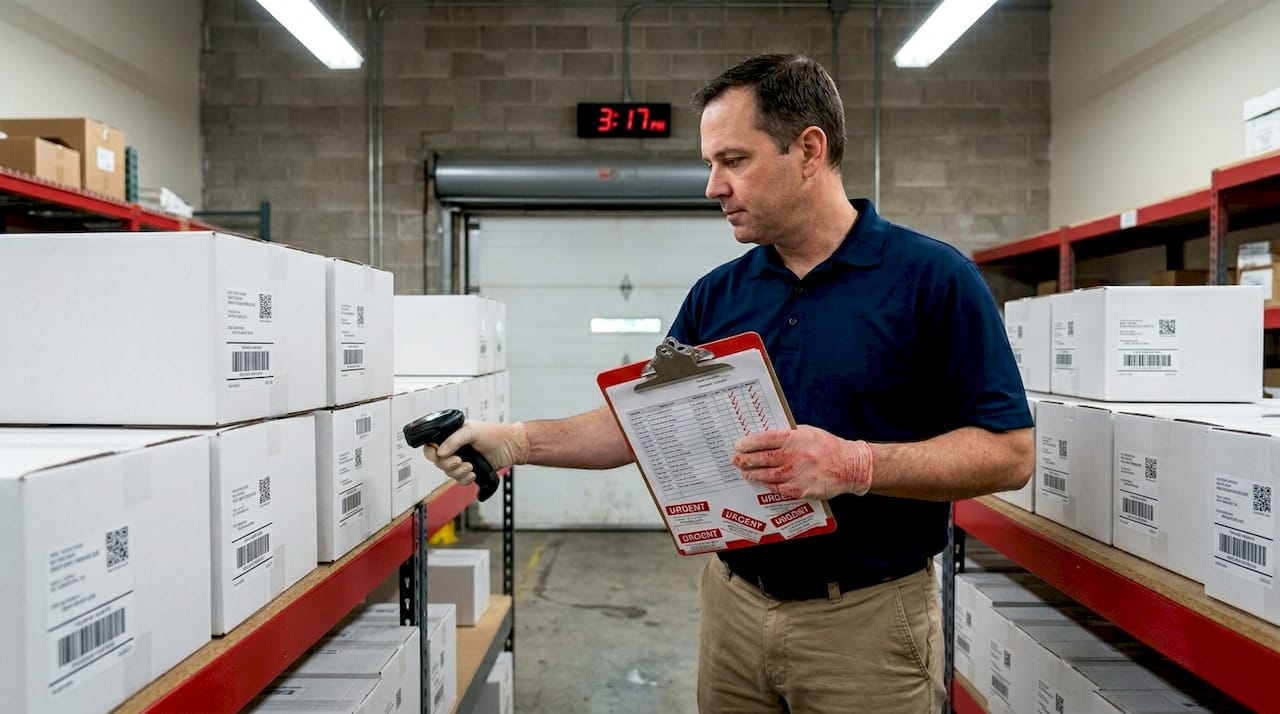
This is one area where otherwise well-run programs frequently stumble. A compliant test cup, collected by a trained collector, with proper documentation, can still produce a rejected result if the specimen is shipped to the lab under incorrect conditions or without prior lab approval for a bulk submission.
| Supply or sample type | Storage condition | Packaging requirement | Shipping approval needed |
|---|---|---|---|
| Urine test cups (unopened) | Room temperature, away from light | Original sealed packaging | No, standard freight |
| Collected urine specimens | 2 to 8°C (refrigerated) | Tamper-evident, biohazard labeled | Yes, lab pre-approval required |
| Oral swab devices (unopened) | Room temperature, low humidity | Sealed packaging, moisture control | No, standard freight |
| Oral swab specimens (collected) | Per manufacturer protocol | Biohazard labeled, sealed bag | Yes, lab pre-approval required |
| Reagents and controls | Per product specification, often refrigerated | Cold-chain packaging | Confirm with supplier |
The most common logistics pitfalls that jeopardize bulk drug testing programs include:
- Skipping lab pre-approval for bulk specimen submissions. Labs have volume thresholds and intake protocols. Sending a large specimen shipment without prior coordination often results in rejection or processing delays.
- Breaking the chain of custody (COC) during transport. Every specimen must travel with an unbroken COC document. A missing or incomplete form makes the result legally unusable.
- Exposing unopened supplies to extreme temperatures. Test cups and reagents stored or shipped in excessive heat or cold can degrade before use, producing false results that expose the agency to liability.
- Using non-compliant packaging for specimens. Federal DOT and lab requirements for biological specimen shipping are specific. Generic packaging that does not meet those standards leads to carrier refusal or lab rejection.
- Failing to document specimen handling at every transfer point. Each handoff in the specimen’s journey must be recorded. Gaps in that record are the kind of detail that surfaces during audits.
Our bulk testing logistics guide breaks down these requirements in more detail and provides agency-ready templates for COC documentation and shipping coordination.
Pro Tip: Before dispatching any bulk specimen shipment, confirm directly with the receiving lab that they have approved the submission volume and that your packaging meets their current intake requirements. This one step prevents the most common cause of bulk submission failure.
Integrating compliance, supply, and logistics: Success framework for agencies
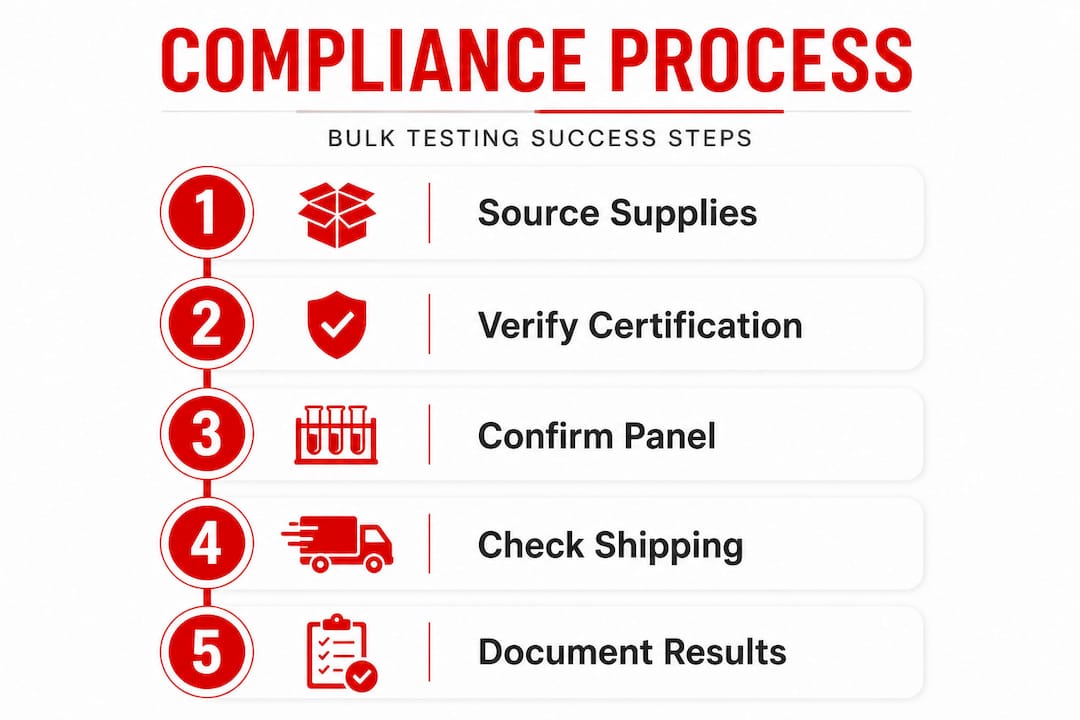
Pulling all three dimensions together, regulatory alignment, supply verification, and logistics integrity, requires a systematic workflow that procurement teams and program managers can follow consistently. This is not about adding bureaucracy. It is about building a repeatable process that protects your program every single time.
“Supplies must match the required analyte and cutoff configuration and reporting nomenclature, or results may not be usable for compliance reporting.”
That single requirement from the federal guidelines summarizes the entire risk. A bulk order that looks like a great deal can silently invalidate months of testing results if the configuration is even slightly off. Here is a practical framework for agencies:
- Start with the current HHS/SAMHSA panel. Before evaluating any supplier, download the most current mandatory guidelines and list the required analytes, cutoffs, and nomenclature for your specific program type (federal workplace, safety-sensitive, healthcare, etc.).
- Develop a supply specification document. Translate the regulatory requirements into a written specification that vendors must match. This document becomes the basis for your purchase order and your audit file.
- Run a compliance verification checklist for every proposed supplier, using the six steps outlined in the previous section.
- Build your logistics protocol before the first order ships. Define your internal handling procedures, storage conditions, chain of custody workflow, and lab pre-approval contacts in writing.
- Train all collection site personnel on the approved supply use and specimen handling protocol before any testing begins.
- Conduct a quarterly review of both supply compliance and logistics performance. Regulations update, products change, and labs revise their intake protocols. A quarterly review catches drift before it becomes a compliance failure.
| Framework element | Key action | Risk if skipped |
|---|---|---|
| Regulatory alignment | Match supplies to current panel | Invalid results, audit failure |
| Supply verification | Request lot documentation | Unknown quality, compliance gap |
| Logistics protocol | Establish COC and shipping process | Rejected specimens, chain breaks |
| Personnel training | Train on supply use and handling | Collection errors, invalid samples |
| Quarterly review | Update specs and protocols | Regulatory drift, silent non-compliance |
The cost of misalignment is not theoretical. When results cannot be used for compliance reporting because the supplies or process had a deficiency, the agency must retest, reopen cases, and often explain the failure to a federal oversight body. That is far more expensive in time, money, and credibility than getting the process right the first time.
The path to reliable compliance for agencies runs directly through this kind of structured procurement process. For agencies still evaluating whether to build out a formal bulk testing program, reviewing why agencies choose bulk drug testing for compliance, safety, and cost reasons makes a strong operational case.
The real-world cost of overlooking compliance in bulk drug testing
Here is something that experienced compliance officers know but that rarely gets said plainly: the most dangerous procurement failures are not the obvious ones. Nobody orders test cups knowing they are non-compliant. The failures happen quietly, through assumptions, vendor assurances that were never verified in writing, and the belief that a supply that has “always worked” is still meeting the current standard.
Federal guidelines are not static. HHS/SAMHSA updates mandatory panels as the drug landscape changes, and those updates have direct consequences for supply specifications. An agency that ordered compliant test cups two years ago and has been on auto-reorder ever since may be running a program with supplies that no longer match the published cutoffs. Nobody caught it because nobody checked.
We have seen programs jeopardized by much smaller omissions. A missing lot certificate on one supply batch. A CLIA waiver that expired and was not renewed. A test cup that screened for a drug at 300 ng/mL when the updated standard required 200 ng/mL. These are small details that have large legal consequences.
The deeper issue is the mindset that compliance is a setup task rather than an ongoing practice. Procurement teams that treat regulatory alignment as a one-time vendor check will always be one guideline update away from a problem. The agencies with the most defensible programs treat compliance as a continuous procurement requirement, baking it into every order, every renewal, and every logistics review.
True value in procurement is not the lowest unit price. It is the highest confidence that every result your program produces will hold up under audit. Reviewing compliance and safety best practices on a regular cycle is one of the simplest habits a program manager can build to stay ahead of this risk.
Choose the right partner for compliant bulk drug testing
The framework above is only as strong as the supplier you work with. Buy Test Cup maintains a catalog of bulk-ready drug test cups and drug test strips that are aligned to current regulatory panel configurations, with CLIA waived options available for point-of-care settings. Every product category includes full lot documentation support so your procurement file is always audit-ready. Whether your agency needs multi-panel urine test cups for federal workplace compliance, specimen collection kits for healthcare monitoring, or adulterant detection products for sample integrity, Buy Test Cup offers same-day shipping on in-stock items and free bulk shipping on qualifying large orders. Start with the drug testing essentials checklist to confirm your program’s supply requirements before placing your next bulk order.
Frequently asked questions
What is the difference between “bulk” and regular drug testing supplies?
Bulk drug testing supplies are procured in large quantities and require verified compliance documentation, panel configuration, and cutoff alignment to regulatory standards. Bulk procurement must align to published HHS/SAMHSA drug testing panels and cannot be selected by price or convenience alone.
Why must labs use the published HHS/SAMHSA panel configurations in bulk testing?
Certified labs must use the exact panels, cutoffs, and nomenclature published by HHS/SAMHSA so that results are legally valid and usable for official compliance reporting. Using non-standard cutoffs or terminology renders results unusable regardless of the testing process otherwise followed.
How do handling and shipping affect compliance in bulk drug testing?
Improper handling, incorrect packaging, or skipping lab pre-approval for bulk submissions can result in rejected specimens and failed compliance audits. Sample handling and shipment must follow all applicable guidelines for results to be accepted for compliance reporting.
What documentation should procurement officers request from drug test supply vendors?
Procurement officers should request lot quality certification and written confirmation of panel and cutoff alignment to the current regulatory guidelines before finalizing any bulk order. Labs are required to maintain lot-level quality documentation for supplied materials to support performance testing and certification audits.