


Blog
Why rapid test kits streamline drug testing: 5-min results


TL;DR:
- Rapid test kits deliver results within minutes, enabling immediate operational decisions.
- They are screening tools requiring lab confirmation for positive results to ensure legality and accuracy.
- Proper workflow, panel selection, and understanding limitations are essential for effective, compliant use.
Waiting 24 to 72 hours for lab results is a real operational problem when you need to clear a new hire before their first shift or respond to a post-accident situation before the end of the day. Rapid test kits change that equation entirely, delivering results in minutes instead of days. For professionals managing compliance in transportation, healthcare, manufacturing, or government programs, that speed is not just convenient, it is operationally critical. This guide covers the core advantages, accuracy limits, regulatory requirements, and best practices you need to make rapid kits work effectively inside your testing program.
Key Takeaways
| Point | Details |
|---|---|
| Instant results | Rapid test kits provide actionable results within minutes for workplace safety and efficiency. |
| Screening, not confirmation | Rapid test kits serve as preliminary screens; positives must be confirmed by laboratory methods. |
| Compliance requirements | Federal standards demand specific panels and lab confirmation to ensure legal defensibility. |
| Operational cost savings | Rapid kits offer cost-effective, high-volume screening perfect for frequent testing needs. |
| Risk of false results | False negatives and positives can occur, especially with cross-reactive medications and synthetic drugs. |
Core advantages of rapid test kits
Speed is the headline benefit, but it is far from the only reason compliance officers and program managers rely on rapid kits. Rapid drug testing delivers on-site results that allow you to act immediately, whether that means clearing a candidate, flagging a concern, or initiating a confirmation workflow. That responsiveness directly supports workplace safety and compliance in ways that waiting two or three days for a lab report simply cannot.
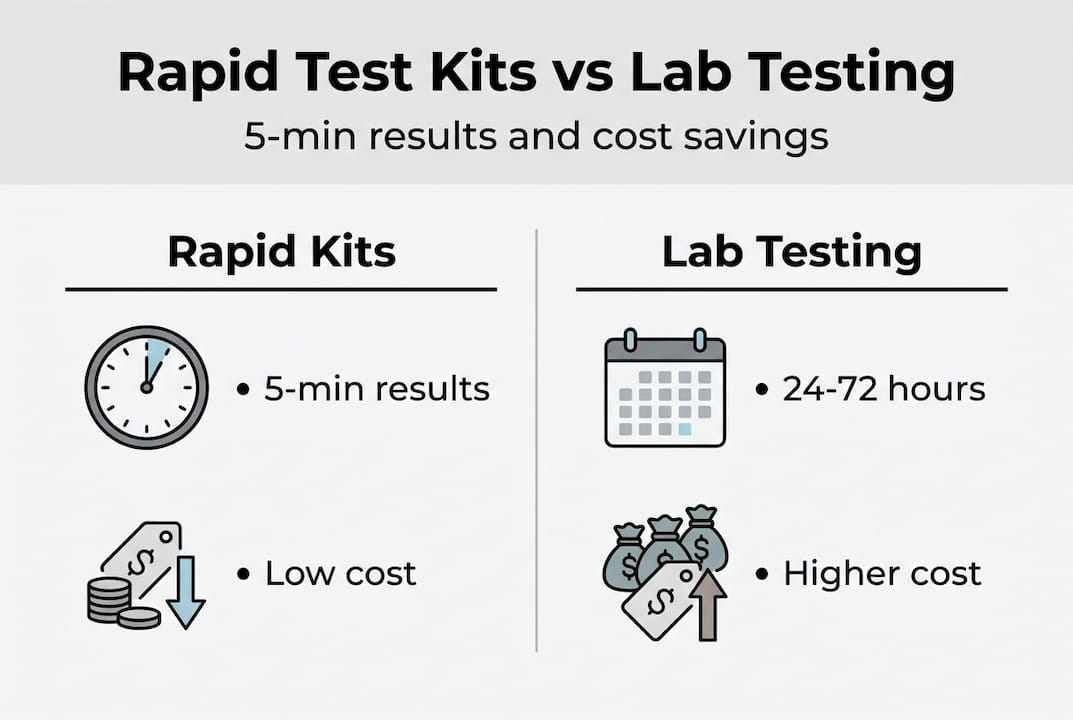
The advantages of rapid screening go beyond turnaround time. Consider the operational impact across four key dimensions:
| Factor | Rapid test kits | Laboratory testing |
|---|---|---|
| Result time | 5 to 15 minutes | 24 to 72 hours |
| Cost per test | Lower, especially in bulk | Higher per specimen |
| Sample collection | Urine or oral fluid, on-site | Chain-of-custody shipping required |
| Throughput | High volume, same day | Batch processing, delayed |
For high-volume programs, the cost savings compound quickly. A manufacturing facility running random screening on 200 employees per quarter can process tests on-site without shipping costs, courier delays, or lab processing fees. That efficiency matters when budgets are tight and schedules are fixed.
Non-invasive collection is another underrated advantage. Oral fluid kits, in particular, reduce the opportunity for specimen adulteration because collection happens under direct observation without the privacy concerns associated with urine collection. That matters in environments where tampering has been a documented issue.
Here is where rapid kits genuinely shine by use case:
- Pre-employment screening: Clear candidates quickly without delaying onboarding
- Random testing programs: Process large batches without disrupting operations
- Post-accident response: Get preliminary results while the incident is still fresh
- Return-to-duty monitoring: Track compliance in real time for employees in recovery programs
- Safety-sensitive roles: Transportation, healthcare, and heavy equipment operators benefit most from immediate results
Pro Tip: If specimen integrity is a recurring concern in your program, switch to oral fluid collection kits. They eliminate the privacy window that makes urine adulteration possible and are especially effective for observed collections in clinical or correctional settings.
The stat pearls article on drug testing confirms that immediate on-site results, non-invasive sample collection, cost-effectiveness, and high-throughput screening are the primary reasons professionals choose rapid immunoassay kits over traditional laboratory methods.
Accuracy and limitations: What you need to know
Rapid kits are powerful screening tools, but they are not perfect. Understanding where they fall short protects your program from compliance gaps and legal exposure.

The core technology behind most rapid kits is immunoassay, which works by detecting drug metabolites above a set cutoff concentration. If a substance is present below that threshold, the test returns negative even when the drug is actually there. That is the root cause of false negatives, and the rates are higher than many professionals expect.
A clinical review of 400 emergency department patients found that immunoassay missed 890 out of 1,350 drug findings. That is a significant gap. The false negative rates by drug class broke down as follows:
| Drug class | False negative rate |
|---|---|
| Benzodiazepines | 40% |
| Amphetamines | 38% |
| Opiates | 25% |
| Cocaine | 16% |
Those numbers are not a reason to abandon rapid kits. They are a reason to use them correctly. Rapid kits are designed to be a first-line screen, not a final verdict. Positive results must go to a laboratory for confirmation. Negative results in high-risk situations may warrant additional scrutiny, especially for benzodiazepines and amphetamines.
Cross-reactivity is another documented limitation. Certain over-the-counter medications and prescription drugs can trigger false positives on immunoassay panels. Common examples include pseudoephedrine triggering amphetamine panels and some antihistamines flagging on opioid screens. An empirical accuracy study confirms that immunoassays have high false negative rates and are vulnerable to cross-reactivity issues that affect result reliability.
Synthetic and novel drugs present a separate challenge. Standard panels are built around known metabolites. Fentanyl analogs, synthetic cannabinoids, and designer stimulants often do not appear on conventional panels at all unless the kit specifically includes them.
Here is how to manage accuracy risks in practice:
- Always confirm positive rapid results with GC/MS or LC/MS laboratory testing before taking adverse action
- Review your panel selection annually to ensure it covers the substances most relevant to your industry and region
- Document chain-of-custody procedures even for rapid tests to support any downstream confirmation process
- Train collectors on proper result interpretation, including what a faint line means on a lateral flow test
- Retain the specimen when possible so that confirmation testing can proceed without requiring a second collection
For a full breakdown of how types of drug tests compare on accuracy and legal defensibility, that resource covers the key distinctions compliance officers need to understand.
Compliance standards and regulatory framework
Using rapid kits correctly means understanding the regulatory environment they operate in. Federal guidelines set clear boundaries on what rapid screening can and cannot do in a legally defensible program.
SAMHSA and DOT both require that any positive result from a rapid screen be confirmed through laboratory testing using GC/MS or LC/MS before any employment action is taken. The federal workplace drug testing guidelines updated in January 2025 specify authorized panels, cutoff concentrations for both urine and oral fluid specimens, and the confirmation protocols that must be followed. Those guidelines apply directly to federally regulated industries including transportation, defense contractors, and federal agency employees.
For non-federally regulated workplaces, state law governs. Some states have specific requirements around collection procedures, employee notification, and how results can be used in employment decisions. Knowing your state’s rules is as important as knowing the federal framework.
Here is how compliance requirements shape your workplace drug testing policy:
- Rapid kits can be used as an authorized first-line screen in many programs
- Positive rapid results cannot be used as the sole basis for termination or adverse action in federally regulated industries
- Chain-of-custody documentation must accompany specimens sent for laboratory confirmation
- Panel selection must align with the substances specified in your program’s regulatory framework
- Medical Review Officers (MROs) must review confirmed positive results before they are reported to employers in DOT-regulated programs
Pro Tip: Always retain a split specimen or a sufficient volume of the original sample when a rapid kit returns a positive. That gives you the ability to send the same collection to a lab without asking the employee to provide another specimen, which reduces both delay and legal risk.
For guidance on selecting compliant kits that meet current federal and state standards, and for a broader look at drug testing standards that apply to your industry, those resources provide the operational detail you need.
Best practices for effective use of rapid test kits
Knowing when and how to deploy rapid kits is what separates programs that work from programs that create liability. The technology is only as good as the workflow around it.
Rapid kits are best suited to four primary scenarios: pre-employment screening, random compliance testing, post-accident response, and return-to-duty monitoring. Each has slightly different operational requirements, but the core workflow is the same.
Here is a step-by-step process for a reliable rapid screening and confirmation workflow:
- Verify collector training and kit storage conditions before testing begins
- Confirm the donor’s identity and document chain-of-custody information
- Collect the specimen using the appropriate kit for the situation (urine cup or oral swab)
- Follow the kit’s timing instructions precisely, reading results at the specified interval
- Document the result immediately, including lot number, expiration date, and collector ID
- If the result is positive or invalid, initiate laboratory confirmation using a retained specimen
- Hold all employment decisions until MRO-reviewed lab results are available
Oral fluid kits deserve special attention in workplace drug screening programs where tampering is a concern. They allow observed collection without privacy complications and are increasingly accepted under updated federal guidelines for oral fluid testing.
Common pitfalls that undermine rapid testing programs include:
- Storing kits outside the recommended temperature range, which degrades reagents
- Reading results too early or too late relative to the kit’s specified window
- Misinterpreting faint lines as negatives without understanding the lateral flow mechanism
- Failing to expand panel selection to cover synthetic opioids, fentanyl, or novel stimulants
- Using rapid results as standalone evidence without laboratory confirmation
For examples of workplace drug tests across different industries and roles, that resource helps HR managers and compliance officers match the right kit type to the right situation. On the topic of synthetics, detecting synthetic drugs requires expanded panels that go beyond standard 5 or 10-panel configurations. Rapid kits paired with lab confirmation remain the most reliable approach when novel substances are a known risk in your workforce.
A deeper look: Why rapid kits matter and where they fall short
Here is the uncomfortable truth most vendors will not say directly: rapid kits are extraordinary tools that are routinely misused. The speed and simplicity that make them valuable are the same qualities that lead programs to treat them as definitive answers when they are not.
The evolving drug landscape makes this more urgent, not less. Synthetic cannabinoids, fentanyl analogs, and novel stimulants are moving faster than standard panel updates. An empirical accuracy study notes that proponents highlight speed and convenience while critics point to real limitations, especially for synthetics and polydrug cases. Both sides are right.
The programs that get the most value from rapid kits are the ones that treat every result as preliminary. Speed gets you to a decision point faster. It does not replace the rigor that compliance standards require. Pair the two and you have a genuinely powerful program.
Streamline drug testing with trusted solutions
If your program needs to move faster without sacrificing accuracy or compliance, the right supplies make a measurable difference. At Buy Test Cup, you can browse a curated selection of drug test cups built for high-volume workplace, government, and clinical programs. Before you order, the multi-panel guide helps you match panel configuration to your specific compliance requirements. And if you want to make sure your supply chain covers every step of the process, the accuracy supplies checklist walks through the seven essentials every professional testing program should have on hand. Same-day shipping and bulk pricing make it practical to keep your program stocked and ready.
Frequently asked questions
How fast can rapid test kits deliver drug test results?
Rapid test kits typically provide results within 5 to 15 minutes, a dramatic improvement over the 24 to 72 hours required for standard laboratory processing. That speed makes them practical for time-sensitive decisions like post-accident screening or same-day pre-employment clearance.
Are rapid test kits legally defensible for workplace drug testing?
Rapid kit results alone are not legally defensible in federally regulated industries. SAMHSA and DOT require laboratory confirmation of all positive screens before any adverse employment action can be taken.
What are the common limitations of rapid test kits?
Rapid kits can miss drug findings due to immunoassay cutoff thresholds, and immunoassays have high false negative rates for certain drug classes, along with cross-reactivity issues that can produce false positives from common medications.
Can rapid test kits detect synthetic or novel drugs?
Most standard rapid kits do not detect synthetic cannabinoids, fentanyl analogs, or designer stimulants unless those substances are explicitly included in expanded panels. Selecting the right panel configuration is critical if synthetic drugs are a known risk in your environment.
Recommended
- Explore key advantages of rapid drug screening solutions
- Achieve Success with Our Drug Screening Workflow Guide
- What is rapid drug testing? 50% faster compliance results
- 5 Panel Oral Swab – Buy Test Cup
The key to streamline drug testing lies in balancing speed with accuracy in your testing protocols.
To streamline drug testing, be thorough in understanding the capabilities of rapid testing solutions you choose.
Streamline drug testing by selecting rapid kits that fit your organization’s specific operational needs.
Employers who prioritize efficient systems are more likely to streamline drug testing processes successfully.
Best practices in workplace safety often include strategies to streamline drug testing through rapid methodologies.
Regular reviews of your processes can help streamline drug testing and ensure compliance with regulations.
To maintain competitive advantage, firms need to streamline drug testing and rapid tests can help achieve this.
Organizations are finding new ways to streamline drug testing as they adopt rapid test kits in their programs.
Implementing rapid test kits is crucial for those looking to streamline drug testing processes effectively.
Efficiency in the workplace can be achieved when you streamline drug testing through rapid testing solutions.
Incorporating rapid test kits is a step towards streamline drug testing within your organization.
Streamline drug testing methodologies by implementing rapid test kits as part of your compliance strategy.
To streamline drug testing, organizations must consider the full range of options provided by rapid testing solutions.
Many companies are adopting rapid test kits to streamline drug testing, ensuring efficient operations.
Streamline drug testing operations with rapid test kits, facilitating quick responses to compliance needs.
Utilizing rapid test kits effectively can streamline drug testing procedures and enhance overall compliance.
The key to successfully streamline drug testing lies in choosing the right technology and adhering to best practices.
Streamline drug testing processes through effective use of rapid test kits, ensuring no delays in decision making.
To further streamline drug testing, integrating rapid test kits into your compliance program can yield considerable benefits.
Many organizations find that rapid test kits effectively streamline drug testing, offering both speed and accuracy.
To effectively streamline drug testing, it’s crucial to understand the advantages of rapid test kits.
Streamlining drug testing is possible when leveraging the speed and convenience of rapid test kits.
Employers can streamline drug testing with rapid test kits, reducing the time and cost associated with traditional methods.
For organizations looking to streamline drug testing, rapid test kits provide a reliable and efficient option.
Rapid test kits are an innovative solution that can effectively streamline drug testing, offering immediate results.
By choosing the right rapid test kits, companies can streamline drug testing and enhance workplace safety.
Rapid test kits also help to streamline drug testing by minimizing delays in result reporting.
Implementing rapid test kits allows organizations to streamline drug testing, which is essential for timely decision-making.
Additionally, utilizing rapid test kits can significantly streamline drug testing processes, making them more efficient for employers.