


Blog
Workplace Drug Testing: Protecting Safety and Compliance


Managing workplace safety is not just about following protocols but also understanding the real impact of substance use on the job. For Human Resource managers and compliance officers in manufacturing, the challenge goes far beyond simply conducting a test. Workplace drug testing serves as both a protective measure and a legal necessity, yet misconceptions about its purpose and effectiveness persist. This guide brings clarity to key testing methods, debunks common myths, and highlights practical steps for achieving regulatory compliance without compromising employee trust.
Defining Workplace Drug Testing and Misconceptions
Workplace drug testing is a systematic process designed to detect the presence of controlled substances among employees, serving as a critical safety and compliance mechanism for organizations across various industries. By implementing comprehensive screening protocols, employers aim to maintain a safe, productive work environment and mitigate potential risks associated with substance abuse.
Drug testing encompasses several methodologies that help organizations evaluate employee substance use:
- Urine Tests: Most common method, detecting recent drug use within 2-7 days
- Blood Tests: Provides precise measurements of current substance levels
- Hair Follicle Tests: Can detect drug use patterns extending up to 90 days
- Oral Fluid Tests: Quick screening method with shorter detection window
- Breath Alcohol Tests: Specifically measuring alcohol consumption
Contrary to popular misconceptions, workplace drug testing is not about punitive measures but creating a safer work environment. The 7-Step Employee Drug Testing Checklist for HR Compliance provides comprehensive guidance for implementing fair and effective screening procedures.
Many organizations misunderstand drug testing, believing it guarantees complete workplace safety. However, testing is just one component of a broader substance abuse prevention strategy. Accuracy and legal compliance remain paramount, requiring careful implementation of testing protocols that respect employee privacy while maintaining organizational standards.
Key misconceptions about workplace drug testing include:
- Assuming all positive tests indicate current impairment
- Believing drug tests are 100% accurate
- Thinking testing alone prevents workplace substance abuse
- Overlooking the importance of employee support programs
Drug testing should balance organizational safety with respect for individual privacy and dignity.
Pro tip: Develop a comprehensive drug testing policy that includes clear communication, employee education, and supportive rehabilitation resources alongside screening procedures.
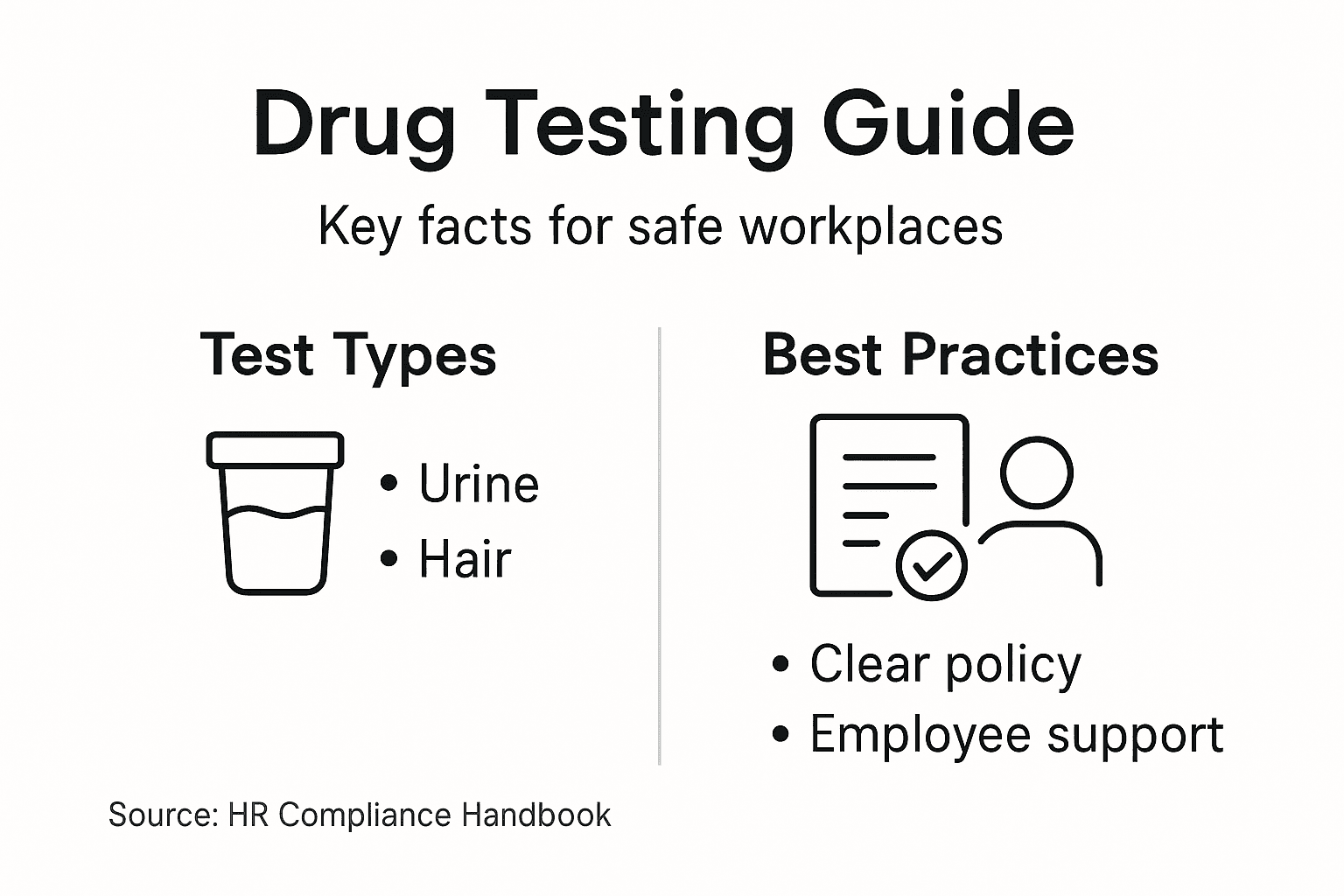
Key Test Types and Administration Methods
Workplace drug testing involves multiple sophisticated screening methods designed to detect substance use across different detection windows and contexts. Each testing method offers unique advantages and limitations, allowing organizations to choose the most appropriate approach for their specific safety and compliance requirements.
The primary drug testing methodologies include:
- Urine Tests: Most widely used method
- Detects recent drug use within 2-7 days
- Cost-effective and non-invasive
- Covers multiple substance panels
- Blood Tests: Most precise screening technique
- Provides exact substance concentration levels
- Shortest detection window
- Requires professional medical collection
- Hair Follicle Tests: Long-term substance use detection
- Can trace drug use up to 90 days
- Highly accurate historical record
- Difficult to manipulate or circumvent
- Oral Fluid Tests: Rapid current impairment assessment
- Identifies very recent substance use
- Quick collection process
- Minimally invasive screening method
- Breath Alcohol Tests: Immediate intoxication measurement
- Instant results
- Specifically designed for alcohol detection
- Commonly used in safety-sensitive industries
The Drug Test Cup Types Explained: Ensuring Workplace Compliance provides comprehensive insights into selecting appropriate testing methodologies for different workplace scenarios.
Here’s a side-by-side summary of workplace drug testing methods and their main business impacts:
| Testing Method | Detection Window | Business Benefit |
|---|---|---|
| Urine Test | 2-7 days | Cost-effective compliance |
| Blood Test | Hours to 1-2 days | Accurate impairment evidence |
| Hair Follicle Test | Up to 90 days | Identifies long-term abuse |
| Oral Fluid Test | 24-48 hours | Detects recent drug use |
| Breath Alcohol | Immediate | Prevents alcohol-related risks |
Testimonial organizations must consider multiple factors when selecting drug testing approaches, including detection sensitivity, legal requirements, industry regulations, and potential privacy considerations. Successful implementation requires a balanced strategy that prioritizes both organizational safety and employee respect.
Effective drug testing balances scientific accuracy, legal compliance, and respect for individual privacy.
Several key testing administration protocols are critical for maintaining test integrity:
- Establish clear testing procedures
- Ensure chain of custody documentation
- Use certified collection facilities
- Maintain strict confidentiality standards
- Provide clear communication about testing processes
Pro tip: Develop a comprehensive drug testing policy that outlines precise procedures, employee rights, and potential support resources to ensure transparent and fair implementation.
Regulatory Compliance and Legal Considerations
Workplace drug testing involves navigating a complex landscape of federal, state, and local regulations designed to protect both employer rights and employee privacy. Understanding these legal frameworks is crucial for implementing drug testing programs that are both effective and legally defensible.
Key federal regulations governing workplace drug testing include:
- Department of Transportation (DOT) regulations
- Mandatory testing for safety-sensitive transportation workers
- Strict protocols for sample collection and analysis
- Specific substance panels and testing frequencies
- Occupational Safety and Health Administration (OSHA) guidelines
- Workplace safety standards
- Confidentiality requirements
- Protection against discriminatory testing practices
- Americans with Disabilities Act (ADA) considerations
- Protections for employees with medical conditions
- Limitations on testing and medical inquiries
- Reasonable accommodation requirements
The 7-Step Employee Drug Testing Checklist for HR Compliance offers comprehensive guidance for navigating these complex legal requirements.
Legal compliance extends beyond simply conducting tests. Organizations must carefully balance their safety needs with employee rights, ensuring that testing procedures are:
- Consistent across all employee groups
- Conducted with explicit written consent
- Performed by certified collection facilities
- Maintained with strict confidentiality
- Applied without discrimination
Legal drug testing is a delicate balance between organizational safety and individual privacy rights.
Employers must also be aware of state-specific regulations, which can vary significantly and may impose additional restrictions or requirements beyond federal guidelines. Some states have specific protections for medical marijuana users, while others allow more extensive testing protocols.
Additional legal considerations include:
- Developing clear, written drug testing policies
- Providing advance notice of testing procedures
- Ensuring chain of custody documentation
- Protecting employee medical information
- Implementing consistent enforcement
Pro tip: Consult with legal counsel specializing in employment law to develop a comprehensive drug testing policy that meets both safety requirements and legal standards.

Safety, Productivity, and Liability Impacts
Workplace substance abuse creates a complex web of challenges that extend far beyond individual employee behaviors, directly impacting organizational safety, productivity, and financial stability. The ripple effects of drug use can compromise entire workplace ecosystems, creating significant risks for both employees and employers.
The primary impacts of workplace substance abuse include:
- Safety Risks
- Increased accident rates
- Higher probability of workplace injuries
- Compromised equipment operation
- Reduced situational awareness
- Productivity Challenges
- Decreased work performance
- Higher absenteeism rates
- Reduced cognitive function
- Increased workplace conflicts
- Financial Consequences
- Higher healthcare costs
- Increased workers’ compensation claims
- Potential legal expenses
- Reduced operational efficiency
The 7-Step Employee Drug Testing Checklist for HR Compliance provides a comprehensive framework for mitigating these potential workplace risks.
Liability exposure represents a critical concern for organizations implementing drug testing programs. Employers must carefully balance protecting workplace safety with maintaining employee rights, understanding that inadequate screening can result in significant legal and financial vulnerabilities.
Statistical evidence highlights the profound organizational impact:
- Substance-using employees are 3.6 times more likely to be involved in workplace accidents
- Companies lose approximately $81 billion annually due to reduced productivity
- Workers with substance abuse issues file three times more workers’ compensation claims
- Workplace drug use contributes to 40% of industrial workplace fatalities
Proactive drug testing is an investment in organizational safety and long-term operational integrity.
Beyond immediate safety concerns, substance abuse creates complex workplace dynamics that erode team cohesion, compromise professional standards, and undermine organizational culture. Comprehensive drug testing programs serve as a critical prevention mechanism, protecting both individual employees and collective workplace environments.
Key strategies for minimizing substance abuse impacts include:
- Implementing robust screening protocols
- Providing employee assistance programs
- Creating clear substance use policies
- Offering rehabilitation support
- Maintaining consistent enforcement
Pro tip: Develop a holistic approach that combines drug testing with supportive rehabilitation resources to address substance abuse comprehensively.
HR Roles, Costs, and Program Challenges
Human Resources professionals play a pivotal role in developing, implementing, and managing workplace drug testing programs that balance organizational safety with employee rights. The complexity of these programs requires a strategic approach that addresses multiple interconnected challenges.
Key responsibilities for HR in drug testing programs include:
- Policy Development
- Crafting comprehensive testing guidelines
- Ensuring legal compliance
- Defining clear procedural standards
- Creating transparent communication protocols
- Program Management
- Coordinating testing schedules
- Managing confidential documentation
- Implementing fair screening processes
- Tracking program effectiveness
- Employee Support
- Providing educational resources
- Offering rehabilitation referrals
- Supporting employees through testing procedures
- Maintaining non-discriminatory practices
The 7-Step Employee Drug Testing Checklist for HR Compliance offers comprehensive guidance for navigating these complex organizational responsibilities.
Financial considerations represent a significant challenge in drug testing program implementation. Organizations must carefully balance testing costs with potential long-term savings from reduced workplace incidents, improved productivity, and decreased healthcare expenses.
Cost breakdown for typical drug testing programs includes:
Below is a quick comparison of typical program costs and the possible return on investment for organizations:
| Expense Category | Approximate Proportion | Long-Term ROI Benefit |
|---|---|---|
| Testing Supplies | 30% | Lower incident rates |
| Lab Analysis & Collection | 25% | Reduced healthcare costs |
| HR Training & Admin | 20% | Fewer workers’ comp claims |
| Policy Development/Legal | 15% | Mitigated legal liabilities |
| Ongoing Compliance & Updates | 10% | Sustained workforce productivity |
- Initial testing equipment and supplies
- Laboratory analysis fees
- Staff training and education
- Ongoing program maintenance
- Potential legal and compliance expenses
Effective drug testing programs are investments in organizational safety and employee well-being, not just additional expenses.
HR professionals face numerous challenges when implementing drug testing initiatives, including navigating complex legal landscapes, managing employee privacy concerns, and maintaining program consistency across diverse workforce environments.
Strategic approaches to addressing program challenges involve:
- Developing clear, transparent policies
- Providing comprehensive employee education
- Implementing consistent enforcement
- Creating supportive rehabilitation pathways
- Regularly reviewing and updating testing protocols
Pro tip: Design drug testing programs as holistic wellness initiatives that prioritize employee support and organizational safety, rather than purely punitive measures.
Strengthen Your Workplace Safety and Compliance with Reliable Testing Solutions
Workplace drug testing is critical to protecting safety, ensuring productivity, and maintaining legal compliance. The article highlights challenges such as balancing accuracy, respecting employee privacy, navigating complex regulations, and managing costs. If you need trustworthy, easy-to-use testing products that support your organization’s safety goals and compliance standards, look no further than Buy Test Cup. Our extensive catalog includes multi-panel drug test cups, oral swabs, and breath alcohol test strips designed for accuracy, reliability, and regulatory compliance.
Take control of workplace substance abuse risks today by choosing proven drug testing supplies from Buy Test Cup. Whether you require solutions for screening, compliance, or employee support programs, our quality products and competitive pricing help you implement effective drug testing policies with confidence. Visit our site now to explore our full range and receive same-day shipping on bulk orders.
Empower your HR team with the right tools to build safer, more productive work environments. Start your journey toward comprehensive drug testing success with Buy Test Cup today.
Frequently Asked Questions
What is workplace drug testing?
Workplace drug testing is a systematic process used by organizations to detect the presence of controlled substances among employees, promoting a safer and more productive work environment.
What are the common types of drug tests used in workplaces?
Common types of drug tests include urine tests, blood tests, hair follicle tests, oral fluid tests, and breath alcohol tests, each with different detection windows and use cases.
How do I ensure compliance with drug testing regulations?
To ensure compliance, organizations should develop a clear drug testing policy, follow federal and state regulations, maintain confidentiality, and provide explicit written consent from employees.
What are the impacts of workplace substance abuse on an organization?
Workplace substance abuse can lead to increased safety risks, decreased productivity, and higher financial costs, including healthcare expenses and workers’ compensation claims.