


Blog
Why Choose Bulk Drug Testing: Compliance, Safety, Cost


TL;DR:
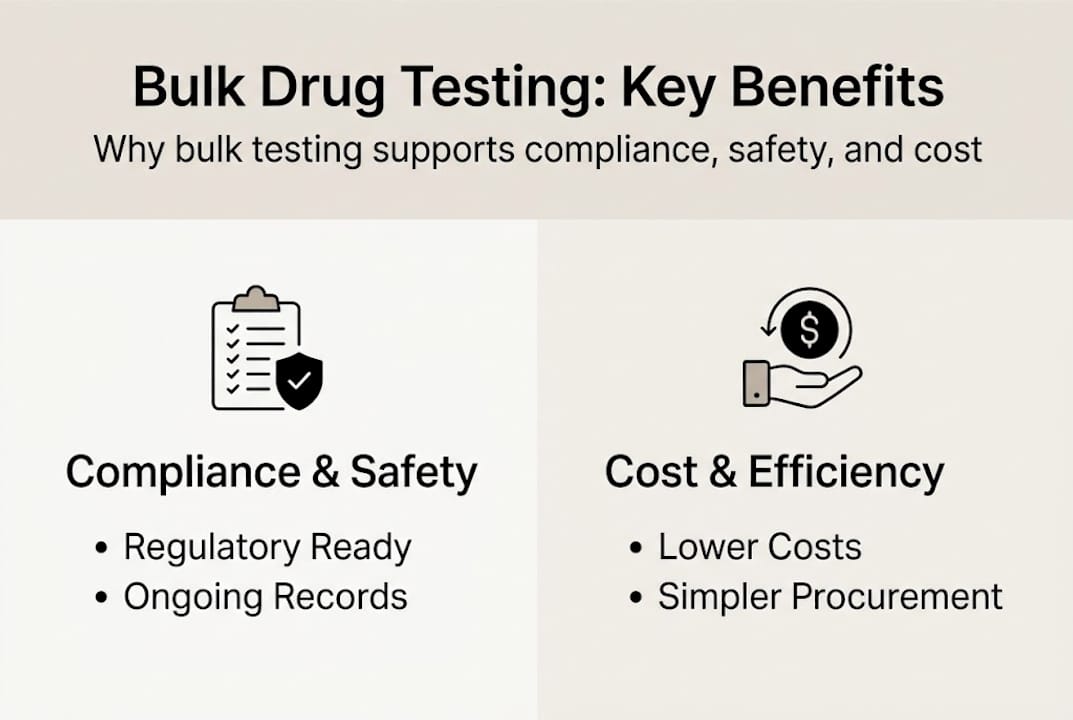
- Bulk drug testing ensures ongoing regulatory compliance through matched, certified test kits.
- Ordering tests in volume lowers costs, streamlines supply, and enhances operational efficiency.
- Consistent bulk testing supports workplace safety, legal defensibility, and public trust.
One-off drug test purchases might seem manageable until an audit reveals gaps, a workplace incident triggers a lawsuit, or a federal inspector flags non-compliant kits. Procurement managers at government agencies and private organizations face mounting pressure to maintain continuous, defensible drug testing programs. Bulk drug testing is not just a volume discount. It is a strategic tool that aligns compliance, cost control, and workplace safety into one coordinated approach. This guide breaks down why organizations that commit to bulk solutions consistently outperform those relying on ad hoc purchasing, and what that means for your procurement strategy in 2026.
Key Takeaways
| Point | Details |
|---|---|
| Meets compliance | Bulk drug testing ensures your organization matches federal workplace guidelines for safety and legality. |
| Reduces costs | Ordering test kits in bulk saves money, time, and eases procurement burdens. |
| Enhances safety | Consistent, scalable testing using bulk kits fosters safer workplaces and public trust. |
| Reduces legal risk | Using compliant bulk kits protects your agency from costly penalties or disputes. |
Regulatory compliance made simple with bulk testing
Compliance is not a one-time checkbox. Federal and industry regulations require ongoing, documented testing that matches specific substance panels and kit standards. If your procurement process does not account for this, you are already behind.
The Department of Transportation, SAMHSA, and GSA each have distinct but overlapping requirements for drug testing programs. The good news is that CLIA-waived, FDA-cleared bulk test kits are designed to match the exact panels these programs require. That means when you order at volume, you are not just buying tests. You are buying pre-aligned compliance infrastructure.
The GSA Drug-Free Workplace Program requires agencies to maintain active, consistent testing protocols. Bulk kits streamline this by ensuring your supply matches program cycles without scrambling for emergency orders. Gaps in supply lead to gaps in documentation, and gaps in documentation invite penalties.
| Regulatory body | Requires bulk-volume testing | CLIA/FDA-cleared kits required |
|---|---|---|
| DOT | Yes | Yes |
| SAMHSA | Yes | Yes |
| GSA | Yes | Recommended |
| Private sector | Varies | Best practice |
One misconception procurement teams carry is that any drug test cup will pass federal inspection. It will not. The kit must match the authorized panel for the program. A 5-panel kit used where a 10-panel is required is a compliance failure, not just an oversight. When choosing the right test kits, panel alignment should be the first filter, not price.
Statistic: Non-compliance with federal workplace drug testing guidelines can result in contract termination, suspension, or fines reaching tens of thousands of dollars per violation.
Bulk testing also has a two-stage architecture that many organizations misunderstand. Initial screens use bulk instant-read cups, but any non-negative result must go to a certified laboratory for confirmation before any employment action is taken. This is not optional for federally regulated roles. Your compliance best practices framework must account for both stages, with bulk kits as the front line and lab confirmation as the backstop.
For safety and compliance in regulated industries, the simplest way to stay aligned is to procure kits that are pre-certified to federal panel standards. That single decision eliminates a large category of compliance risk before testing even begins.
Pro Tip: Build your procurement cycle around testing frequency, not just budget cycles. If your program mandates quarterly random testing for 200 employees, order bulk kits to cover at least two cycles ahead. This prevents supply shortfalls that create compliance gaps.
Cost efficiency and operational advantages
Compliance covered, procurement teams naturally move to the return on investment question. Bulk drug testing delivers measurable cost advantages that compound over time, especially for organizations running frequent or mandatory testing cycles.

The per-unit cost of a drug test kit drops significantly at volume. What costs $4.50 per test in small orders can fall to under $2.00 per test when ordered in case quantities. For an agency running 1,000 tests per year, that difference exceeds $2,500 annually from a single line item. Multiply that across multiple departments or sites, and the savings become a budget line worth defending.
Beyond unit price, bulk purchasing reduces the administrative load of frequent small orders. Every purchase order has processing costs: staff time, approval workflows, vendor coordination, and invoice reconciliation. Fewer, larger orders mean fewer cycles of that overhead.
| Order type | Cost per test | Admin cycles per year | Supply risk |
|---|---|---|---|
| Single-unit orders | High | 12+ | High |
| Monthly small batches | Medium | 12 | Medium |
| Bulk quarterly orders | Low | 4 | Low |
| Annual bulk contract | Lowest | 1-2 | Minimal |
Here is what else bulk ordering does that smaller purchases cannot:
- Inventory predictability: You always have kits on hand for unannounced or random testing without scrambling.
- Vendor leverage: Volume orders give you negotiating power on price, shipping terms, and priority fulfillment.
- Expiration management: Ordering in predictable cycles helps you align kit shelf life with usage rates, reducing waste.
- Audit readiness: Consistent batch tracking from bulk orders simplifies chain-of-custody documentation.
For HR and compliance teams, top bulk drug testing supplies also mean less time coordinating reorders and more time managing the actual testing program. The operational lift of maintaining a compliant program is significant enough without adding supply chain stress on top.
Pro Tip: Negotiate free bulk shipping thresholds with your supplier. Many vendors offer free shipping on orders over a certain case quantity. If your annual volume qualifies, consolidating shipments can add another layer of savings without sacrificing delivery speed.
For agencies specifically, reliable compliance for agencies means having a procurement structure that supports mandatory testing cycles without budget surprises. Bulk ordering makes that structure predictable and defensible in budget reviews.
Supporting workplace safety and public trust
Cost arguments win budget approvals, but safety and trust are what sustain a drug testing program over the long term. Organizations in safety-sensitive industries do not have the option to test inconsistently, and the public facing ones carry reputational stakes that make a failed program far more damaging than any kit cost.
Consistent screening does two things simultaneously. It deters substance abuse by making detection feel inevitable rather than random. And it demonstrates due diligence to regulators, insurers, and the public. Both outcomes matter for your organization’s risk profile.
The GSA Drug-Free Workplace Program is explicit: effective programs must reduce drug-related incidents through consistent, documented testing. Bulk testing makes that consistency achievable because supply is never the limiting factor.
Consider the sectors where this matters most:
- Transportation and logistics: DOT-regulated drivers, operators, and controllers face random and post-incident testing requirements. A supply gap means a missed test, which is itself a violation.
- Healthcare: Patient safety depends on staff being unimpaired. Bulk testing programs allow facilities to screen at hire, randomly, and post-incident without procurement delays.
- Public safety: Law enforcement, corrections, and emergency services operate under intense scrutiny. Consistent testing is as much about public trust as internal policy.
- Government contracting: Many federal contracts require contractors to maintain certified drug-free workplace programs. Inconsistent testing can void compliance certifications.
For boosting workplace safety, the key insight is that bulk programs remove the friction that causes testing gaps. When kits are always available, supervisors and HR teams are more likely to test when required, not when it is convenient.
“Organizations with consistent, documented drug testing programs report fewer workplace accidents, lower workers’ compensation claims, and stronger employee trust metrics compared to those with irregular testing schedules.”
Insurance carriers take notice too. A documented bulk testing program is evidence of proactive risk management. That can translate to lower premiums or more favorable coverage terms for protecting safety and compliance in high-risk roles.
Risk management: Reducing liability and legal exposure
A workplace drug incident without a documented testing program behind it is a legal liability with no defense. Bulk testing solves this not just through volume but through the documentation trail it creates.
Every bulk order comes with batch numbers, certification records, and expiration tracking. When a test result is challenged, you need to show the kit was compliant, the test was conducted correctly, and the result was handled per protocol. Without that paper trail, a single wrongful termination claim can cost more than years of bulk testing investment.
The mandatory federal guidelines are clear: initial screens with bulk kits are the starting point, but DOT and federally regulated roles require certified lab confirmation before any adverse action. Skipping confirmation, or using a non-compliant kit for the initial screen, opens the door to privacy lawsuits and employment disputes that are expensive to defend and often avoidable.
Here is where bulk programs build legal defensibility:
- Standardized kits: Every test uses the same certified, panel-matched kit, eliminating variation that plaintiffs exploit.
- Batch documentation: Bulk orders have traceable lot numbers, supporting chain-of-custody requirements.
- Policy alignment: Ordering to match your written testing policy shows organizational intent and consistency.
- Storage records: Proper bulk inventory management demonstrates that kits were stored within manufacturer guidelines.
Statistic: Workplace drug and alcohol testing programs reduce injury rates by up to 51% in safety-sensitive environments, according to industry safety studies, yet organizations without documented programs face 3-5x higher litigation costs when incidents occur.
Your compliance drug testing guide should address split-sample requirements for federally regulated tests. When an employee disputes a positive result, a properly handled split sample is your first line of legal defense. Bulk kits that support split-sample collection make this standard practice rather than an exception.
For your drug testing program workflow, risk management starts at procurement. Choosing compliant kits, maintaining documented inventory, and following confirmation protocols are not administrative burdens. They are the foundation of a legally defensible program.
Pro Tip: Maintain a digital log of every bulk order: vendor, lot number, quantity, expiration, and storage location. This record is your first response to any legal challenge and takes minutes to build if you start at purchase.
Why procurement pros should champion bulk testing solutions
Here is the perspective most compliance guides miss: procurement managers are not just buyers in a drug testing program. They are the architects of organizational safety culture, and bulk testing is one of the most undervalued tools in their arsenal.
Most programs are designed to meet the minimum threshold. Test enough people, use an approved kit, file the paperwork. That approach keeps you compliant on paper but leaves real value on the table. The organizations that use bulk testing strategically do something different. They treat procurement as a policy function, not a supply function.
When procurement owns the bulk testing relationship, three things happen. Reporting becomes simpler because supply is consistent and traceable. Cultural trust increases because employees see a systematic, fair process rather than sporadic testing that feels punitive. And supplier leverage grows, giving you room to negotiate on quality, not just price.
For reliable program implementation, the real competitive advantage is treating bulk testing as infrastructure, not a commodity purchase. That mindset shift is where procurement professionals earn their seat at the policy table.
Get started with reliable bulk drug testing solutions
Ready to put these best practices in action? Buy Test Cup offers a full range of bulk test cups designed to meet federal panel requirements, including CLIA-waived and FDA-cleared options for DOT, SAMHSA, and GSA programs. Whether you are setting up a new testing program or scaling an existing one, the right supplies are the foundation.
Review the multi-panel drug testing guide to match your required substance panels to the right kit configuration. Then use the drug testing essentials checklist to make sure your program covers every operational and compliance requirement before your next testing cycle begins.
Frequently asked questions
Are bulk drug tests accepted for DOT and federal compliance?
Bulk drug test kits are accepted for initial screening under DOT and federal programs, but any non-negative result requires certified laboratory confirmation before any employment action is taken.
What substances do bulk drug test kits typically detect?
Standard bulk kits follow federal workplace drug panel guidelines, covering 5 to 13 substances including THC, cocaine, opiates, amphetamines, and benzodiazepines depending on the panel selected.
How does bulk ordering improve drug test program efficiency?
Bulk purchasing reduces cost per test, ensures consistent kit availability, and cuts the administrative workload of frequent reorder cycles that create supply gaps and overhead costs.
What are the risks of using the wrong drug test kits?
Using kits that do not match the required federal panel or lack proper certification can result in regulatory penalties, invalidated results, and significant legal exposure from employment disputes.