


Blog
Why Choose Bulk Testing Supplies for Drug Screening


TL;DR:
- Bulk testing supplies offer organizations running large-scale drug screening programs significant cost savings of up to 35 percent per unit versus small orders. Proper management of inventory shelf life, storage conditions, and demand planning is essential to prevent spoilage and maximize these savings while ensuring regulatory compliance. Effective bulk procurement turns inventory management into a predictable, audit-ready process that supports rapid testing and operational efficiency.
Bulk testing supplies are the most cost-effective procurement model for organizations running large-scale drug screening programs, delivering per-unit savings of 25% to 35% compared to small-order purchasing. For administrators managing compliance under DOT, SAMHSA, or state workplace safety regulations, that margin is not incidental. It directly affects program sustainability. Products like CLIA-waived 5-panel and 8-panel urine drug test cups, available through suppliers such as Buytestcup, represent the standard entry point for bulk procurement. The decision to buy in bulk touches every dimension of your program: cost, inventory reliability, workflow speed, and audit readiness.
Why choose bulk testing supplies over small-order purchasing
The core financial argument for bulk purchasing is straightforward. Lower per-unit pricing reduces your cost per screen, and fewer annual shipments cut freight expenses significantly. For a program running 500 or more tests per month, those two factors alone justify the volume commitment.
The savings extend beyond the invoice price. When you place fewer purchase orders, your procurement team spends less time on requisitions, vendor communications, and receiving paperwork. That administrative reduction has a real labor cost attached to it, even if it rarely appears on a drug testing budget line.
However, the financial picture is not complete without accounting for spoilage. Effective cost per test rises when inventory expires before use. A concrete example: purchasing 1,000 test cups at $1.50 each, with 100 expiring unused, raises your effective cost to $1.66 per test. That is an 11% cost increase that erases a significant portion of the bulk discount.
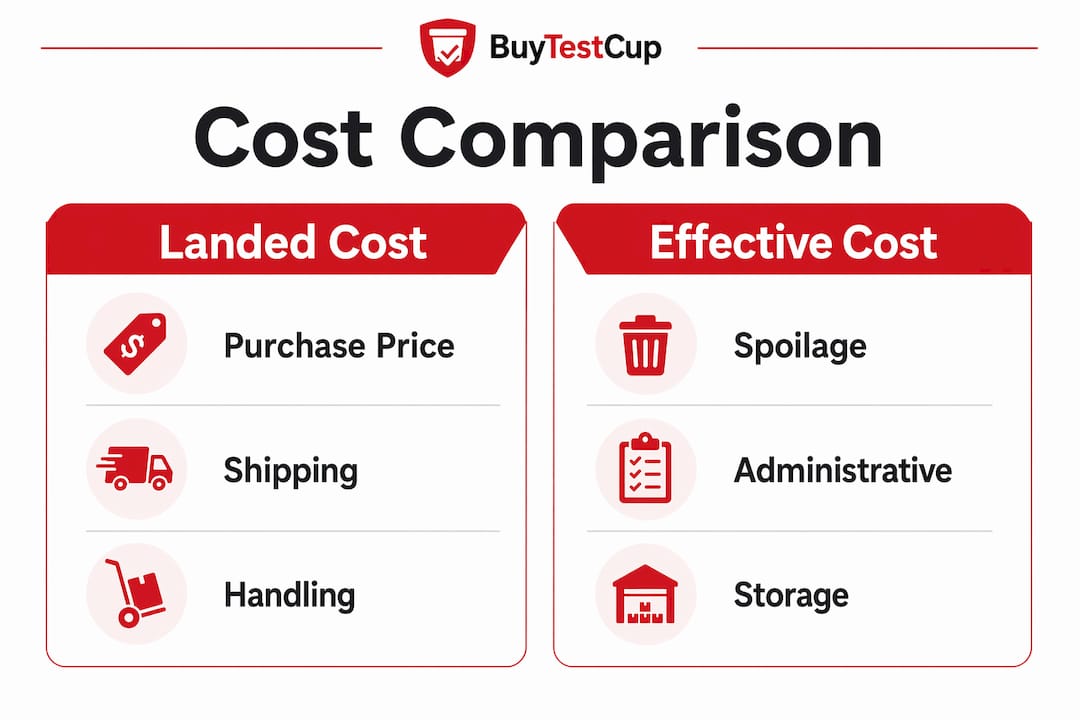
The distinction between landed cost and effective cost is one most procurement teams miss entirely. Landed cost covers purchase price plus shipping and handling. Effective cost adds spoilage, storage overhead, and administrative time. Separating these two figures gives you an accurate baseline for comparing bulk orders against smaller, more frequent purchases.
Pro Tip: Before committing to a volume order, calculate your monthly test consumption rate over the previous six months. Divide your intended order quantity by that rate to confirm you will use the inventory before expiration. If the math does not work, order a smaller quantity or negotiate a split shipment.
Key cost factors to evaluate before placing a bulk order:
- Per-unit price at each volume tier (500, 1,000, 2,500 units)
- Freight cost per order versus annual freight cost across smaller orders
- Storage cost per square foot for the inventory footprint
- Projected spoilage rate based on consumption history
- Administrative hours saved per year at your current order frequency
What operational advantages do bulk supplies provide?
Bulk procurement transforms inventory management from a reactive, order-by-order process into a predictable, program-level function. That shift matters most when testing demand spikes unexpectedly, such as during post-incident screenings, new hire surges, or random testing cycles.

The most direct operational benefit is the elimination of stockout risk. When your inventory levels stay predictable, you never face the scenario of delaying a required test because supplies are in transit. For organizations subject to mandatory testing timelines, a stockout is not just an inconvenience. It is a compliance failure.
Staffing firms and multi-site employers gain a specific competitive advantage from bulk inventory. Instant screening capability allows a staffing firm to clear a candidate the same day a client requests placement. That speed is impossible when test kits must be ordered per event. Organizations with fluctuating headcounts, such as construction contractors or seasonal employers, benefit from the same logic.
Numbered operational benefits of maintaining bulk drug test inventory:
- No testing delays. Kits are on hand when a test is triggered, whether scheduled or unannounced.
- Simplified procurement cycles. Fewer purchase orders mean less administrative burden per quarter.
- Consistent product across sites. All locations use the same panel configuration and lot number, supporting uniform results documentation.
- Faster onboarding. New hires clear pre-employment screening without waiting for supply replenishment.
- Audit-ready documentation. A single large purchase order is easier to reconcile against test records than a series of small orders.
Pro Tip: If your organization tests across multiple locations, designate a central inventory point and ship to sites on a scheduled cadence. This prevents individual sites from over-ordering and reduces total inventory exposure to expiry risk.
How should you manage shelf life and storage for bulk supplies?
Rapid urine drug test cups carry a shelf life of 18 to 24 months under proper storage conditions. The expiration date printed on each unit’s packaging is the definitive reference point, not the purchase date or the lot manufacture date.
Storage environment is the variable most organizations underestimate. Heat cycling and moisture exposure degrade the biochemical stability of reactive test strips, producing unreliable results even within the printed expiration window. A supply room that reaches 90°F in summer and drops to 55°F in winter is actively shortening your inventory’s usable life.
The table below summarizes standard storage requirements and shelf life expectations for common bulk drug test formats:
| Product type | Typical shelf life | Recommended temperature | Humidity range | Key storage risk |
|---|---|---|---|---|
| Urine drug test cups | 18 to 24 months | 36°F to 86°F (2°C to 30°C) | Below 70% RH | Heat cycling, direct sunlight |
| Dip strip panels | 12 to 24 months | 36°F to 86°F (2°C to 30°C) | Below 70% RH | Moisture exposure, open packaging |
| Oral fluid swabs | 12 to 18 months | 59°F to 77°F (15°C to 25°C) | Below 60% RH | Temperature extremes |
| Breath alcohol strips | 12 to 18 months | 59°F to 77°F (15°C to 25°C) | Below 60% RH | Humidity degradation |
Stock rotation using the first-in, first-out (FIFO) method is the standard practice for preserving bulk inventory value. FIFO means the oldest lot numbers are used before newer stock, regardless of where items are physically stored. Without deliberate rotation, newer shipments get used first because they are placed at the front of the storage area, and older stock quietly expires at the back.
Integrating expiry date tracking into your compliance workflow also protects you during audits. If a test result is challenged, you need documentation showing the kit used was within its valid shelf life at the time of the screen. That documentation is impossible to reconstruct after the fact if your inventory records do not capture lot numbers and expiration dates at the point of use.
Pro Tip: Label each storage shelf with the expiration date of the lot stored there. When a new shipment arrives, place it behind existing stock and update the shelf label. This takes two minutes per delivery and eliminates FIFO errors entirely.
How to evaluate bulk testing supply options
Selecting the best bulk testing supplies requires comparing products across four dimensions: panel configuration, regulatory status, vendor reliability, and purchasing model. Getting one of these wrong can cost more than the bulk discount saves.
The table below outlines the primary factors to evaluate when comparing bulk drug test vendors and products:
| Evaluation factor | What to look for | Red flags |
|---|---|---|
| Panel configuration | 5, 8, 10, 12, or higher panel options matching your policy | Limited SKU range, no custom options |
| CLIA-waived status | Confirmed waiver for point-of-care use | No documentation provided |
| Minimum order quantity | Aligns with your consumption rate | MOQ exceeds 6-month supply |
| Shipping policy | Free bulk shipping threshold, same-day fulfillment | No stated lead times |
| Expiration dating | Long-dated lots, lot number documentation | Short-dated stock sold at discount |
| Customer support | Dedicated B2B account support | No direct contact for order issues |
CLIA-waived test cups are the regulatory baseline for point-of-care workplace testing. Without that waiver, your program may not meet clinical or occupational health compliance requirements, regardless of how accurate the test is in practice.
Purchasing models vary beyond the standard bulk order. Subscription-based replenishment programs deliver a fixed quantity on a set schedule, removing the reorder decision entirely. Private-label options allow larger organizations to brand their testing supplies, which supports chain-of-custody documentation and reduces the risk of product substitution errors. For most procurement teams, a standard bulk order with a reliable supplier covers the majority of program needs, but knowing these options exist allows you to negotiate more effectively.
Pro Tip: Request a certificate of analysis and a sample lot with documented expiration dates before placing your first large order with a new vendor. A supplier unwilling to provide either is not a vendor you want managing your compliance supply chain.
What I’ve learned from watching bulk purchasing programs succeed and fail
I have reviewed enough drug testing program audits to identify a consistent pattern. The programs that run cleanly, pass audits without findings, and stay within budget share one characteristic: they treat bulk purchasing as a managed program, not a one-time procurement decision.
The most common failure I see is the organization that negotiates a strong bulk price, takes delivery of 2,000 test cups, stores them in an unconditioned supply closet, and discovers six months later that 400 units have degraded or expired. The savings evaporate. The compliance record shows a gap. The procurement team is left explaining why they bought more than they could use.
The second most common failure is the opposite: under-ordering to avoid expiry risk, then running out of stock during a random testing cycle or a post-incident event. Both failures are preventable with a consumption-based ordering model and basic storage discipline.
What actually works is treating your bulk testing supply program the way a hospital treats its pharmaceutical inventory. You set par levels based on documented consumption. You track lot numbers and expiration dates in your compliance system. You build a vendor relationship that allows you to adjust order quantities quarterly without penalty. The 7 essentials checklist from Buytestcup is a practical starting point for building that discipline into your procurement workflow.
Bulk purchasing advantages are real and significant. But they are only realized by organizations that manage the back end of the program as carefully as they manage the front-end price negotiation.
— matthew
How Buytestcup supports bulk drug test procurement
Buytestcup supplies drug test cups ranging from 5-panel to 28-panel configurations, all available for bulk ordering with competitive per-unit pricing. Free shipping applies to qualifying bulk orders, reducing your landed cost without requiring a separate freight negotiation. The ordering process is built for B2B procurement teams: straightforward volume tiers, clear lot documentation, and nationwide fulfillment with same-day shipping on in-stock items. Whether you are running a workplace compliance program, a clinical screening operation, or a government agency with mandatory testing requirements, Buytestcup’s catalog covers the panel configurations and CLIA-waived products your program requires. Explore the full bulk screening options to match your consumption rate to the right order tier.
FAQ
What cost savings can bulk testing supplies deliver?
Organizations typically save 25% to 35% on per-unit costs by purchasing drug test supplies in bulk, with additional savings from reduced shipping frequency and lower administrative overhead.
How long do bulk urine drug test cups stay usable?
Rapid urine drug test cups have a shelf life of 18 to 24 months when stored within the recommended temperature and humidity ranges. The expiration date on the packaging is the authoritative reference for each lot.
What is the difference between landed cost and effective cost in bulk purchasing?
Landed cost covers the purchase price plus shipping and handling. Effective cost adds spoilage and administrative overhead, and separating these figures is the only accurate way to evaluate whether a bulk order genuinely saves money.
Do bulk drug test cups need to be CLIA-waived?
Yes, for point-of-care workplace and clinical testing, CLIA-waived status is the regulatory requirement that authorizes use outside of a certified laboratory. Purchasing non-waived tests for compliance programs creates audit exposure.
How do you prevent bulk test inventory from expiring before use?
Calculate your monthly consumption rate, order no more than a 12-month supply at one time, and apply FIFO stock rotation so the oldest lot numbers are used first. Tracking expiry dates per lot in your compliance records also protects you if a test result is ever challenged.