


Blog
Bulk testing logistics guide: streamline compliance and delivery


TL;DR:
- Proper logistics planning prevents temperature excursions and supply disruptions in drug testing programs.
- Compliance requires thorough vendor vetting, environmental control, and detailed documentation throughout the supply chain.
- Implementing real-time tracking and validation processes reduces audit risks and improves program efficiency.
Imagine a shipment of 50,000 drug test cups sitting on a loading dock in summer heat, waiting for customs clearance that nobody pre-arranged. By the time the paperwork clears, the temperature-sensitive kits are compromised, your compliance deadline has passed, and your agency is facing a gap in testing coverage. Shipping qualification studies are recommended for sensitive products precisely because temperature excursions, transit delays, and environmental variations are real, costly risks. This guide breaks down every phase of bulk testing logistics so your procurement decisions hold up under regulatory scrutiny and real-world pressure.
Key Takeaways
| Point | Details |
|---|---|
| Follow all compliance protocols | GDP, temperature control, and documentation are vital for regulatory and audit success. |
| Vet suppliers and logistics partners | Choose partners with proven records for reliable, on-time delivery and compliance. |
| Pre-plan for sensitive product handling | Temperature-sensitive kits need special transport and storage to maintain effectiveness. |
| Accelerate with process coordination | Coordinating supplier, shipping, and customs steps reduces delivery times and prevents delays. |
| Continuous monitoring and improvement | Post-delivery validation and review help you refine processes and stay compliant year after year. |
Assess compliance and logistical requirements
Before you place a single bulk order, you need a clear picture of the regulatory landscape. For government agencies and healthcare facilities, that means understanding Good Distribution Practice (GDP), FDA requirements, and any state or local rules that govern how drug testing supplies are stored, transported, and documented.
GDP standards in pharma logistics require temperature mapping, IQ/OQ/PQ qualification protocols, full traceability, and FEFO inventory management. These are not optional extras. They are the baseline expectations auditors will check when they walk through your facility.
Key compliance requirements to address before ordering:
- Temperature mapping: Know the acceptable storage range for each kit type and document it.
- IQ/OQ/PQ qualification: Installation, operational, and performance qualification for storage equipment.
- Traceability: Lot numbers, expiration dates, and chain of custody records for every shipment.
- FEFO inventory rotation: First Expiry, First Out ensures older stock is used before newer stock, reducing waste and compliance risk.
- Audit documentation: Maintain receiving logs, temperature excursion reports, and corrective action records.
“Compliance in testing logistics is not just about passing audits. It is about building a system that protects public health every day the program operates.”
Understanding compliance in testing logistics from the start prevents costly retrofits later. Agencies that treat compliance as a design principle rather than an afterthought consistently perform better in inspections and experience fewer supply disruptions.
Prepare for large-scale ordering and shipping
With your regulatory requirements mapped out, the next step is translating those requirements into concrete procurement and shipping decisions. This phase is where many agencies stumble, because they focus on price per unit without accounting for the full cost of a failed shipment.
Supplier vetting is non-negotiable. Review your supplier’s track record on shipment accuracy, on-time delivery rates, and how they handle quality complaints. Ask for documentation of their own GDP compliance and quality management systems. A low unit price from an unreliable supplier is not a bargain.
Here is a practical comparison of supplier evaluation factors:
| Evaluation factor | Why it matters | Red flag |
|---|---|---|
| On-time delivery rate | Gaps in supply affect testing schedules | Below 95% on-time |
| GDP certification | Confirms compliant handling | No documentation available |
| Temperature control capability | Protects kit integrity | No cold chain options |
| Lot traceability system | Required for audits | Manual paper-only records |
| Complaint resolution time | Signals operational quality | Over 10 business days |
Shipping qualification studies are your next priority. Qualification studies for sensitive products assess worst-case scenarios: peak summer temperatures, holiday shipping delays, and cross-country transit variations. Running these studies before a large order ships means you are not discovering failure modes when 10,000 kits are already in transit.
Steps to prepare your bulk order for shipping:
- Confirm storage capacity at the receiving site before the shipment departs.
- Coordinate pickup and delivery windows with your logistics partner at least two weeks in advance.
- Request temperature data loggers be included in each pallet.
- Verify that the carrier has experience with healthcare or pharmaceutical cargo.
- Establish a contingency plan for delayed or rejected shipments.
Pro Tip: Build a two-week buffer into your ordering timeline. Qualification studies, supplier lead times, and carrier coordination all take longer than expected, especially for first-time bulk orders.
Reviewing bulk testing workflow steps before finalizing your order plan helps you align procurement timing with your actual testing schedule, so you are not sitting on excess inventory or scrambling for last-minute stock.
Optimize transport and storage for sensitive kits
A well-planned order can still fail at the transport and storage stage. This is the execution phase, and the details matter more than most procurement officers realize.

Drug test kits vary significantly in their environmental sensitivity. Immunoassay-based rapid test cups typically require storage between 36°F and 86°F. Some enzyme-linked kits have narrower ranges. Mixing kit types in the same storage area without proper separation creates cross-degradation risk, particularly in facilities with inconsistent climate control.
Key storage and transport parameters by kit type:
| Kit type | Recommended storage temp | Transport requirement | Shelf life typical |
|---|---|---|---|
| Rapid urine test cups | 36°F to 86°F | Standard with temp monitoring | 12 to 24 months |
| Oral fluid swabs | 59°F to 77°F | Climate-controlled preferred | 12 to 18 months |
| Immunoassay dip strips | 36°F to 86°F | Standard with temp monitoring | 18 to 24 months |
| Specimen collection kits | 59°F to 86°F | Standard | 24 months |
Temperature-sensitive kits require pre-conditioned vehicles and seasonal mapping, and mixing kit types in storage should be avoided to prevent cross-degradation. This is not just a best practice recommendation. It is a GDP requirement that auditors will verify through your storage logs.
Real-time tracking technology has become affordable and practical for bulk healthcare shipments. GPS-enabled temperature loggers transmit data continuously, allowing your team to flag excursions before the shipment arrives. If a refrigerated truck loses cooling during a summer transit, you want to know within hours, not after delivery.
Additional storage protocols to implement:
- Designate separate storage zones for different kit types and label them clearly.
- Conduct receiving inspections on every bulk shipment, not just spot checks.
- Record lot numbers and expiration dates in your inventory system at the point of receiving.
- Apply FEFO labels to shelving so staff rotate stock correctly without relying on memory.
Pro Tip: Photograph pallet conditions at delivery. Date-stamped photos are fast, low-cost evidence for compliance records and invaluable if a supplier dispute arises later.
Exploring the bulk drug testing supply benefits available to agencies helps you match kit selection to your specific storage infrastructure, so you are not ordering products that require capabilities your facility does not have.
Streamline supply chain and accelerate delivery
Logistics compliance and delivery speed are not competing priorities. When your supply chain is well-coordinated, both improve simultaneously. The key is eliminating the gaps between supplier, shipper, and receiving site that cause delays to compound.
Steps to accelerate delivery without cutting corners:
- Share your testing calendar with your supplier at least 30 days in advance so they can pre-stage inventory.
- Prepare customs documentation before the shipment departs, not while it is sitting at the border.
- Use direct point-to-point shipping routes where possible to eliminate intermediate handling.
- Assign a single point of contact at your facility to manage inbound shipment coordination.
- Confirm delivery appointments with the receiving site 48 hours before arrival.
The impact of end-to-end coordination is not theoretical. A bulk HIV test kit shipment to Mali was expedited from five weeks down to eleven days through supplier coordination, tax waivers, and direct airport clearance. That kind of result requires every stakeholder in the chain to be aligned before the shipment moves.
“Speed in healthcare supply chains comes from preparation, not from rushing. Every day saved at the planning stage prevents a week of scrambling during execution.”
Understanding how rapid test kit supply chains work at scale helps procurement officers identify where coordination gaps are most likely to occur in their own operations. Pairing that knowledge with reliable bulk supply sourcing closes the loop between planning and execution.
Validate and monitor your bulk testing logistics
Delivery is not the finish line. Post-delivery validation is what separates compliant programs from ones that pass audits by luck. This phase confirms that everything that was supposed to happen during transport actually did.
Start with temperature log review. Pull the data from every logger included in the shipment and compare readings against the acceptable range for each kit type. Document any excursions, even minor ones, and record the corrective action taken. This documentation is exactly what auditors want to see.
Post-delivery validation checklist:
- Review all temperature logs within 24 hours of delivery.
- Conduct a physical count against the purchase order and packing list.
- Inspect packaging for damage, moisture, or evidence of temperature stress.
- Enter lot numbers and expiration dates into your inventory management system.
- File receiving documentation in your compliance records folder.
- Schedule a follow-up review 30 days post-delivery to assess inventory consumption against projections.
GDP compliance requires temperature mapping, IQ/OQ/PQ qualification, and FEFO traceability as ongoing operational standards, not one-time setup tasks. That means your validation process should feed directly into your next procurement cycle, informing supplier performance reviews and shipping protocol updates.
Pro Tip: Set a calendar reminder for 90 days before your earliest expiration date in each batch. That gives you time to redistribute or use stock before it expires, rather than discovering waste during a year-end inventory count.
Using a structured drug screening workflow guide alongside your logistics process ensures that compliance does not stop at the receiving dock. It extends through every test administered under your program.
Why today’s logistics decisions shape tomorrow’s compliance
Here is an uncomfortable truth most logistics guides skip: the agencies that struggle most with compliance audits are rarely the ones that made one big mistake. They are the ones that made dozens of small, reasonable-looking shortcuts over time, each one individually defensible, collectively disqualifying.
Waiting for an audit finding to trigger a process improvement is the most expensive way to run a testing program. By the time an inspector identifies a gap, you have likely been out of compliance for months. The corrective action costs more than the prevention would have, and the reputational damage with oversight bodies is harder to repair than any documentation gap.
Treating logistics strategy as an investment changes the math entirely. A temperature data logger added to every pallet costs a few dollars per shipment. A failed shipment of 20,000 test cups costs tens of thousands of dollars plus the downstream cost of missed testing windows. The ROI on proactive logistics infrastructure is not subtle.
Technology is the underutilized lever here. Real-time tracking systems, digital temperature logs, and automated FEFO alerts are available at price points that work for mid-size agency budgets. The agencies using them are not just more compliant. They are faster, because they spend less time investigating problems and more time executing their programs. Holistic bulk logistics planning that incorporates these tools from the start is what separates programs that scale smoothly from ones that hit a wall every time volume increases.
Next steps: simplify bulk testing procurement and logistics
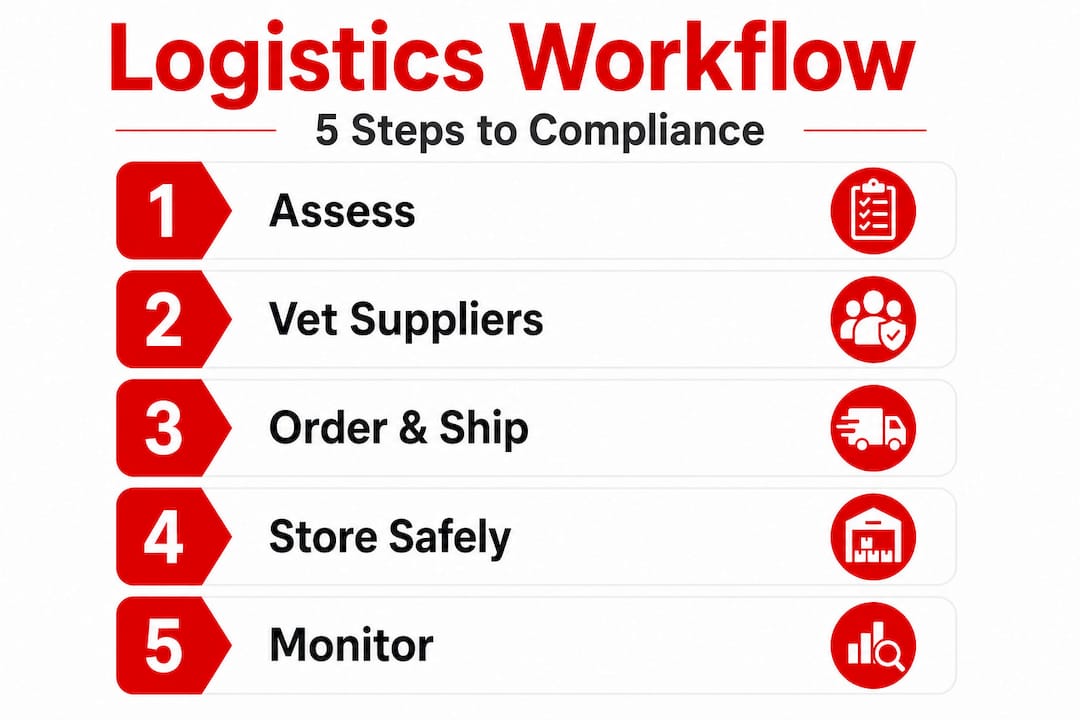
You now have a logistics framework that covers compliance requirements, supplier vetting, transport optimization, and post-delivery validation. The next step is putting it into practice with a sourcing partner that understands what government agencies and healthcare facilities actually need at scale.
Buy Test Cup offers a full range of bulk drug test cups and bulk testing strips built for high-volume compliance programs, including CLIA waived multi-panel cups, adulterant testing kits, and oral fluid swabs. Bulk orders qualify for free shipping, and same-day shipping is available for urgent procurement needs. For a deeper look at how to integrate your supply chain with your testing operations, the full workflow guide walks through every step from ordering to result documentation.
Frequently asked questions
What is the main compliance risk in bulk testing logistics?
Temperature excursions and inadequate documentation are the top compliance risks. Shipping qualification studies exist specifically to identify and mitigate these risks before a large shipment is committed.
How can I reduce delays in international drug test shipments?
Pre-clearance documentation, direct airport delivery, and close supplier coordination are the most effective tools. A coordinated bulk shipment can cut delivery time from five weeks to eleven days when all stakeholders are aligned before departure.
What’s the first step for sourcing compliant bulk drug tests?
Conduct a regulatory review and select suppliers with documented compliance histories. GDP-compliant suppliers maintain temperature mapping, traceability, and FEFO protocols as standard practice.
Are rapid drug test kits suitable for bulk procurement?
Yes, rapid kits are cost-effective and portable, but they require robust inventory control and FDA/CLIA verification before bulk purchasing. Larger order volumes reduce per-test cost but increase the importance of proper storage management.
What is FEFO and why is it critical in healthcare logistics?
FEFO stands for First Expiry, First Out. FEFO inventory management ensures that test kits closest to their expiration date are used first, preventing waste and keeping your program compliant with GDP standards.