


Blog
Random drug testing: Benefits, challenges, and how to start


TL;DR:
- Random drug testing primarily deters substance use and ensures regulatory compliance.
- Evidence is weak that it directly reduces workplace injuries or accidents.
- Implementing a well-designed, legally compliant program requires careful planning and legal review.
Random drug testing is often sold as a guaranteed path to a safer workplace. The reality is more complicated. While testing programs create measurable deterrence and support regulatory compliance in industries like transportation and construction, research on injury prevention shows the evidence is far weaker than most employers expect. This guide breaks down the true benefits, the real legal and operational challenges, and a practical framework for building a program that actually delivers results without exposing your organization to unnecessary risk.
Key Takeaways
| Point | Details |
|---|---|
| Limited safety impact | Random drug testing alone has not been shown to significantly reduce workplace injuries in most industries. |
| Legal complexities | State laws and industry rules vary, requiring customized policies and careful compliance. |
| Balanced approach | A successful drug testing program combines legal knowledge, privacy protection, and clear communication with employees. |
| High-risk industry value | Random testing offers the greatest benefit in high-risk or safety-sensitive environments. |
Understanding random drug testing: What it is and how it works
To answer why organizations should consider random drug testing, it’s important to start with exactly what it is and how it works. Random drug testing (RDAT) is a workplace screening program where employees are selected for testing through a neutral, computerized process rather than based on suspicion, a scheduled date, or a specific event. That neutrality is the point. It creates an ongoing deterrent because any employee, at any time, could be selected.
This is what sets RDAT apart from other common testing types. Pre-employment testing catches candidates before they join, but it doesn’t monitor behavior after hire. Post-accident testing is reactive, triggered after something has already gone wrong. For-cause testing requires observable signs of impairment. Random testing is the only format that applies continuous, unpredictable pressure on employees who are already part of the workforce.
The basic process follows a consistent sequence:
- A random selection system (usually software) draws employee names or ID numbers from a defined pool.
- Selected employees receive immediate notification, typically with a short window of two to four hours to report for testing.
- A trained collector oversees specimen collection, most often a urine sample, using a chain-of-custody form.
- The sample goes to a certified laboratory for analysis.
- A Medical Review Officer (MRO), a licensed physician trained in substance abuse, reviews all results. The MRO is critical for catching false positives. Prescription medications including antidepressants, antihistamines, and certain antibiotics can trigger positive screens that are perfectly legitimate.
Understanding drug testing policies at the state level is essential before you design your program. Legal variation is significant and often overlooked.
| State | Key restriction |
|---|---|
| Iowa | Strict rules on who can be included in random testing pools |
| Connecticut | Random testing limited to high-risk or safety-sensitive jobs |
| Florida | Employer-friendly, broad permission for random testing |
| Texas | No state law restricting private employer random testing |
Iowa is a notable example. State rules on testing pools specify who can be included in random selections, and getting this wrong exposes employers to legal liability. Connecticut restricts random testing to high-risk positions. Some states also require written policy disclosure to employees before any testing begins.
Pro Tip: Before launching any random testing program, have your written policy reviewed by an employment attorney familiar with the laws of every state where you operate. A one-size-fits-all program rarely holds up under state-level scrutiny.
Key benefits: Why organizations implement random drug testing
After understanding the basics, organizations need to consider the reasons that drive random drug testing decisions. The motivations are real and significant, even if some commonly assumed benefits are less proven than employers expect.
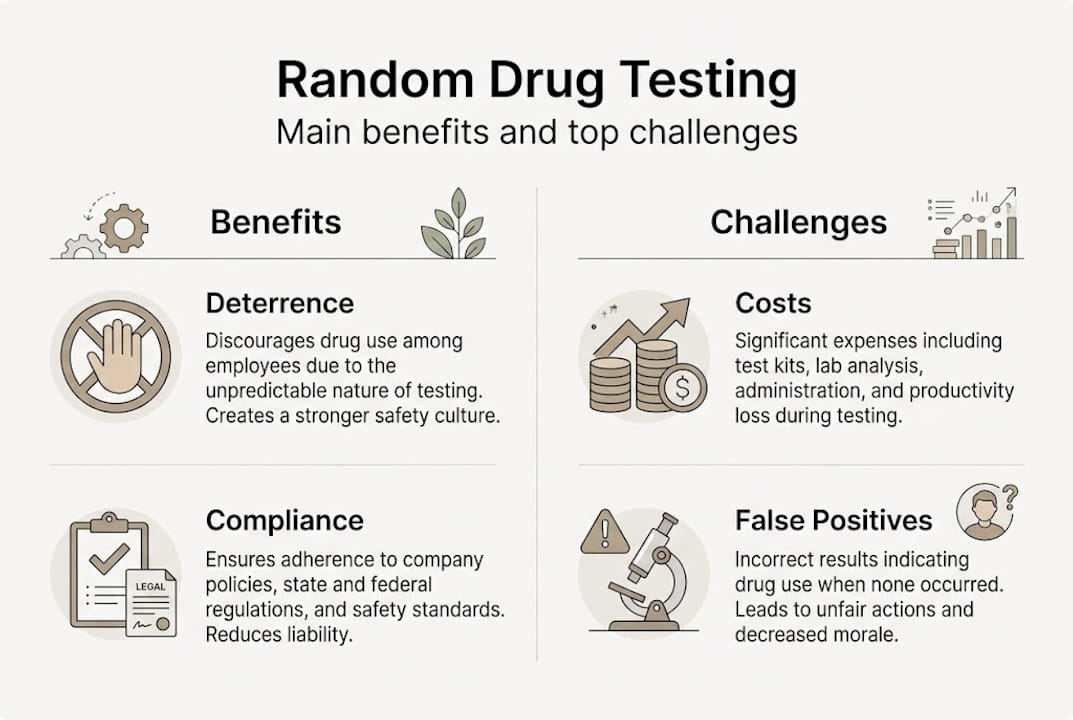
Deterrence is the most reliable benefit. Employees who know they could be tested at any time are statistically less likely to use substances during the workweek. This is different from preventing a specific incident. It’s a behavioral shift that happens because the risk of detection is ongoing. Studies on deterrence in safety programs consistently show that unpredictability is more effective than scheduled oversight.
Regulatory compliance is often non-negotiable. For organizations operating under Department of Transportation (DOT) rules, random drug testing is a federal requirement, not a choice. This applies to commercial truck drivers, airline crew members, mass transit operators, pipeline workers, and others in safety-sensitive roles. Failing to maintain a compliant random testing program in these industries can result in loss of operating authority, significant fines, or both.
Here’s how the major motivations compare in terms of evidence and impact:
| Motivation | Strength of evidence | Primary industry relevance |
|---|---|---|
| Regulatory compliance | Very strong (federal mandates) | Transportation, aviation, pipeline |
| Deterrence effect | Moderate (behavioral research) | All industries |
| Injury reduction | Very low evidence | All industries |
| Workforce trust and culture | Context-dependent | All industries |
That third row deserves attention. A Cochrane Review, one of the most rigorous standards in evidence-based research, found very low evidence that random drug and alcohol testing actually prevents workplace injuries. The studies available were limited in number, varied in quality, and showed no clear effect on accident rates. This does not mean random testing is pointless. It means injury reduction alone is a weak justification for a program.
The numbered steps that typically justify a decision to implement RDAT:
- Confirm whether federal or state regulations require it for your industry or specific job roles.
- Evaluate the deterrence value relative to the nature of your work environment.
- Review your current safety and compliance guide to identify gaps.
- Consider how testing integrates with your existing harm reduction in drug testing strategy.
- Calculate the full cost of program implementation against projected risk reduction.
Pro Tip: Don’t rely on injury reduction statistics to justify your random testing program internally. Instead, frame it around deterrence, regulatory compliance, and risk management. These are arguments that hold up under scrutiny.
Workforce trust is real, but conditional. When employees understand why testing exists and feel that it is applied fairly and without bias, random testing can actually build trust. It signals that the organization takes safety seriously and that no one gets a pass because of their seniority or role. Transparency in how the random selection works is key to this outcome.
Major challenges and pitfalls to avoid
While the advantages are appealing, random drug testing is not without meaningful challenges. Organizations that rush into implementation without addressing these often end up with programs that are legally vulnerable, operationally expensive, and damaging to workplace morale.
Privacy and employee morale are serious concerns. Employees generally perceive random testing as an intrusion, particularly in office environments or roles that aren’t safety-sensitive. When workers don’t understand the rationale for testing, or feel that certain employees are being targeted despite the “random” label, satisfaction drops. High-trust work environments can be particularly sensitive to the introduction of surveillance-style policies.
Common pitfalls organizations experience include:
- Failing to disclose the testing policy in writing before implementation
- Using poorly designed random selection systems that create biased or predictable patterns
- Not training supervisors and HR staff on proper notification and collection procedures
- Neglecting to account for prescription medications, leading to contested results and potential legal claims
- Ignoring state-specific rules, particularly in states like Iowa and Connecticut, where testing pool regulations are tightly defined
“The legal complexity of random drug testing increases significantly when organizations operate across multiple states. What is fully permissible in Texas may be restricted or prohibited in Connecticut. Legal review at the state level is not optional, it is a baseline requirement.”
The cost of a program is higher than most employers anticipate. Direct costs include testing supplies, laboratory fees, MRO review, and collector training. Indirect costs include lost productivity during testing windows, administrative time managing the selection process, and the potential cost of legal defense if an employee challenges the program. Organizations with large workforces running quarterly random pools can spend tens of thousands of dollars annually.
False positives create significant operational and legal risk. This is where the MRO becomes indispensable. A test that screens positive for opioids might reflect a valid prescription for a pain medication. Without an MRO review, that result could trigger disciplinary action against an employee who did nothing wrong. Reviewing drug screening best practices before finalizing your program structure helps prevent these costly errors.
The solution to most of these challenges is not to avoid random testing altogether. It is to invest in program design before you invest in testing supplies. Clear written policies, proper legal review, trained personnel, and a qualified MRO are foundational requirements, not optional upgrades.
Building an effective random drug testing program
Given the challenges, a thoughtful approach to program design maximizes benefits and minimizes risks. The following framework reflects what well-run programs actually look like in practice, particularly in industries where the stakes are high.
-
Define your policy scope and objectives. Decide which employees are included, which substances are tested, and what the consequences of a positive result will be. This needs to be in writing, reviewed by legal counsel, and provided to every employee before the program begins.
-
Clarify federal and state legal requirements. DOT-regulated employers must follow federal RDAT mandates precisely. Non-regulated employers need to check state law. Some states require annual notification. Others define the percentage of your workforce that can be tested per year (DOT typically requires at least 50% for drugs and 10% for alcohol annually).
-
Implement a verifiably random selection process. Use software or a third-party administrator that generates a truly random draw. Document every selection. If your process ever looks like it could be influenced by a manager or HR team member, you’ve created legal exposure.
-
Establish a clear chain of custody for all specimens. From collection through laboratory analysis, every step must be documented. Use collection kits that support proper chain-of-custody documentation. This protects both the organization and the employee.
-
Contract with a certified laboratory and an MRO. The lab must be SAMHSA-certified (Substance Abuse and Mental Health Services Administration) for federally mandated programs. The MRO reviews all non-negative results and contacts employees to verify any legitimate medical explanations before a result is finalized. Following the employee drug testing steps outlined in a formal checklist helps your team stay compliant at every stage.
-
Build a communication and education plan. Employees who understand the purpose and process of random testing are more likely to accept it. Hold a policy rollout meeting. Provide FAQs. Make the MRO review process transparent. When workers know that a prescription medication won’t cost them their job, they stop fearing the process.
Pro Tip: Set your annual testing rate slightly above the minimum required percentage. Running at exactly the minimum leaves no room for administrative error, rescheduled tests, or unusual circumstances. A 5 to 10 percent buffer protects compliance without significant added cost.
While evidence on injury reduction from RDAT remains weak, the compliance and deterrence arguments are strong enough to justify careful program design in high-risk industries. The key word is careful. Programs thrown together without legal review and proper operational procedures routinely generate more problems than they solve.
A fresh perspective: Rethinking random drug testing for real results
With the framework in place, it’s important to take a step back and reconsider how random drug testing fits into the bigger picture.
The most dangerous assumption in workplace drug testing is that the act of testing equals the act of creating safety. It doesn’t. Organizations that install random testing programs and then consider the safety problem solved are substituting process for outcomes. The Cochrane evidence on RDAT is clear: there is very low evidence that testing alone prevents injuries. That finding should reshape how you frame the value of your program.
The organizations that get the most out of random testing treat it as one component of a broader safety culture, not a standalone solution. They pair testing with supervisory training on impairment recognition, clear return-to-duty protocols, and access to employee assistance programs. They invest in effective approaches to drug screening that are transparent, fairly applied, and integrated with their overall safety strategy.
The most effective programs we’ve seen are built on a simple principle: testing should support people, not just catch them. When that’s the organizational mindset, random testing produces better outcomes, fewer legal challenges, and stronger workforce trust than any purely punitive approach ever could.
Ready for a compliant and effective drug testing program?
If you’re ready to apply these best practices and enhance your workplace with reliable drug testing solutions, here’s how to get started. Buy Test Cup offers a full range of CLIA-waived drug test cups designed for workplace compliance programs, including multi-panel options that screen for the substances most relevant to your industry. For programs that require flexible, cost-effective screening formats, our testing strips deliver accurate results at scale. You can also explore our drug testing program workflow resources to build a compliant, step-by-step process that protects your organization and your employees. We offer bulk pricing, same-day shipping, and free shipping on large orders to keep your program running without gaps.
Frequently asked questions
Does random drug testing actually reduce workplace accidents?
Evidence from Cochrane shows very low evidence that random drug and alcohol testing prevents workplace injuries, meaning deterrence and compliance remain stronger justifications than accident reduction for most employers.
Is random drug testing legal in all states?
No. State laws vary significantly, with some states like Iowa restricting who can be included in testing pools and Connecticut limiting random testing to high-risk or safety-sensitive positions only.
How can employers avoid false positives in random testing?
Employers should contract with a qualified Medical Review Officer (MRO) who will contact employees with non-negative results to verify any legitimate prescription medications before finalizing a positive result.
What types of jobs or industries benefit most from random drug testing?
High-risk industries such as transportation, aviation, pipeline operations, and construction receive the clearest benefit, particularly where federal mandates like DOT regulations make random testing a legal requirement rather than a discretionary choice.