


Blog
HR’s guide to drug testing: Policies, laws, and best practices

TL;DR:
- Workplace drug positivity remains high, with a 4.6% average and THC detections surging 683%.
- HR must develop legally compliant, ethical drug testing programs emphasizing safety, privacy, and consistent procedures.
- Regular policy updates, careful handling of gray areas like cannabis, and employee communication are essential for effective management.
Workplace drug positivity is not falling. In fact, US workplace positivity averages 4.6% in 2026, and THC detection rates have climbed a staggering 683% since cannabis legalization began spreading across states. For HR professionals in compliance-heavy industries, that number is not just a statistic; it is a daily operational reality that touches hiring, safety, litigation risk, and employee relations all at once. This guide breaks down what you need to know about your legal obligations, your procedural responsibilities, and the judgment calls that no compliance manual fully prepares you for.
Key Takeaways
| Point | Details |
|---|---|
| Regulations drive HR policy | HR must structure drug testing around ADA, DOT, and shifting state laws. |
| Balancing safety and rights | Effective programs protect people while respecting privacy and legal protections. |
| Gray areas require expertise | Legal marijuana and prescriptions demand careful HR review using MROs. |
| Annual updates essential | Drug testing policies should evolve yearly to reflect new laws and risks. |
| Resources improve outcomes | Utilizing guides and verified test supplies boosts accuracy and compliance. |
Why drug testing matters: Safety, compliance, and risk
Drug testing sits at the intersection of worker safety, regulatory compliance, and organizational liability. For HR teams in transportation, healthcare, manufacturing, and construction, it is not optional. It is a core operational function with legal teeth.
The reasons organizations implement drug testing programs fall into several distinct categories:
- Regulatory compliance: Federal agencies like the Department of Transportation require testing for workers in safety-sensitive roles. Failing to test, or testing incorrectly, exposes organizations to serious federal penalties.
- Safety risk reduction: Impaired workers cause accidents. In industries where heavy machinery, vehicles, or patient care are involved, the stakes of a missed test are measured in injuries or fatalities.
- Insurance and liability: Many commercial insurers require documented testing programs as a condition of coverage. A positive post-accident test without a proper pre-established policy creates legal vulnerability, not protection.
- Organizational culture: A consistent, fair testing program signals that safety is a shared value, not just a policy checkbox.
The legal backbone here involves two major frameworks. Federal law under the ADA permits testing for current illegal drug use but requires HR to provide reasonable accommodations for employees who are in recovery or taking legally prescribed medications. Testing someone simply because they have a history of substance use, without evidence of current illegal use, crosses a legal line under the Americans with Disabilities Act.
Beyond legal minimums, there is a genuine tension worth acknowledging. Ethical drug testing policy requires that safety goals do not override an employee’s right to privacy or their protections under disability law. HR professionals who treat drug testing purely as a gatekeeping mechanism, rather than a safety tool with ethical dimensions, tend to create programs that generate more legal exposure than they prevent.
“A drug testing program that is legally defensible but operationally blind to employee rights is a liability, not an asset. The goal is compliance with judgment, not compliance as a substitute for it.”
Following best practices for compliance means building procedures that hold up to scrutiny from regulators, employees, and courts alike. This requires more than a written policy; it requires consistent, documented execution.
Understanding the legal framework: Federal, state, and special cases
The legal landscape for workplace drug testing is not a single unified rulebook. It is a layered system of federal mandates, state statutes, and agency-specific rules that interact in ways that are not always intuitive.
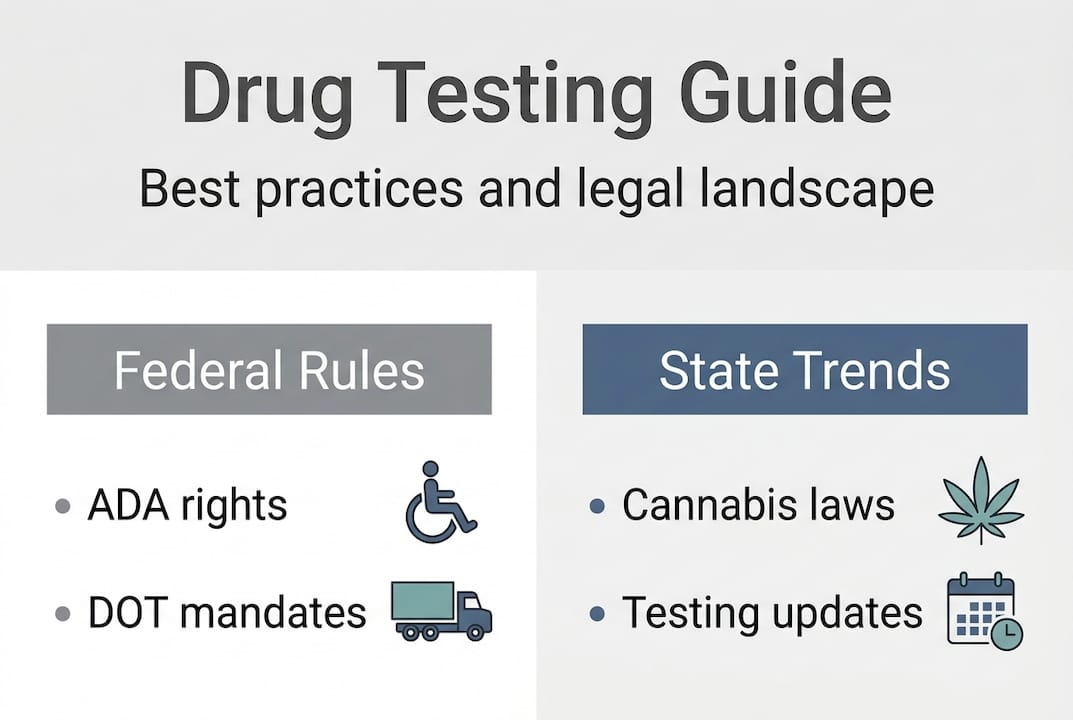
At the federal level, two frameworks dominate HR decision-making. The ADA governs disability protections, and DOT mandates testing for safety-sensitive roles including commercial drivers, aviation workers, railroad employees, and pipeline operators. DOT rules are highly prescriptive: pre-employment, random, post-accident, reasonable suspicion, and return-to-duty testing are all specifically defined with procedural requirements that HR cannot improvise around.
State law adds serious complexity. A growing number of states have enacted cannabis legalization measures that conflict directly with federal testing standards. HR teams must track these variables actively. Here is a snapshot of how the landscape varies:
| Jurisdiction | Cannabis status | Employer testing rights | Notes |
|---|---|---|---|
| Federal (DOT) | Illegal | Mandatory for safety-sensitive roles | State laws do not override DOT rules |
| California | Recreational legal | Restricted; cannot test for off-duty use | Significant privacy protections |
| Texas | Illegal (medical limited) | Broad employer discretion | Fewer restrictions on testing |
| Oklahoma | Medical legal | Safety-sensitive roles redefined | New rules expand employer authority |
| New York | Recreational legal | Cannot test for cannabis pre-employment | Exceptions for safety-sensitive roles |
One of the most important but overlooked roles in this framework is the Medical Review Officer (MRO). An MRO is a licensed physician who reviews laboratory-confirmed positive results before they are reported to employers. MRO prescription reviews confirm a significant share of apparent positives as legitimate medical use: approximately 71% of opiate positives and 63% of amphetamine positives are verified as lawful prescription use after MRO review. Without this step, HR would routinely take adverse action based on results that are legally protected.
Key legal considerations HR must track include:
- Whether your state has enacted cannabis employment protections and whether they apply to your industry
- Whether any of your roles fall under DOT or other federal safety mandates that override state law
- How your ADA obligations interact with positive test results from employees disclosing prescriptions
- Oklahoma’s drug testing policy guidance is one example where state law recently expanded the definition of safety-sensitive work, giving employers broader testing authority than before
Understanding which industry standards apply to your workforce is not a one-time exercise. Legal changes in 2025 and 2026 have already shifted the ground under several state frameworks, and more changes are expected.
The HR professional’s daily responsibilities in drug testing
Understanding the law is necessary but not sufficient. The practical execution of a drug testing program is where most programs succeed or fail. HR professionals in compliance-heavy industries are responsible for building processes that run consistently, regardless of who is conducting the test on any given day.
Here is the sequence most HR teams follow to maintain a defensible, fair program:
- Establish a written policy. Your policy must specify which testing types you conduct (pre-employment, random, post-accident, reasonable suspicion), which positions are subject to testing, the substances tested for, and the consequences of a positive result. Vague policies do not protect employers.
- Select a certified testing vendor. Use a laboratory with SAMHSA certification for federally mandated testing. For workplace programs outside federal mandates, confirm CLIA-waived status for point-of-care testing devices.
- Train supervisors on reasonable suspicion documentation. Supervisors must document specific, observable behaviors, not general impressions, before sending an employee for reasonable suspicion testing. Undocumented suspicion claims are a legal liability.
- Maintain chain-of-custody documentation. Every specimen must travel from collection through analysis with a documented, unbroken chain of custody. A gap in that chain can invalidate the entire result in a legal proceeding.
- Manage positive results through proper channels. In DOT-regulated industries, HR ensures DOT adherence by removing employees from safety-sensitive duties immediately upon a positive result and referring them to a Substance Abuse Professional (SAP) before any return-to-duty process begins.
- Communicate results appropriately. Positive results go through the MRO to the designated employer representative, not directly to supervisors. Skipping this step exposes HR to privacy claims and creates documentation gaps.
- Review policies annually. Cannabis law alone changed in multiple states between 2024 and 2026. A policy that was compliant last year may not be compliant today.
Following a thorough step-by-step employee drug testing process is what separates programs that hold up in audits from those that create expensive litigation.

Pro Tip: The most common procedural mistake HR teams make is delaying post-accident testing. DOT rules require testing within specific windows after an accident (8 hours for alcohol, 32 hours for controlled substances). Missing those windows does not just compromise results; it puts your organization out of compliance entirely.
Using proven effective drug screening practices means building timing checkpoints into your incident response protocols, not relying on individual managers to remember them under stress.
Navigating gray areas: Handling marijuana, prescriptions, and changing trends
Even with a well-built program, HR professionals hit situations where the right answer is not obvious. Cannabis legalization, rising prescription drug use, and the limitations of urine testing all create gray zones that require judgment, not just procedure.
Start with an honest acknowledgment: urine testing detects past use, not current impairment. A positive THC result tells you the employee used cannabis at some point in the past several weeks; it does not tell you they were impaired at work. This distinction matters enormously as cannabis laws evolve, because courts and state agencies are increasingly asking whether a positive result alone is sufficient cause for an adverse employment action.
With workplace THC positivity rising 683% post-legalization, HR teams that have not updated their policies to account for state-specific cannabis protections are operating with programs that generate legal exposure rather than reducing it.
Here is how common gray-area situations compare in terms of HR response:
| Situation | Test result | HR action | Key consideration |
|---|---|---|---|
| Legal state cannabis use, non-safety role | Positive THC | Consult state law before action | Many states prohibit adverse action |
| DOT safety-sensitive role, any cannabis | Positive THC | Remove from duty, SAP referral required | Federal law overrides state protections |
| Positive amphetamine, valid prescription | Positive AMP | MRO reviews and verifies | No adverse action if MRO confirms legit use |
| Common cold medication (pseudoephedrine) | False positive meth | MRO review resolves | Confirmatory GC-MS testing distinguishes |
| Poppy seed consumption | Opiate positive | MRO review, confirm with GC-MS | Threshold adjustments reduce false positives |
Pro Tip: When an employee discloses a prescription at the time of a positive test result, do not attempt to evaluate the legitimacy of that disclosure yourself. Route it immediately to your MRO. The MRO exists precisely to make that judgment with medical authority. HR stepping into that role creates both legal exposure and accuracy risk.
Best practices for managing gray areas include:
- Document state-specific rules in a separate addendum to your main policy, and review that addendum whenever your state legislature is in session
- Never take adverse action on a non-MRO-reviewed result for a confirmed positive; always allow the medical review process to complete
- Train managers to avoid making statements about test results to other employees; confidentiality breaches are among the most common drug testing-related HR claims
- Update policies annually with input from legal counsel who tracks state-level cannabis legislation in your specific operating states
Leveraging a harm reduction in drug testing approach, particularly for non-safety-sensitive roles, can improve employee trust in the program and reduce legal risk without compromising safety outcomes.
A seasoned view: What most HR guides miss about drug testing programs
Most compliance guides treat drug testing as a technical problem with a procedural solution. Follow these steps, check these boxes, and you are covered. That framing is not wrong; it is incomplete.
The real challenge in 2026 is that employee attitudes toward drug use, particularly cannabis, have shifted faster than most HR policies. Workers who legally used cannabis over the weekend in a state where it is fully legal are increasingly resistant to testing programs they perceive as invasive and disconnected from actual impairment. That resentment affects your program’s credibility, your ability to recruit in competitive labor markets, and sometimes your ability to retain experienced employees who see a positive result as unjust.
The most effective HR professionals we see building strong programs are not just following the rulebook. They are asking harder questions: Does this test support a genuine safety outcome, or is it a legacy policy from 20 years ago? Are our managers equipped to document observable impairment, or are we entirely dependent on urine tests to do work our supervisors should be doing? Are we applying the same rigor to alcohol, which is far more reliably correlated with on-the-job impairment, as we apply to cannabis?
One-size-fits-all programs are the most common pitfall. A construction company with heavy equipment operators has genuinely different risk exposure than a financial services firm. Programs designed around the most restrictive federal standards may be appropriate for one and operationally damaging for the other. Calibrating your program to your actual workforce risk profile, rather than defaulting to maximum restriction, tends to produce better outcomes on every dimension: safety, compliance, retention, and employee trust.
Annual policy reviews are non-negotiable, but they should go beyond legal updates. Build in a review of your positivity data, your false positive rate, your MRO referral rate, and your SAP completion rate. Those numbers tell you whether your program is working or just running. Reviewing real-world testing scenarios from comparable organizations can surface patterns your internal data does not yet show.
Staff education is as important as process documentation. Employees who understand why testing exists, what happens to their results, and what protections they have are significantly more cooperative and less likely to challenge results. That investment in communication is not a soft HR nicety; it is a risk reduction strategy.
Next steps: Strengthen your drug testing program with top solutions
The strategies in this guide only produce results when backed by accurate, reliable testing tools and clear operational workflows. Whether you are building a new program or auditing an existing one, the quality of your testing supplies directly affects the defensibility of your results. Buy Test Cup offers a full range of drug test cups designed for workplace compliance programs, including CLIA-waived multi-panel options that meet federal and DOT requirements. To translate policy into process, the drug screening workflow guide walks HR teams through each operational step to protect chain-of-custody integrity. You can also review the essential drug testing supplies checklist to make sure your program is equipped at every stage, from collection through result communication.
Frequently asked questions
What counts as a safety-sensitive position under federal rules?
Safety-sensitive roles are those where drug impairment could significantly endanger the person or others, such as commercial driving, and are specifically outlined in DOT regulations. Examples include commercial motor vehicle operators, aviation personnel, and mass transit workers.
Can HR require drug testing for employees in recovery or on prescribed medication?
No. The ADA protects employees in recovery or with properly prescribed medication; HR can only test for current illegal drug use, and adverse action based on past addiction history or lawful prescriptions violates disability law.
How should HR handle a positive marijuana test in a state where it’s legal?
HR should consult both state and federal guidelines and route the result through an MRO, because state-federal cannabis conflicts require medical review before any adverse employment action, especially in DOT-regulated roles where federal law supersedes state cannabis protections.
How often should HR review and update its drug testing policy?
Drug testing policies need annual review at minimum, with additional reviews triggered by state cannabis law changes, shifts in your workforce composition, or updates to DOT or SAMHSA guidance.