


Blog
Drug testing policies explained: guide for HR managers 2026


Many HR managers believe that drug testing policies are straightforward, yet California’s laws restrict random testing far more than most realize. With AB 2188 and SB 700 reshaping marijuana rules in 2026, confusion about what employers can and cannot test has never been higher. Misunderstanding these evolving regulations risks costly lawsuits, compliance violations, and workforce trust erosion. This guide clarifies California’s legal framework, explores drug testing methods, and delivers actionable best practices so you can design, implement, and maintain policies that protect your organization while respecting employee rights.
Key takeaways
| Point | Details |
|---|---|
| California restricts random testing | Random drug testing is only permitted for safety-sensitive, DOT-regulated, or heavy equipment operator roles, not general employees. |
| Marijuana laws changed dramatically | AB 2188 and SB 700 prohibit employment actions based on non-psychoactive THC metabolites detected days or weeks after use. |
| Test types vary in detection windows | Urine tests detect 5-10 days, hair follicle up to 90+ days, saliva 48 hours, and blood provides immediate accuracy but high cost. |
| ADA accommodations are mandatory | Employers must engage in interactive dialogue when applicants disclose disabilities affecting drug testing requirements during hiring. |
| Annual policy reviews prevent exposure | Updating policies yearly or when laws change reduces legal risks and keeps your organization compliant with evolving standards. |
Understanding legal frameworks for workplace drug testing in California
California’s drug testing landscape shifted dramatically in recent years, and 2026 brings even stricter enforcement of laws protecting employee privacy and marijuana use. AB 2188 and SB 700 prohibit employers from taking adverse action based on non-psychoactive THC metabolites detected in drug tests. These metabolites linger in the body for weeks after marijuana consumption, long after any impairment has passed. This means pre-employment and random tests that detect past use, rather than current impairment, cannot legally justify hiring or termination decisions for most positions.
Random drug testing faces severe restrictions in California. You can only conduct random tests for employees in safety-sensitive roles, those subject to Department of Transportation regulations, or workers operating heavy equipment. For all other positions, random testing is prohibited unless you have reasonable suspicion of impairment or the employee consents. Pre-employment testing remains legal, but only after extending a conditional job offer. Even then, the test must detect active impairment, not inactive metabolites from days or weeks prior.
Employee privacy is a cornerstone of California labor law. Courts have ruled that drug testing must balance legitimate business interests with individual privacy rights. Employers who overstep by testing without clear justification or failing to follow proper protocols face significant liability. Your California workplace drug testing laws compliance depends on narrow, well-documented testing criteria.
Pro Tip: Draft your policy language to explicitly distinguish between detecting impairment versus past use. Specify that testing aims to identify employees unable to perform duties safely, not to punish legal off-duty conduct.
Key legal requirements for California employers include:
- Maintain a clear, written drug testing policy distributed to all employees and applicants.
- Update policies annually to reflect AB 2188, SB 700, and any new legislation.
- Limit random testing to legally defined safety-sensitive roles only.
- Conduct pre-employment testing only after conditional offers and focus on active impairment.
- Document all policy acknowledgments, test results, and disciplinary actions meticulously.
“Employers must navigate a complex web of state and federal laws, balancing workplace safety with employee rights and privacy protections.”
Failure to comply with these frameworks exposes your organization to wrongful termination lawsuits, discrimination claims, and regulatory penalties. California courts have awarded substantial damages to employees whose privacy or disability rights were violated during drug testing. Understanding these laws is not optional; it is the foundation of defensible HR practice.
Types of drug tests and their implications for policy design
Choosing the right drug testing method directly impacts your policy’s effectiveness, cost, and legal defensibility. Urine tests are cost-effective and provide results within days, making them the most common choice for workplace screening. They detect drug use within approximately 5 to 10 days, depending on the substance and frequency of use. However, this limited detection window means urine tests may miss occasional users or those who abstained briefly before testing.

Hair follicle tests offer a much longer detection window, identifying drug use up to 90 days or more. This makes them ideal for roles requiring comprehensive screening or when you need historical insight into an applicant’s substance use patterns. Hair tests are harder to adulterate than urine samples, reducing the risk of false negatives. The downside is higher cost and longer turnaround times, typically one to two weeks. For safety-critical positions, the investment often justifies the thoroughness.
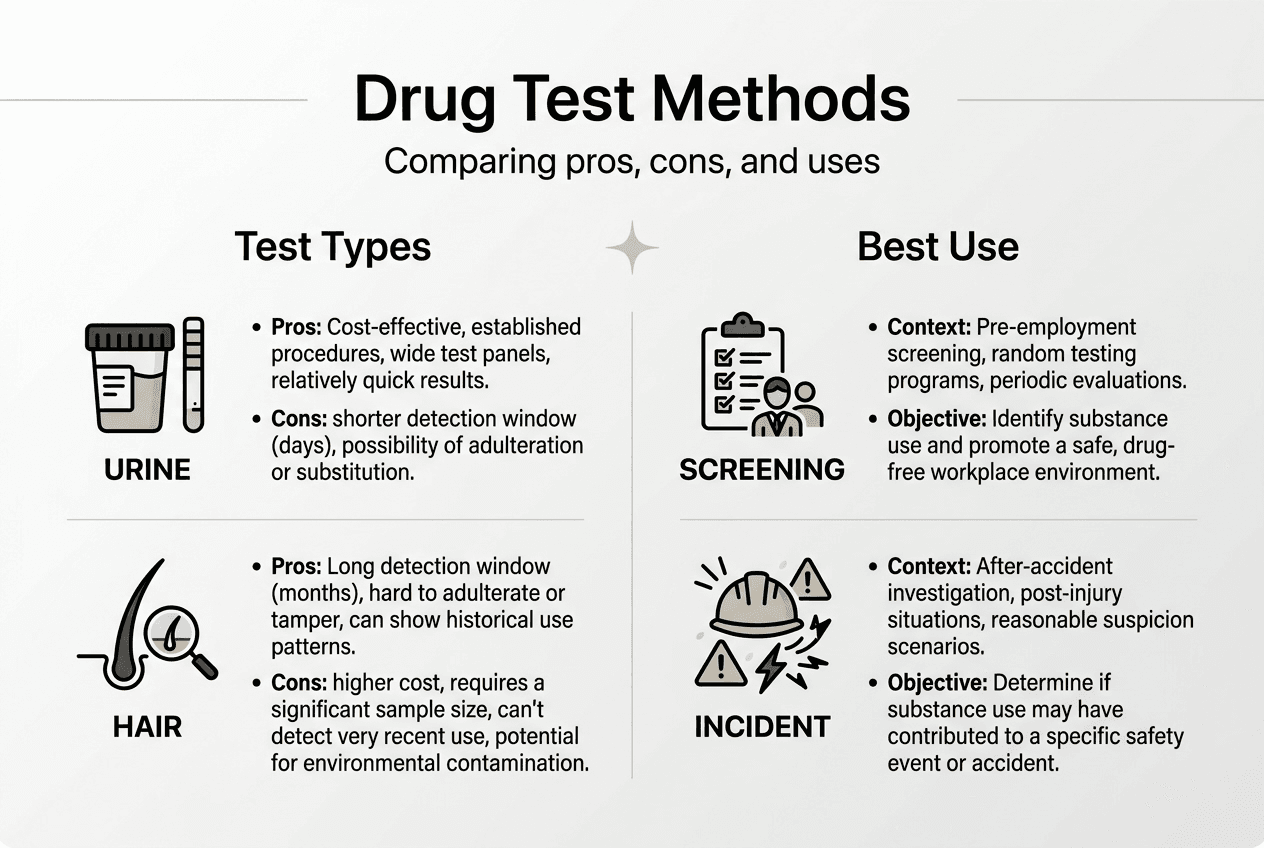
Saliva tests deliver rapid results, often within 48 hours, and detect very recent use, usually within the past 24 to 48 hours. This makes them useful for reasonable suspicion or post-accident testing when you need to confirm impairment at the time of an incident. Saliva tests are less invasive than urine or blood collection, improving employee comfort and compliance. However, their short detection window means they miss drug use that occurred days earlier, limiting their utility for pre-employment screening.
Blood tests are the gold standard for accuracy and can detect active drug presence in real time. They are highly reliable for confirming impairment immediately after an accident or safety incident. Blood tests are also the most expensive and invasive option, requiring medical personnel for collection. Because of these factors, reserve blood testing for high-stakes situations where precise, immediate results are legally or operationally necessary.
Pro Tip: Match your testing method to the job role and testing scenario. Use urine tests for routine pre-employment screening, saliva for reasonable suspicion, and hair follicle for safety-sensitive positions requiring long lookback periods.
| Test Type | Detection Window | Cost | Best Use Case |
|---|---|---|---|
| Urine | 5-10 days | Low | Routine pre-employment and random testing |
| Hair Follicle | 90+ days | High | Safety-sensitive roles, comprehensive screening |
| Saliva | 24-48 hours | Moderate | Reasonable suspicion, post-accident testing |
| Blood | Real-time | Very High | Immediate impairment confirmation, legal cases |
Understanding these differences allows you to design policies that balance accuracy, cost, and legal compliance. For example, if your policy relies on urine tests but you need to demonstrate impairment rather than past use, you may need to supplement with saliva or blood testing in specific scenarios. Your laboratory drug tests guide can help you select the right combination of methods for your organization’s needs.
Key considerations when selecting drug testing methods:
- Align detection windows with your policy goals: recent impairment versus historical use.
- Budget for testing costs across different employee populations and testing frequencies.
- Ensure collection procedures protect sample integrity and reduce adulteration risks.
- Train HR staff on proper specimen handling and chain of custody protocols.
- Communicate testing methods clearly in your written policy to set accurate expectations.
By tailoring your testing approach to specific roles and situations, you create a defensible, cost-effective program that supports both safety and compliance.
Best practices for maintaining compliant and effective drug testing policies
A drug testing policy is only as strong as its maintenance and enforcement. Employers must have clear, updated policies that explicitly address marijuana in compliance with AB 2188 and SB 700. Review your policy at least annually, and immediately after any legislative changes, to ensure alignment with current laws. Outdated policies create legal exposure and undermine employee trust.
Your written policy should explicitly state who is subject to testing and under what conditions. Define safety-sensitive roles clearly, specifying job titles and duties that justify random or post-accident testing. For non-safety-sensitive positions, limit testing to pre-employment (after conditional offers) and reasonable suspicion scenarios. Vague language invites disputes and weakens your legal position if challenged.
Provide clear procedures for medication verification and ADA accommodations. Employees taking prescribed medications that may trigger positive test results need a confidential process to disclose and verify their prescriptions. Similarly, applicants with disabilities affecting their ability to provide specimens must receive reasonable accommodations during testing. Failing to accommodate can result in costly lawsuits, as recent court rulings demonstrate.
Document everything. Require employees to sign acknowledgment forms confirming they received, read, and understood the drug testing policy. Retain these acknowledgments in personnel files. After testing, maintain detailed records of test results, chain of custody, and any disciplinary actions taken. This documentation is your defense if an employee claims the policy was not communicated or was applied inconsistently.
Train your HR team on legal requirements and the ADA interactive process. Many compliance failures stem from HR personnel who lack current knowledge of drug testing laws or disability accommodation obligations. Invest in regular training sessions covering California-specific regulations, federal DOT requirements if applicable, and best practices for handling positive results or accommodation requests.
Pro Tip: Create a policy review calendar with quarterly check-ins and annual comprehensive updates. Assign a specific HR team member as the drug testing policy owner responsible for monitoring legal changes and initiating updates.
Follow this sequence to maintain a compliant policy:
- Review your policy annually or immediately after legislative changes affecting drug testing.
- Explicitly define safety-sensitive roles and the conditions triggering testing for each employee category.
- Establish confidential procedures for prescription medication verification and ADA accommodations.
- Require signed acknowledgment forms from all employees and applicants subject to testing.
- Train HR personnel on current laws, testing protocols, and interactive accommodation processes.
- Document all policy distributions, test results, accommodation requests, and disciplinary actions.
- Audit your program quarterly to identify gaps, inconsistencies, or areas needing improvement.
Consistent application of your policy across all employees is critical. Selective enforcement or favoritism invites discrimination claims. If you test one employee for reasonable suspicion, apply the same standard to all employees in similar circumstances. Your employee drug testing checklist can help standardize your procedures and reduce the risk of inconsistent application.
Regularly solicit feedback from managers and employees about policy clarity and fairness. Policies that feel arbitrary or punitive damage morale and increase turnover. Transparent, consistently enforced policies that respect privacy and legal protections foster a safer, more trustworthy workplace culture.
Legal compliance and accommodation challenges in drug testing programs
The Americans with Disabilities Act creates significant obligations for employers during drug testing, especially at the hiring stage. Employers are liable under the ADA for failing to accommodate applicants during hiring, including drug testing. When an applicant discloses a disability that affects their ability to provide a urine sample, for example, you must engage in an interactive process to identify reasonable accommodations. Ignoring or dismissing these requests can result in six-figure lawsuit settlements and reputational damage.
Recent court cases illustrate the high cost of non-compliance. In one ruling, an employer withdrew a job offer after an applicant disclosed a medical condition preventing urine sample collection and requested an alternative testing method. The court found the employer violated the ADA by failing to engage interactively and explore accommodations like saliva or hair testing. The damages awarded exceeded $100,000, plus legal fees. This case underscores that drug testing policies cannot be rigid; they must flex to accommodate disabilities.
Another common pitfall is acting on test results that detect inactive metabolites without evidence of impairment. California law now prohibits employment decisions based solely on THC metabolites that indicate past marijuana use, not current impairment. If you terminate an employee because a urine test detected marijuana metabolites from a weekend barbecue two weeks ago, you risk a wrongful termination lawsuit. Your policy must clarify that testing aims to identify impairment affecting job performance, not to punish legal off-duty conduct.
Documentation is your strongest defense in legal disputes. Maintain detailed records of policy distribution, signed acknowledgments, test results, chain of custody, accommodation requests, and disciplinary actions. If an employee claims they were never informed of the drug testing policy, a signed acknowledgment form proves otherwise. If an applicant alleges you refused accommodation, documented interactive process notes demonstrate your good-faith efforts.
Common compliance challenges include:
- Failing to engage interactively when applicants disclose disabilities affecting testing.
- Acting on test results detecting past use rather than current impairment.
- Applying drug testing policies inconsistently across employees or departments.
- Neglecting to update policies after legislative changes like AB 2188 or SB 700.
- Inadequate documentation of policy acknowledgments, test results, and disciplinary decisions.
“The ADA requires employers to engage in a flexible, interactive dialogue with applicants and employees to identify reasonable accommodations that do not impose undue hardship.”
Your drug testing compliance guide provides detailed protocols for navigating these challenges. Key steps include training HR staff on ADA obligations, establishing clear accommodation procedures, and auditing your program regularly for consistency and legal alignment.
Privacy protections also play a major role in compliance. California law requires employers to handle drug test results confidentially and limit access to personnel with a legitimate need to know. Sharing test results with managers or coworkers who do not need the information violates privacy rights and exposes your organization to lawsuits. Establish strict protocols for storing and sharing test results, and train all personnel involved in drug testing on confidentiality requirements.
Finally, be prepared for employees to challenge positive results. Provide a clear process for employees to request retesting or dispute results they believe are inaccurate. Offering a second test at a different laboratory, at the employee’s expense if desired, demonstrates fairness and reduces the risk of legal challenges. Transparency and procedural fairness are your best defenses against claims of arbitrary or discriminatory enforcement.
Enhance your drug testing with the right supplies and workflows
Implementing a compliant drug testing program starts with reliable test supplies like drug test cups and strips. High-quality testing products ensure accurate results, reduce false positives, and support defensible employment decisions. Structured workflows help maintain accuracy, protect employee privacy, and ensure legal adherence throughout the testing process. By combining clear policies with dependable supplies, you create a program that meets both safety and compliance goals.
Explore resources tailored specifically for HR professionals to elevate your drug testing success in 2026. Detailed guides on drug testing program workflow compliance walk you through every step, from specimen collection to result documentation. The employee drug testing checklist ensures you cover all critical compliance points, reducing the risk of legal exposure or procedural errors. With the right tools and knowledge, you can confidently manage drug testing programs that protect your workforce and your organization.
Frequently asked questions about drug testing policies
Can employers test employees for marijuana use detected days ago?
No, California law prohibits employment actions based on non-psychoactive THC metabolites that indicate past marijuana use, not current impairment. Employers must demonstrate active impairment affecting job performance, not simply past consumption detected in a test.
What are best practices for ADA accommodations during drug testing?
Engage in an interactive dialogue immediately when an applicant or employee discloses a disability affecting testing. Explore alternative testing methods like saliva or hair tests, provide additional time, or offer assistance as needed. Document all accommodation discussions and decisions.
How often should drug testing policies be reviewed and updated?
Review your policy at least annually and immediately after any legislative changes. California’s drug testing laws evolve frequently, and outdated policies create legal exposure. Schedule quarterly check-ins to monitor for new regulations or court rulings affecting your program.
What types of drug tests detect recent versus past drug use?
Saliva and blood tests detect recent use within 24 to 48 hours, ideal for confirming impairment. Urine tests detect use within 5 to 10 days, while hair follicle tests identify use up to 90 days or more. Match the test type to your policy goals and legal requirements.
Are random drug tests allowed for non-safety sensitive positions in California?
No, random drug testing is prohibited for non-safety-sensitive positions in California. You can only conduct random tests for safety-sensitive roles, DOT-regulated employees, or heavy equipment operators. For other positions, limit testing to pre-employment and reasonable suspicion scenarios.