


Blog
Why alcohol breath tests matter for workplace safety


TL;DR:
- Relying on incidents to trigger workplace alcohol testing is risky and can cause regulatory crises for organizations.
- Proactive, evidence-based breath alcohol testing enables rapid, accurate results essential for safety and compliance.
Relying on an incident to trigger your first alcohol screening is not a safety program, it is a liability waiting to happen. Organizations that treat breath alcohol testing as a reactive measure consistently find themselves one failed inspection or injured worker away from a regulatory crisis. The evidence-based case for proactive breath alcohol testing is strong, and it extends well beyond keeping a few breathalyzers in the supply closet. This guide unpacks the operational, regulatory, and cultural reasons why breath alcohol tests are a core tool for safety officers and HR managers who need defensible, real-time results.
Key Takeaways
| Point | Details |
|---|---|
| Rapid on-site testing | Alcohol breath tests deliver almost immediate results for safe workforce decisions. |
| Compliance-driven protocols | Regulations demand evidential devices and quality assurance for defensible outcomes. |
| Link to safety culture | Best results come from integrating breath testing into a broader safety strategy. |
| Limits and misuse risks | Breath tests are powerful, but have limitations and should not be used in isolation. |
How alcohol breath tests work in workplace safety
With that foundational perspective, let’s clarify how breath tests are actually used in real workplace safety programs.
Breath alcohol testing works by measuring the concentration of ethanol vapor in a person’s exhaled breath and converting that reading into a blood alcohol concentration (BAC) estimate. The process is non-invasive, requires no needles or specimen collection rooms, and delivers results on-site in two to five minutes. That speed is not a convenience feature. It is a functional requirement for any safety-sensitive workplace where a supervisor needs to make an immediate staffing decision.
Modern workplace breath testing fits into several testing scenarios:
- Pre-employment screening, conducted before an individual enters a safety-sensitive role
- Random testing, applied to a statistically selected subset of employees at unannounced intervals
- Post-incident testing, conducted immediately after an accident or near-miss to establish whether impairment was a contributing factor
- Reasonable suspicion testing, initiated by a trained supervisor who observes behavioral or physical signs of impairment
- Return-to-duty and follow-up testing, required after an employee completes a substance abuse program
Alcohol breath testing provides rapid, non-invasive screening that fits workplace safety workflows and supports regulatory compliance programs across all five of these scenarios. That versatility is why it anchors so many organizational safety plans.
“A breath alcohol test does not replace judgment, but it removes the subjectivity from a moment when subjectivity is dangerous. When a supervisor has an objective number, they can act without hesitation.”
Pro Tip: Integrate your breath testing protocol into your existing workplace drug screening overview so that employees understand breath tests as one coordinated piece of the broader safety program, not a standalone punitive action.
Breath tests also integrate cleanly with HR documentation practices. The result is timestamped, the procedure is standardized, and the chain of custody is clear. Compare that to a supervisor’s written observation of slurred speech or unsteady gait, which is inherently subjective and harder to defend in a grievance or legal proceeding.
Regulatory requirements: Why evidence-based breath testing matters
Understanding breath testing’s functionality, let’s examine why regulatory requirements make evidence-based practices essential.
The Department of Transportation (DOT) and agencies operating under its umbrella, including the Federal Motor Carrier Safety Administration (FMCSA), the Federal Aviation Administration (FAA), and the Federal Transit Administration (FTA), set the most detailed federal standards for workplace alcohol testing in the United States. These standards do not simply require that employers test. They specify how testing must occur, what devices may be used, and who may operate them.
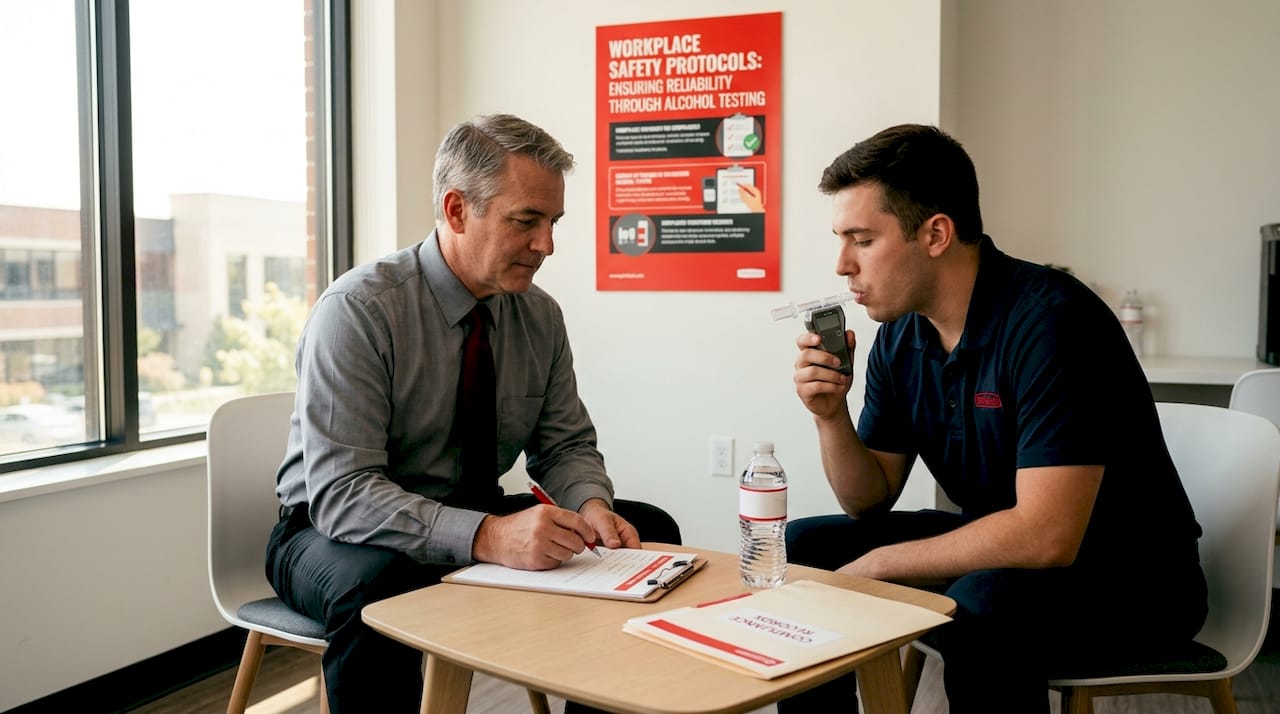
The federal DOT alcohol testing programs rely on evidential breath testing (EBT) device specifications, quality assurance plans, and conforming product lists to make results accurate and defensible. An EBT that does not appear on the National Highway Traffic Safety Administration (NHTSA) conforming product list cannot produce results that survive a legal challenge.
Here is a summary of the core regulatory requirements and what they mean for your program:
| Requirement | What it means in practice | Why it matters |
|---|---|---|
| Conforming product list (CPL) | Device must be NHTSA-approved | Non-approved devices cannot produce defensible results |
| Quality assurance plan (QAP) | Regular calibration and inspection schedule | Prevents drift in device accuracy over time |
| Trained breath alcohol technician (BAT) | Operator must complete DOT-approved training | Reduces procedural errors that invalidate results |
| Confirmatory test protocol | Positive screens confirmed with a second EBT test | Protects employees from false positives |
| Documentation requirements | Chain of custody forms and result records | Creates audit trail for HR and legal review |
Key program integrity steps to build into your policy:
- Select only devices on the current NHTSA conforming product list
- Schedule calibration checks at manufacturer-specified intervals
- Certify your breath alcohol technicians through an approved training program
- Maintain complete documentation for every test event, including result, time, device ID, and technician name
- Review your written compliance policy examples annually to reflect any regulatory updates
Pro Tip: One-off or ad-hoc screenings conducted outside documented protocols expose your organization to grievance claims and regulatory sanctions. Your drug testing safety program is only as defensible as its weakest procedural link.
Organizations that skip quality assurance steps often discover the problem at the worst possible time, during a post-accident investigation or an administrative hearing. Building the system correctly from the start is always cheaper than defending a flawed one later.
Speed, accuracy, and action: Operational advantages for HR
With regulatory context established, let’s evaluate why these operational advantages matter for HR and workforce decision makers.
Time is the defining variable in impairment management. An employee who tests positive at 8 a.m. cannot wait until a laboratory returns a result two or three days later before you remove them from a safety-sensitive position. That delay is not just operationally inefficient. It is potentially negligent.
Workplace breath testing is favored for employee health monitoring and impairment management because it gives near-immediate results, enabling prompt removal from safety-sensitive duties rather than waiting for slower lab processes. The FAA’s own advisory framework recognizes on-site immediacy as a functional advantage, not just a logistical nicety.
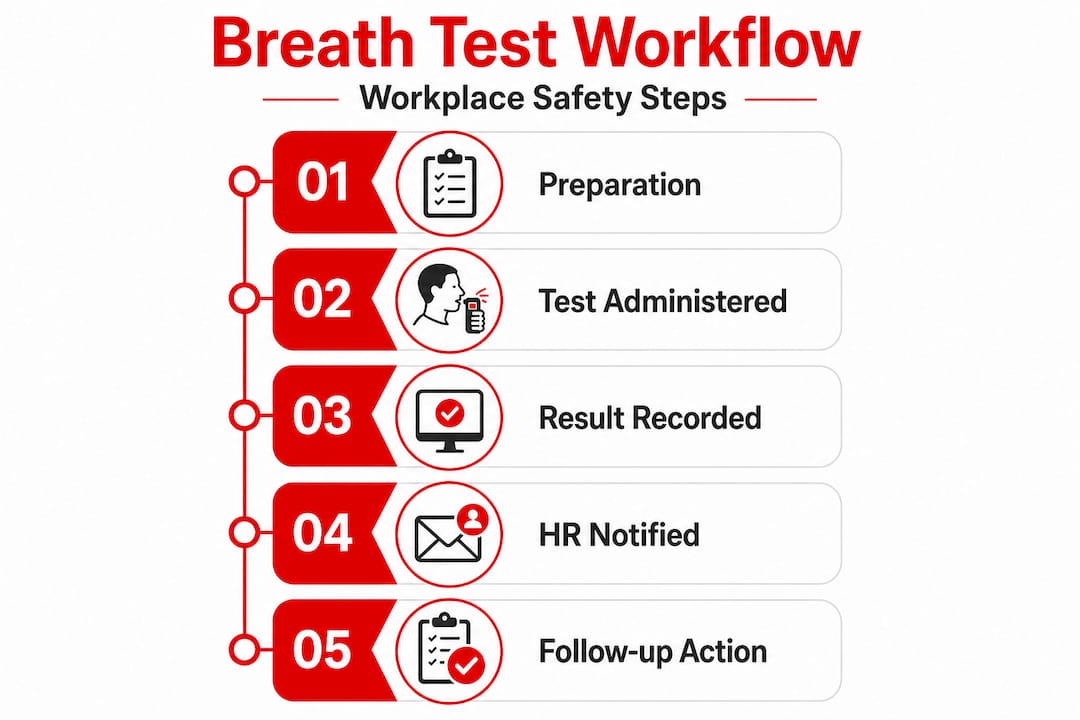
From an HR workflow perspective, the process looks like this when a breath test is triggered:
- Observation and documentation: The supervisor documents the basis for testing (post-incident, random selection, or reasonable suspicion observation).
- Initial screening test: The employee provides a breath sample; the device produces a BAC reading within minutes.
- Confirmation if initial is positive: A second confirmatory test on an EBT follows a mandatory 15-minute waiting period to rule out residual mouth alcohol.
- Immediate staffing action: A confirmed positive allows the employer to remove the employee from duty and initiate the organization’s substance abuse referral process.
- Documentation and follow-up: All results are recorded, chain of custody is completed, and a substance abuse professional (SAP) referral is made as required.
This structured workflow, built around the drug screening workflow, closes the loop between a safety observation and a documented HR action in a single shift rather than across several days.
Key operational advantages at a glance:
- Results available on-site in two to five minutes
- Confirmatory protocol reduces false-positive risk before any HR action is taken
- No specimen transport or laboratory wait time
- Devices are portable and can be deployed in remote or field locations
- Lower per-test cost compared to laboratory-based blood alcohol analysis
For organizations managing large workforces in transportation, construction, healthcare, or manufacturing, those advantages translate directly into lower administrative burden, faster incident response, and stronger documentation for risk management purposes.
Limits and best practices: What alcohol breath tests can and cannot do
Now that the operational strengths are clear, it’s important to recognize both the boundaries and optimal integration of breath testing in your organization’s approach.
Breath tests are not infallible. Understanding their limits is what separates a well-designed program from one that will eventually produce a contested result. Physiological factors matter here. Residual mouth alcohol from recent use of mouthwash, certain medications, or even burping before the test can temporarily elevate a reading. That is exactly why the DOT protocol requires a 15-minute observation period before both the initial and confirmatory tests.
Breath test results correlate closely with blood alcohol measurements, but physiological and procedural variables can shift results. Defensible workplace programs therefore rely on evidential devices plus required procedures rather than screening devices alone. Using a consumer-grade or non-EBT device and calling it a compliance test is a gap that experienced legal counsel will identify immediately.
Additional limitations to account for in program design:
- Breath tests detect only alcohol, not other impairing substances
- Equipment malfunction or calibration drift can affect results if maintenance schedules are ignored
- Operator error in the observation period or sample collection procedure can invalidate a result
- Employees may challenge results if documented protocols were not followed precisely
- Breath testing alone cannot assess the degree of functional impairment, only BAC level
Perhaps most importantly, the evidence on whether random alcohol testing prevents workplace injuries is more nuanced than most compliance-focused articles acknowledge. Random alcohol testing’s effectiveness in reducing workplace injuries has limited and very-low-quality evidence, which means breath tests should be viewed as one component of a broader safety management system, not a stand-alone injury prevention tool.
“A breath test tells you where someone’s BAC is at a specific moment. It does not tell you about the culture, supervision quality, workload, or fatigue that also contribute to workplace incidents. The test is a data point, not a safety program.”
Best practices for maximizing program effectiveness:
- Pair breath testing with supervisor training in impairment recognition
- Connect positive results to an employee assistance program (EAP) rather than only punitive action
- Use workplace testing examples from comparable organizations to benchmark your testing frequency and protocols
- Review incident data regularly to assess whether your testing program is catching the right moments
- Combine breath alcohol testing with broader substance awareness and fatigue management programs
The goal is a system where the test is one reliable data point within a larger, coherent safety architecture.
What most guides miss about breath alcohol testing in the workplace
Here is the perspective that rarely appears in compliance-focused literature: organizations that treat breath alcohol testing purely as a regulatory checkbox tend to get the minimum benefit from it. They test because they must, they document because they must, and they respond only when a test triggers a positive result. That approach satisfies a regulator. It does not build a safer workplace.
Progressive organizations use the breath testing program as a visible, consistent signal that safety is taken seriously at every level. When employees see that testing applies equally to supervisors and frontline staff, that protocols are clearly communicated rather than selectively enforced, and that positive results lead to support rather than only termination, the program becomes something different. It becomes a trust mechanism.
The comprehensive drug safety research consistently points to one uncomfortable truth: transparency reduces resistance and increases program effectiveness. Employees who understand why they are being tested, what the procedure involves, and what happens after a positive result are far less likely to challenge results or disengage from the safety culture entirely. The organizations with the most contentious testing environments are often those where protocols were rolled out without explanation or consultation with the workforce.
We have seen this pattern across industries. A testing program announced as “we’re watching you” generates grievances and distrust. The same program framed as “we are all accountable to the same standard because the work we do requires it” produces measurably different responses. The breath test itself is identical in both cases. The organizational outcome is not.
The most effective safety officers we work with do not ask “how many positives did we catch this quarter?” as their primary metric. They ask “how is our incident rate trending, and are our employees using the EAP?” Those are the indicators that a breath testing program is doing real safety work rather than just generating compliance documentation.
Find the right alcohol testing solutions for your workplace
Ready to enhance your workplace alcohol testing strategy? Here’s where to start. At Buy Test Cup, we supply the evidence-backed, quality-assured products that compliance programs require, from alcohol and drug test strips that meet workplace screening needs to complete urine specimen testing supplies for multi-panel programs. Our catalog is built for B2B buyers managing high-volume testing requirements, with bulk pricing and same-day shipping options. You can also review our drug testing program workflow resources to build or audit your current protocol against regulatory standards. Whether you are standing up a new program or tightening an existing one, we make it straightforward to get the right tools in place.
Frequently asked questions
How fast can alcohol breath tests give results for workplace decisions?
Most workplace breath alcohol tests provide on-site results within two to five minutes, allowing supervisors to make immediate staffing decisions without waiting for laboratory analysis.
What regulations require evidential breath alcohol testing in the workplace?
Federal DOT alcohol testing programs mandate evidential breath testing devices from the NHTSA conforming product list, along with quality assurance plans and certified breath alcohol technician training for covered industries.
Can random breath alcohol testing alone prevent all workplace injuries?
No. Random alcohol testing shows limited evidence of reducing workplace injuries on its own and should be integrated into a broader safety management system that includes supervisor training, EAP access, and fatigue management.
Are breath test results as accurate as blood alcohol tests?
Breath and blood alcohol results correlate closely, but physiological factors and procedural variables can affect breath readings, which is why defensible programs require evidential devices and strict adherence to observation period protocols.