


Blog
How Employee Safety Drives Effective Drug Screening


TL;DR:
- Evidence shows drug testing primarily deters use, with limited proof of directly reducing injuries.
- Effective programs balance safety, compliance, privacy, and foster a safety culture for meaningful impact.
- Practical design includes clear policies, supervisor training, employee support, and regular program review.
Most HR managers and safety officers assume that having a drug screening program automatically makes their workplace safer. The reality is more complicated. Cochrane reviews find very low evidence that random drug and alcohol testing actually prevents workplace injuries, with only one qualifying study in aviation alcohol testing. That gap between assumption and evidence is exactly why the design of your program matters far more than simply having one. Getting drug screening right means understanding what it can and cannot do for safety, and building policies that reflect that honest picture.
Key Takeaways
| Point | Details |
|---|---|
| Compliance isn’t enough | Genuine employee safety requires moving beyond regulations to thoughtful policy design. |
| Evidence is mixed | Research shows drug screening deters substance use but provides limited proof of injury reduction. |
| Best practices protect all | Supervisor training, verified results, and clear communication balance safety, privacy, and compliance. |
| Context matters | Legal, privacy, and cultural factors must shape your screening approach for maximum effectiveness. |
Why employee safety must drive drug screening policies
Drug screening exists for a reason: some jobs carry real physical risk when a worker is impaired. A forklift operator, a commercial driver, or a pipeline technician working under the influence creates danger not just for themselves but for everyone nearby. That is why drug screening for safety in safety-sensitive roles is not optional. It is a foundational responsibility.
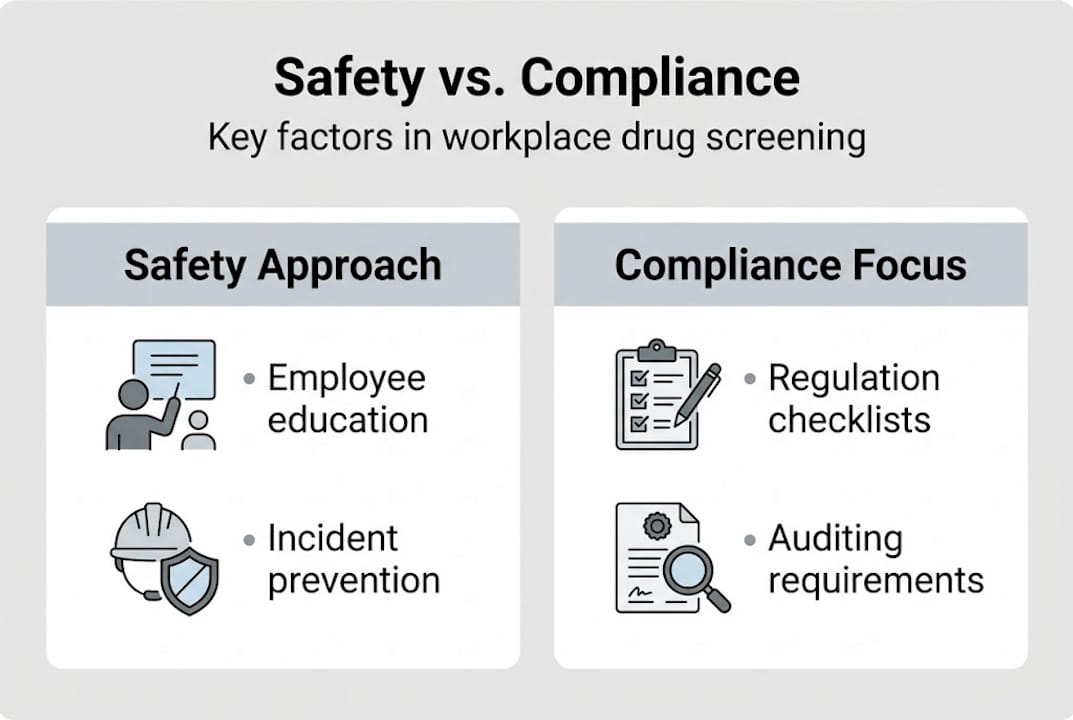
But there is a critical distinction that many organizations blur: compliance and safety outcomes are not the same thing. Compliance means meeting legal requirements. Safety outcomes mean actually reducing incidents, injuries, and harm. A program can check every regulatory box and still fail to move the needle on real-world safety.
Federal guidelines from SAMHSA, DOT, and HHS mandate specific testing panels for safety-sensitive federal positions, covering substances like THC, cocaine, opiates, amphetamines, PCP, and fentanyl. These agencies recognize that both safety and fair treatment must be protected simultaneously.
OSHA adds another layer of nuance. Post-incident testing is permitted, but only when there is reasonable cause to believe substance use contributed to the incident. Blanket post-incident testing, where everyone involved gets tested regardless of circumstances, can actually backfire by discouraging workers from reporting injuries at all.
Here are the core safety-sensitive categories where screening is most justified:
- Transportation roles: Drivers, pilots, rail operators
- Heavy equipment operators: Crane, forklift, and machinery workers
- Emergency responders: Police, firefighters, paramedics
- Healthcare providers: Anyone administering medications or performing procedures
- Energy and utilities: Workers in high-voltage, pipeline, or chemical environments
“A drug testing policy that prioritizes compliance over safety culture will produce paperwork. A policy that prioritizes safety culture will produce results.”
Pro Tip: Review your drug testing policy guide annually to ensure your program reflects current regulations and your organization’s actual risk profile, not just what was written three years ago.
The evidence: Does drug screening actually improve workplace safety?
This is where the conversation gets uncomfortable for many safety professionals. The honest answer is: it depends, and the evidence is thinner than most people expect.
Cochrane review findings show that higher random testing rates do correlate with lower positive test rates, meaning testing deters substance use. That is a real and meaningful effect. However, deterrence is not the same as injury prevention. Only one study met the quality threshold to assess whether random drug and alcohol testing actually prevents injuries, and it was limited to alcohol testing in aviation.
Here is a clear breakdown of what the evidence supports:
| Outcome | Evidence strength | Notes |
|---|---|---|
| Deterrence of substance use | Moderate | Higher testing rates lower positive results |
| Injury reduction (aviation, alcohol) | Low, limited | Only one qualifying study found |
| Long-term injury reduction (drivers) | Some support | Specific to commercial driving contexts |
| Injury reduction across industries | Very low | Insufficient research exists |
What does this mean for your program? It means you should not assume that testing frequency alone translates to a safer workplace. The mechanism matters. Testing deters use, and reduced use plausibly reduces impairment-related incidents. But the chain of causation is not as clean as regulators or vendors often suggest.
The strongest safety case for drug screening exists in:
- Commercial driving: Long-term data supports injury reduction in this sector
- Aviation alcohol testing: The one area with direct injury prevention evidence
- Pre-employment screening: Filters candidates who may pose elevated risk in safety-sensitive roles
Where evidence is weakest:
- General industry settings without clear impairment risk
- Post-incident testing applied as a blanket policy
- Programs that test but offer no intervention or support pathway
Pro Tip: Use your employee drug testing steps as a living document. Build in a review cycle that asks not just “are we testing?” but “is our testing strategy reducing actual risk in our specific environment?”
For random drug testing compliance, the goal should be a program that deters use and creates a genuine safety culture, not one that generates test volume without strategic intent.
Best practices: Creating safety-centered drug screening programs
Knowing the evidence gaps should motivate better program design, not abandonment of testing. Here is a practical framework for building a program that actually delivers on safety.
Step-by-step program framework:
- Define your safety-sensitive positions clearly. Not every role carries the same risk. Tailor testing requirements to actual job hazards.
- Write a policy that employees can understand. Vague policies create confusion and legal exposure. Be specific about when, why, and how testing occurs.
- Train supervisors to recognize impairment. Testing catches past use. Supervisors catch present impairment. Both matter.
- Use Medical Review Officer (MRO) verification. An MRO reviews positive results before any action is taken, protecting employees from false positives and protecting you from wrongful termination claims.
- Build a clear consequence and support pathway. What happens after a positive? Is there a return-to-duty process? An Employee Assistance Program (EAP) referral? Clarity here is essential.
- Audit your program annually. Regulations change. Your workforce changes. Your program should too.
Comprehensive programs with MRO verification and supervisor training are the standard for balancing safety, compliance, and legal protection against retaliation claims.
Here is how compliance-only programs compare to safety-focused ones:
| Feature | Compliance-only program | Safety-focused program |
|---|---|---|
| Goal | Meet regulatory requirements | Reduce actual incidents |
| Supervisor role | Minimal | Active impairment recognition training |
| MRO involvement | Sometimes | Always |
| Employee communication | Policy document | Ongoing education and transparency |
| Post-positive pathway | Termination | EAP referral, return-to-duty option |
| Program review cycle | Rarely | Annual or after incidents |
Pro Tip: Review your drug testing workflow tips to identify gaps between your written policy and what actually happens on the ground. The two are often further apart than HR realizes.
For drug testing best practices, the organizations that see the strongest safety outcomes treat their programs as living systems, not static documents.
Navigating privacy, legal, and culture challenges
Even a well-designed program can create serious problems if it ignores privacy rights, recent legal shifts, and the cultural dynamics of your workforce.

The legal landscape has shifted significantly. Cannabis legalization across many states has created a real tension: federal panels still test for THC, but a positive result may reflect off-duty use days or weeks before the test, not current impairment. Critics of blanket testing argue, with some merit, that current urine-based testing detects past use rather than present impairment, which raises legitimate fairness questions, especially post-cannabis legalization.
For drug testing safety compliance, here is what protects both your organization and your employees:
- Clearly communicate your testing policy before hiring. Employees who know the rules upfront are less likely to claim unfair treatment.
- Apply testing consistently. Selective testing based on personal bias is a fast track to discrimination claims.
- Understand your state’s cannabis laws. Some states prohibit adverse action based solely on off-duty cannabis use.
- Use MRO review for all positives. This step alone prevents a significant portion of wrongful termination exposure.
- Never use testing as retaliation. Ordering a test after an employee files a complaint is a legal liability, not a safety tool.
- Offer support, not just consequences. Programs with EAP referrals and return-to-duty options reduce legal risk and improve outcomes.
“Privacy is not the enemy of safety. Programs that respect employee rights consistently outperform those that treat testing as surveillance.”
Culture is the piece that most compliance-focused programs underestimate. If employees see testing as punitive rather than protective, they will find ways to work around it, hide symptoms, or avoid reporting near-misses. Your compliance drug testing guide should address not just the legal requirements but how you communicate the program’s purpose to your workforce.
A better path: Getting beyond check-box safety in drug screening
Here is the uncomfortable truth that most drug testing vendors will not tell you: a program built purely around regulatory compliance will not move your injury rates. We have seen organizations with rigorous testing schedules and spotless audit records still struggling with preventable incidents. Why? Because they treated testing as the finish line rather than one tool in a larger safety system.
The organizations that actually reduce harm are the ones that use a 7-step employee drug testing checklist as a starting point, not an endpoint. They layer in supervisor training, open-door reporting cultures, and genuine employee assistance resources. They ask hard questions: Are we testing the right people? Are we testing at the right times? Is our program deterring reporting of real safety concerns?
HR and safety leaders have an opportunity to champion something more ambitious than compliance. Build programs your workforce trusts. That trust is what converts a testing policy into an actual safety culture.
Bring robust safety and compliance to life with trusted screening solutions
Translating these best practices into daily operations starts with having reliable, compliant testing tools. Buy Test Cup supplies the drug test cups, multi-panel kits, oral swabs, and specimen collection devices that HR and safety teams rely on for accurate, defensible results. All products meet CLIA-waived standards, supporting both regulatory compliance and real-world program integrity. Whether you are running pre-employment screening, random testing, or post-incident protocols, you need tools that hold up under scrutiny. Ready to elevate your drug testing program with the right supplies and workflow support? Buy Test Cup has what your program needs.
Frequently asked questions
What substances are typically included in federal drug screening panels?
Federal panels from SAMHSA test for THC, cocaine, opiates, amphetamines, PCP, and increasingly fentanyl for safety-sensitive positions. The specific panel depends on the agency and position classification.
Does random drug testing truly reduce workplace injuries?
Cochrane evidence shows random testing deters substance use effectively, but direct evidence for injury reduction across most industries remains very limited. Commercial driving and aviation alcohol testing have the strongest support.
How can HR balance employee privacy with safety in drug screening?
MRO verification, supervisor training, and clearly written policies are the three pillars that let HR protect employee rights without compromising safety standards. Consistency in application matters just as much as the policy itself.
What are the risks of blanket post-incident testing?
OSHA guidance cautions that blanket post-incident testing can discourage workers from reporting injuries, creating a chilling effect that actually undermines safety reporting culture. Testing should be tied to reasonable cause, not automatic policy.