


Blog
Regulatory Compliance in Drug Testing: 2026 Guide


TL;DR:
- Regulatory compliance in drug testing is increasingly complex due to evolving federal and state laws, especially around marijuana.
- Employers must follow strict federal guidelines, maintain detailed documentation, and adapt policies to multi-jurisdictional requirements for legal defense.
Regulatory compliance in drug testing has never been more operationally demanding. Federal agencies updated oral fluid testing rules, states are reshaping marijuana workplace protections, and the assumption that a policy written three years ago still holds up is increasingly risky. Compliance officers now face a framework where federal mandates, state statutes, and evolving testing technologies pull in different directions simultaneously. This guide cuts through that complexity with a current, practical breakdown of the legal requirements, compliance standards, and operational best practices your program needs to stay defensible in 2026.
Federal regulatory compliance in drug testing
The federal framework for workplace drug testing runs through two primary authorities: the Department of Health and Human Services (HHS) and the Department of Transportation (DOT). Understanding where each applies is non-negotiable for any compliance officer managing a regulated workforce.
HHS sets the Mandatory Guidelines for Federal Workplace Drug Testing Programs, which define authorized analyte panels, specimen cutoff concentrations, and result reporting nomenclature. A critical update for 2026: existing panels and nomenclature effective since July 7, 2025, remain unchanged, with HHS confirming no revisions as of March 13, 2026. That stability sounds reassuring, but it comes with a catch. The HHS framework explicitly requires annual review, meaning the absence of a change this cycle does not excuse your team from monitoring the next publication cycle.
Key federal requirements your program must address:
- Authorized analyte panels: Results must use the exact analyte names and cutoff values specified by HHS. Deviating from this nomenclature, even inadvertently, creates documentation deficiencies that can undermine adverse employment actions.
- Chain-of-custody procedures: Every specimen must follow a documented chain of custody from collection through laboratory analysis. Gaps in this record are among the most common reasons positive results get successfully challenged.
- Confirmatory testing mandate: A presumptive positive from an immunoassay screen is not actionable on its own. Confirmatory testing via gas chromatography/mass spectrometry or equivalent methods is required before any employment decision can be defended.
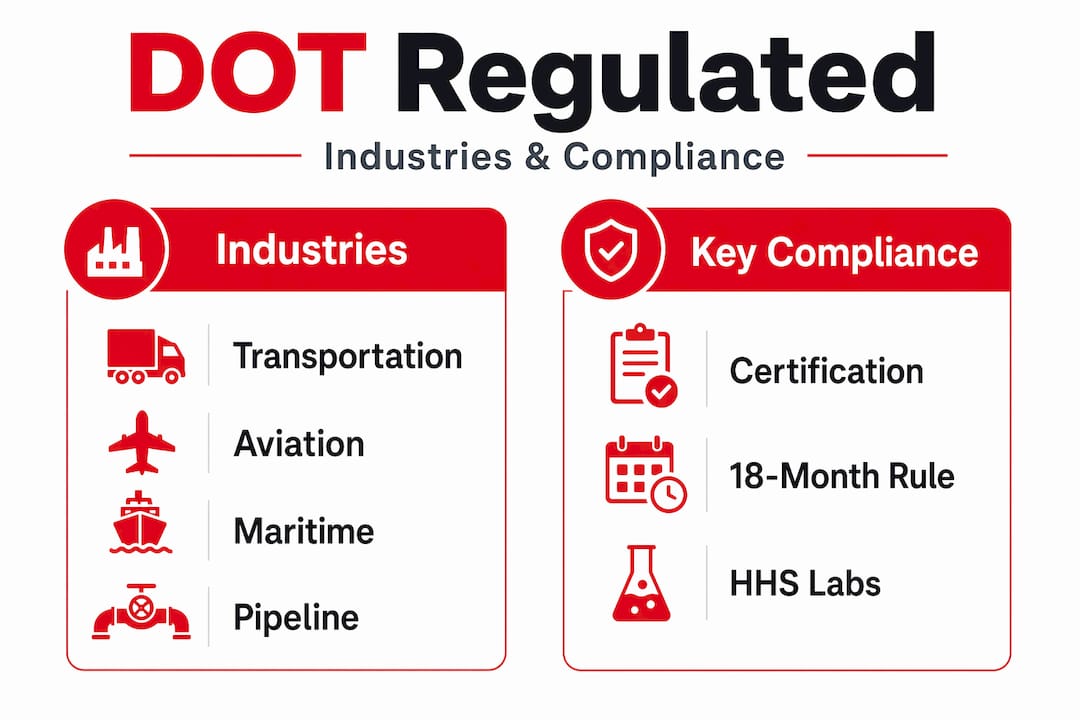
- DOT oral fluid testing transition: DOT published a final rule effective June 10, 2026, requiring oral fluid testing availability only when two certified labs and devices are present, with an 18-month grace period triggered once the second HHS-certified oral fluid lab is announced.
Pro Tip: Track the HHS certification announcements page directly. The 18-month DOT grace period clock starts on the announcement date, not the date you discover it. Missing that trigger date could put your oral fluid testing transition out of compliance before you realize it.
DOT-regulated industries include transportation, aviation, maritime, and pipeline sectors, among others. If your workforce includes safety-sensitive roles under any of these sectors, DOT rules govern specimen type, collection procedures, laboratory selection, and Medical Review Officer involvement. That is a separate compliance layer from general HHS guidelines, and conflating the two is a common and costly mistake.
State drug testing laws and multi-jurisdictional complexity
Federal rules set the floor, but state laws often build an entirely different structure on top of it. For compliance officers managing employees across multiple states, the variation is not minor. It touches pre-employment testing authorization, random testing frequency, post-accident testing windows, and increasingly, medical and recreational marijuana protections.

Consider the contrast between jurisdictions:
| State Category | Pre-Employment Testing | Random Testing | Marijuana Protections |
|---|---|---|---|
| Permissive states (e.g., CA, NY) | Allowed with restrictions | Limited or prohibited | Strong off-duty use protections |
| Neutral states (e.g., TX, FL) | Generally allowed | Employer discretion | Minimal protections |
| Zero-tolerance states (e.g., OK for safety roles) | Required for safety roles | Mandated in some sectors | Limited; safety exemptions apply |
Oklahoma provides a sharp illustration of how state law can actually tighten requirements beyond federal minimums. Oklahoma now mandates zero tolerance standards for safety-sensitive positions and limits employer discretion in how those roles are defined, with amendments taking effect in May and November 2026. An employer cannot simply self-designate every role as safety-sensitive to avoid marijuana accommodation obligations. The definition is now legally constrained.
Marijuana legalization across states has introduced a particularly sharp compliance challenge. An employee may be legally using cannabis in their state of residence, but your federal contract requires a drug-free workplace. Or your policy prohibits positive marijuana tests, but state law restricts adverse actions for off-duty use. Changing federal status of marijuana combined with state protections creates real employer liability if disciplinary policies are not carefully constructed and current.
Pro Tip: Maintain a jurisdiction matrix for every state where you have employees. One column for what is permitted, one for what is required, and one for current legal status of marijuana protections. Review it every quarter. The cost of a legal challenge far exceeds the time investment.
The risk of getting state law wrong is not hypothetical. Civil litigation from wrongful termination claims, discrimination allegations based on disability status related to substance use treatment, and failure to accommodate medical marijuana users all represent documented legal exposure. Consult legal counsel with multi-state employment law expertise, and build that consultation into your annual compliance review process.
Best practices for implementing a compliant testing program
Good intentions and a solid policy document are not enough. The gap between a written policy and a legally defensible program lives in the operational details: how supervisors are trained, how collections are conducted, and how documentation is maintained.
Here is a practical sequence for building a program that holds up under scrutiny:
- Differentiate presumptive from confirmatory testing. Every positive initial screen must be confirmed by a certified laboratory using a secondary method before it triggers any employment action. This is not optional under federal law, and failure at this step has resulted in successful legal challenges against employers.
- Train supervisors on reasonable suspicion standards. Reasonable suspicion testing is not based on gut instinct. Supervisors must document objective facts, such as observed behavioral changes, slurred speech, or the smell of alcohol, contemporaneously. Vague or after-the-fact documentation is a liability.
- Build a collection protocol that protects chain of custody. Collectors must be trained, collection sites must meet applicable standards, and specimen handling procedures must be followed exactly. A single procedural deviation can invalidate an otherwise valid positive result.
- Prepare your oral fluid transition plan now. With DOT’s 18-month grace period tied to infrastructure availability, compliance officers should identify certified oral fluid testing vendors and draft transition protocols before the clock starts. Waiting until the announcement creates an operational scramble.
- Create a stigma-conscious testing environment. Testing environments that feel punitive drive non-cooperation and damage the program’s credibility. Nonjudgmental testing environments improve cooperation without compromising reporting standards. Separate testing administration from disciplinary processes where possible.
- Schedule formal policy reviews at least annually. Regulations change. State laws shift. Court decisions create new precedents. The drug testing industry requires continuous legal and procedural monitoring, particularly on cannabis policies.
Pro Tip: Pair each policy review with a direct conversation with your HHS-certified laboratory’s compliance contact. Labs see regulatory signals early. That relationship is one of your best early-warning systems.
Selecting testing methods and compliant supplies
The specimen type and testing technology you choose carry regulatory weight. Not all methods are accepted across all contexts, and using an uncertified device or a non-authorized specimen type can compromise your entire program.
| Specimen Type | Regulatory Status (2026) | Key Advantages | Limitations |
|---|---|---|---|
| Urine | Fully accepted under HHS and DOT | Long detection window; well-established protocols | Privacy concerns; adulteration risk |
| Oral fluid | Conditionally accepted under DOT (awaiting lab infrastructure) | Observed collection; shorter window suits recent use detection | Fewer certified labs; transition not yet fully active |
When selecting drug testing methods, compliance officers should prioritize the following criteria:
- Federal or state mandate alignment: Your specimen type and panel must match what the applicable regulation requires. A DOT-regulated employer cannot substitute an unapproved method because it is cheaper or more convenient.
- Laboratory certification: Use only HHS-certified labs for federal testing programs. Confirm certification status before signing contracts, and verify annually. A lab’s certification can lapse.
- Device authorization: Testing cups, strips, and collection kits used in federally mandated programs should carry CLIA waiver status and meet HHS device authorization criteria where applicable.
- Documentation and lot traceability: Maintain records of testing device lot numbers, expiration dates, and storage conditions. This documentation supports defensibility if a result is challenged.
Oral fluid testing offers one significant operational advantage worth noting: the collection is directly observed, which eliminates the specimen adulteration and substitution risks inherent in unsupervised urine collection. As the DOT oral fluid infrastructure matures through 2026 and into 2027, compliance officers should monitor regulatory standards in testing for guidance on approved devices and certified collector requirements.
Legal risks and compliance pitfalls to avoid
Documentation failures and procedural shortcuts are where compliant programs come apart. These are the most common vulnerabilities compliance officers should address before they become litigation:
- Skipping confirmatory testing. Relying on a preliminary positive to remove someone from a safety-sensitive role without a confirmed laboratory result exposes your organization to wrongful termination claims. The legal standard is clear.
- Poorly documented reasonable suspicion. Supervisor observations must be specific, behavioral, and recorded at the time of the incident. “He seemed off” does not survive legal scrutiny. “At 2:15 PM, the employee exhibited slurred speech and unsteady gait during a safety briefing” does.
- Ignoring the off-duty use distinction. Particularly with marijuana, disciplinary actions not aligned with evolving laws create serious liability. A positive test result does not automatically prove current impairment or on-duty use.
- Outdated policies. A policy that references superseded federal panels or does not reflect current state marijuana protections is a compliance liability, regardless of how well your team follows it.
- Chain-of-custody gaps. Any break in the documented chain of custody for a specimen weakens the legal defensibility of the result. Train collectors, review your collection site procedures, and audit your documentation process at least once per year.
Managing accommodations also belongs in this category. Employees in recovery or with documented substance use disorders may have disability accommodation rights under the ADA or state equivalents. Your policy must address these situations explicitly, and your supervisors need to know when to escalate to HR or legal rather than act unilaterally.
My take on where compliance officers actually lose ground
I’ve reviewed enough drug testing program failures to see a consistent pattern. It is almost never about ignorance of the law. It’s about the gap between what the policy document says and what actually happens on the floor.
Supervisors are the most vulnerable point in any program. They get trained once, the training is forgotten within six months, and the next time they need to document reasonable suspicion, they improvise. That improvisation is where litigation is born. In my experience, quarterly refreshers, even brief ones, and a one-page reasonable suspicion documentation template dramatically reduce that risk. It is the single highest-leverage investment in compliance I’ve seen organizations make.
The other thing I would push back on is the instinct to treat regulatory compliance as a legal and HR function only. Your relationship with your testing laboratory is a compliance asset. Labs see guidance documents before they are finalized, they work directly with certification bodies, and the good ones will flag changes proactively. Building that relationship costs nothing but a quarterly phone call.
Finally, the shift toward oral fluid testing is coming faster than most compliance teams are prepared for. The DOT grace period creates a false sense of runway. Start your transition planning now, not after the second certified lab announcement drops.
— matthew
How Buytestcup supports your compliance program
When your program needs to meet federal and state compliance standards for drug testing, the supplies you use matter as much as the policies you write. Buytestcup carries a comprehensive selection of CLIA-waived drug test cups, dip strips, oral swabs, and specimen collection kits designed to meet the regulatory standards your program depends on. Whether you are outfitting a DOT-regulated transportation fleet or managing workplace testing for a multi-site organization, the catalog covers multi-panel configurations that align with current HHS-authorized testing panels. Explore the full range of federally compliant test cups and bulk pricing options that make program-wide implementation practical without compromising on quality or documentation standards.
FAQ
What are the current federal drug testing panel requirements for 2026?
The HHS-authorized testing panels and analyte nomenclature effective since July 7, 2025, remain unchanged as of March 2026, requiring specific analyte names and cutoff values for all federally mandated test reporting.
When does DOT’s oral fluid testing rule take effect?
DOT’s final rule became effective June 10, 2026, but oral fluid testing is only required once two HHS-certified labs, collectors, and devices are available. An 18-month grace period begins upon the official announcement of the second certified oral fluid lab.
Can an employer take adverse action based on a positive drug screen alone?
No. Federal compliance standards for drug testing require confirmatory laboratory testing before any employment decision can be made on a positive result. Presumptive positives from initial screens are not sufficient on their own.
How should supervisors document reasonable suspicion for drug testing?
Supervisors must record specific, objective behavioral observations at the time of the incident. Contemporaneous written documentation is legally required to support a reasonable suspicion determination and defend against discrimination claims.
Do state marijuana laws override federal drug testing requirements?
No. Federal drug testing mandates, particularly for DOT-regulated roles, apply regardless of state marijuana laws. However, state protections for off-duty marijuana use may restrict disciplinary actions in non-federally mandated contexts, requiring careful policy separation.