

Blog
Drug Testing Trends in 2026: What Employers Must Know


TL;DR:
- In 2026, urine-based collections remain the legal standard for federally regulated drug testing due to the absence of certified oral fluid laboratories. Employers must verify lab certification monthly, adhere to stable testing panels, and prepare contingency plans for transitioning to oral fluid testing within the regulatory timeframe. Technological advances like multiplex panels and microneedle skin patches signal future innovations, but current compliance depends on infrastructure and rigorous verification practices.
Drug testing trends in 2026 are defined by a regulatory environment that keeps urine-based collections firmly in place, even as oral fluid and non-invasive technologies gain commercial momentum. The gap between what federal policy authorizes and what certified laboratory infrastructure can actually deliver shapes every compliance decision employers and policy makers face this year. Understanding that gap is not optional. It determines which specimen types you can legally use, which labs you can contract with, and how your Medical Review Officers document results. This guide covers the federal updates, lab certification realities, emerging screening technologies, and practical program design that matter most right now.
What drug testing trends in 2026 mean for federal compliance
Federal workplace drug testing in 2026 is governed by two realities that pull in opposite directions. Policy authorizes oral fluid testing. Infrastructure does not yet support it. That tension defines every compliance decision at the federal level this year.
The Department of Transportation amended 49 CFR Part 40 to require directly observed urine collections when oral fluid testing is not feasible, effective June 10, 2026. The rule also established an 18-month grace period for employers transitioning toward oral fluid collection protocols. That grace period matters, but it does not solve the underlying problem.
The underlying problem is certification. No HHS-certified oral-fluid laboratories are currently available for the required drug and specimen validity testing. DOT-regulated employers need two HHS-certified oral fluid labs to operate a compliant program. With zero available, oral fluid testing remains legally authorized but operationally impossible in federally regulated contexts. Urine collections are not a fallback. They are the only viable option right now.
Key regulatory facts every compliance officer should have on file:
- The DOT Part 40 amendment took effect June 10, 2026, requiring directly observed urine collection when oral fluid is not feasible.
- The 18-month grace period applies to oral fluid implementation timelines, not to existing urine collection requirements.
- Panel and nomenclature stability was confirmed with no revisions to urine or oral fluid drug testing panels effective July 7, 2025.
- Federal Register Volume 91 Issue 63 (April 2, 2026) reaffirms the absence of certified oral fluid labs for validity testing.
Pro Tip: Review the Federal Register notices from March, April, and May 2026 as a set. Each one addresses a different layer of the same compliance picture: panel stability, lab certification gaps, and the DOT amendment. Reading them together prevents the common mistake of treating any single notice as the full story.
The practical implication is straightforward. Federal testing emphasizes regulatory feasibility over employer preference. Your program must reflect what is executable today, not what the market is moving toward.
How lab certification and panel stability affect accuracy and litigation risk
Certified laboratory status is not a formality. It is the legal foundation of every test result your organization relies on. SAMHSA updates its certified laboratory roster monthly, and the May 2026 list reflects the current state of both urine and oral fluid certification. Cross-checking that list before contracting with any lab is a non-negotiable step.
Here is why panel stability matters as much as lab certification. Medical Review Officers and laboratory information systems are built around the standardized cutoff values and nomenclature published in the Federal Register. When those values shift, every downstream system needs recalibration. The March 2026 confirmation of no panel revisions for urine and oral fluid testing means your MRO reporting systems, chain-of-custody forms, and result interpretation protocols remain valid without modification. That consistency reduces litigation exposure and supports defensible documentation.
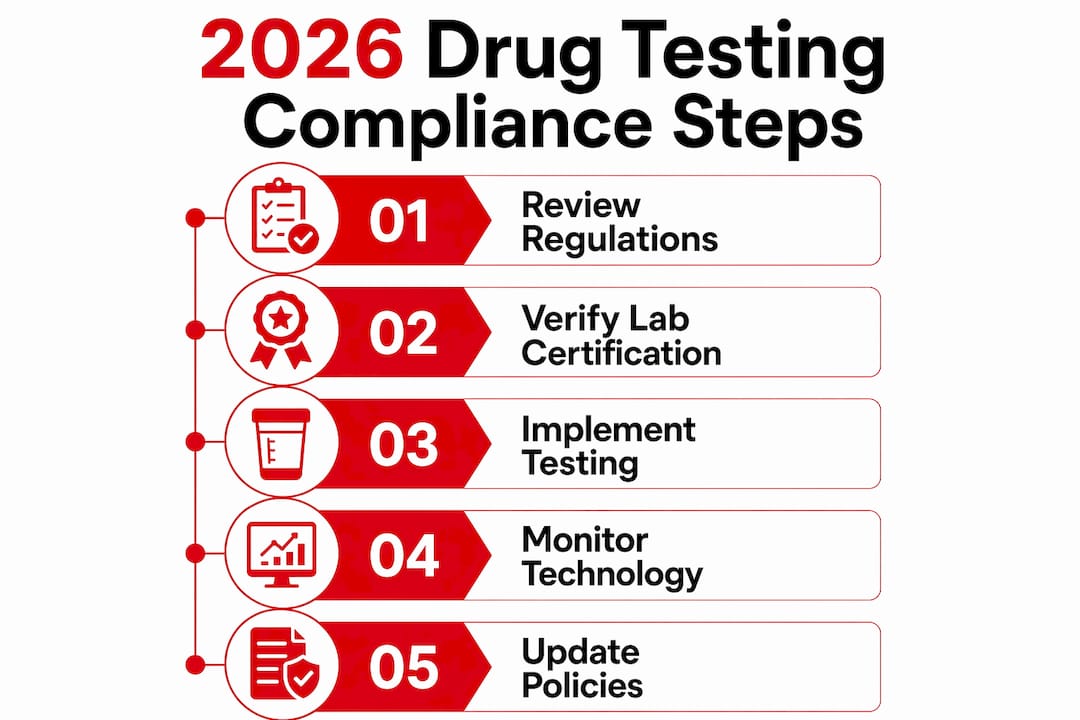
Follow these steps to maintain certification-aligned compliance in 2026:
- Pull the SAMHSA certified lab list every month. Labs can lose certification between your annual contract reviews.
- Confirm your contracted lab appears on the current list before submitting any specimen for federally regulated testing.
- Verify that your chain-of-custody documentation uses the current Federal Register nomenclature, not legacy panel names from prior years.
- Brief your MRO on the March 2026 panel stability notice so result interpretation stays consistent across facilities.
- Document your lab verification process. If a result is challenged in court or arbitration, showing a dated record of your certification check is a concrete defense.
A common misconception worth addressing directly: many HR and safety professionals assume oral fluid testing is operationally interchangeable with urine testing and plan to switch specimen types as soon as their state authorizes it. That assumption is wrong in federally regulated contexts. Authorization does not guarantee lab availability or collection protocol readiness. Build contingency plans around urine collections, not around oral fluid timelines you cannot control.
Pro Tip: Ask your lab account manager for written confirmation of their current HHS certification status every quarter. A verbal assurance is not documentation. A dated email or certificate copy is.
For a deeper look at how these standards interact with workplace safety programs, the 2026 compliance guide from Buytestcup covers the federal rule changes and their practical implications for compliance professionals.
What technological innovations are reshaping drug screening in 2026?
The commercial drug testing market is moving faster than federal certification infrastructure. The drug testing market is projected to grow from $15.65 billion in 2026 to $23.45 billion by 2034, at a compound annual growth rate of 5.18%. That growth is driven primarily by saliva-based and multiplex testing technologies, not by urine collection improvements. The market is telling you where the industry is heading, even if federal compliance requirements have not caught up yet.
| Technology | Current status | Primary application | Timeline to federal use |
|---|---|---|---|
| Oral fluid testing | Authorized, no certified labs | Non-DOT workplace programs | Post-certification (unknown) |
| Urine immunoassay | Fully certified, default method | All federally regulated testing | Active now |
| Microneedle skin patches | Research phase | Biomarker detection studies | 5+ years |
| Multiplex saliva panels | Commercial adoption growing | Non-regulated employer programs | 2 to 4 years |
The most forward-looking development in drug screening technology is microneedle-based skin sampling. A 2026 biomedical study published in Science Translational Medicine sampled 21 participants and demonstrated clinical biomarker identification from interstitial fluid using microneedle patches. The findings show that interstitial fluid contains biomarkers distinct from plasma, which opens the door to continuous, non-invasive monitoring that would be impossible with urine or saliva collection. This is not a near-term compliance tool. It is a signal of where drug screening technology is heading over the next decade.
For employers running non-DOT programs, oral fluid and rapid multiplex testing are already practical options. These programs are not subject to the HHS certification requirement that blocks oral fluid use in federally regulated testing. A safety-sensitive employer in a non-regulated industry can deploy saliva-based panels today, provided state law permits it and the testing vendor meets the organization’s internal quality standards. The comparison of urine and oral fluid specimen methods is a useful reference for employers evaluating which approach fits their specific program structure.
How employers and policy makers can build effective programs aligned with 2026 realities
Translating regulatory updates and technology trends into a functioning drug testing program requires decisions at three levels: specimen type selection, laboratory contracting, and technology adoption timing. Getting all three right simultaneously is where most programs fall short.
On specimen type selection, the decision tree is simpler than it appears. If your program is federally regulated under DOT or HHS rules, you use urine. If your program is non-federally regulated, you have more flexibility, but you still need to verify state law and confirm your testing vendor’s quality controls. Do not let the commercial availability of oral fluid kits lead you to assume federal authorization exists where it does not.
Practical steps for building a compliant 2026 program:
- Audit your current specimen type against your regulatory category. DOT-regulated employers must use urine for directly observed collections under the June 2026 amendment.
- Contract only with labs on the current SAMHSA certified list. Verify monthly, not annually.
- Build a contingency protocol for the 18-month oral fluid grace period. Document what triggers a switch and what lab infrastructure must be in place before you make it.
- Monitor the Federal Register for oral fluid lab certifications. The first HHS-certified oral fluid lab will change the compliance picture significantly for DOT programs.
- For non-regulated programs, evaluate rapid oral fluid panels against your hiring speed requirements. Rapid tests reduce turnaround time but require clear documentation of confirmation testing protocols.
- Train HR and safety staff on the difference between regulatory authorization and operational feasibility. This single knowledge gap causes more compliance errors than any other factor.
Policy makers designing or revising workplace drug testing legislation should account for the infrastructure lag between authorization and implementation. Writing oral fluid testing mandates into law without corresponding lab certification requirements creates compliance confusion at the employer level. The workplace drug testing policy examples resource from Buytestcup provides concrete policy language aligned with 2026 federal standards.
What I’ve learned about the gap between policy and practice in drug testing
After years of watching employers navigate federal drug testing requirements, the pattern I see most often is this: organizations treat regulatory authorization as operational permission. They read that oral fluid testing is authorized, assume their current vendor can handle it, and build a program around a method that has no certified lab support. That is not a compliance strategy. It is a liability.
The 2026 regulatory picture is actually cleaner than it looks. Urine collections are the default. Panel nomenclature is stable. The SAMHSA lab list is updated monthly and publicly available. The rules are not ambiguous. What creates confusion is the gap between what the market is selling and what federal compliance actually requires. Vendors promoting oral fluid kits are not wrong about the technology. They are wrong about the regulatory context for federally regulated employers.
My honest recommendation: treat the 18-month grace period as a planning window, not a permission slip. Use it to evaluate lab certification developments, update your contingency protocols, and train your MROs on what a certified oral fluid result will look like when labs eventually come online. Do not use it to justify deploying oral fluid testing in a DOT program before the infrastructure exists. The best practices for drug testing compliance are not complicated. They require discipline, not innovation.
— matthew
How Buytestcup supports compliant drug testing programs in 2026
Buytestcup supplies the testing products that keep workplace drug screening programs running accurately and on schedule. The catalog includes urine drug test cups designed for directly observed collections, multi-panel configurations that align with current Federal Register panel standards, and testing strips for rapid screening needs. Every product category is built around the compliance requirements that govern federally regulated and non-regulated programs alike. Government agencies, clinics, and employers ordering in bulk benefit from same-day shipping and volume pricing. If you are building or auditing a drug testing program for 2026, the 8-panel urine test cup is a reliable starting point for directly observed urine collections that meet current DOT and HHS standards.
FAQ
What is the default specimen type for federally regulated drug testing in 2026?
Urine is the default specimen type for all federally regulated drug testing in 2026. No HHS-certified oral fluid laboratories are currently available, making urine-based directly observed collections the only compliant option under DOT and HHS rules.
Can employers use oral fluid testing for workplace drug programs in 2026?
Employers running non-federally regulated programs can use oral fluid testing where state law permits. DOT-regulated employers cannot use oral fluid testing in 2026 because no HHS-certified oral fluid labs exist to process the required drug and specimen validity testing.
Were drug testing panels changed for 2026?
No. The Federal Register confirmed in March 2026 that there were no revisions to urine or oral fluid drug testing panels, with nomenclature remaining stable from the July 7, 2025 effective date. This stability supports consistent MRO reporting and reduces litigation risk.
How often should employers verify their lab’s HHS certification?
Employers should verify their laboratory’s certification against the SAMHSA certified lab list every month. SAMHSA updates the list monthly, and a lab can lose certification between annual contract reviews.
What does the DOT Part 40 amendment effective June 10, 2026 require?
The amendment requires directly observed urine collection when oral fluid testing is not feasible, and it establishes an 18-month grace period for transitioning to oral fluid collections once certified lab infrastructure becomes available.