


Blog
Why Compliance in Drug Testing Matters in 2026


TL;DR:
- Drug testing compliance is a strict legal requirement vital for program validity and legal defensibility. It involves adherence to complex federal, state, and industry-specific regulations, particularly regarding specimen collection and confirmatory testing procedures. Proactive, documented program management minimizes legal risks and ensures reliable, fair workplace drug testing practices.
Drug testing compliance is not a formality. It is a legally binding, operationally complex requirement that determines whether your program holds up in court, satisfies federal regulators, and protects both your organization and the employees you screen. Understanding why compliance in drug testing is non-negotiable has never been more pressing, particularly as federal drug testing standards shift in 2026 with new oral fluid rules, evolving cannabis policy, and stricter documentation expectations from regulators across every safety-sensitive sector.
Why compliance in drug testing is a legal and regulatory requirement
Drug testing operates inside one of the most densely regulated compliance environments in American employment law. For professionals managing programs in transportation, healthcare, federal contracting, or any DOT-covered industry, understanding the current regulatory framework is not optional. It is the foundation on which every test, every result, and every employment decision rests.
The backbone of federal workplace drug testing is 49 CFR Part 40, the DOT rule that governs procedures for transportation employers. In 2026, a significant amendment to this rule now permits oral fluid testing as an alternative to urine collection. However, the transition is controlled. The DOT’s 2026 final rule establishes an 18-month grace period that begins only after the announcement of a second HHS-certified oral fluid laboratory, allowing employers to continue using directly observed urine collections in the interim. This is not a loophole. It is a structured transition that requires proactive monitoring from compliance officers.
Cannabis policy adds another layer of complexity. Despite federal rescheduling discussions, marijuana remains prohibited under all DOT regulations without exception. A Medical Review Officer cannot reclassify a positive cannabis result as negative based on a state-issued medical marijuana card. DOT’s zero-tolerance position means that marijuana accounts for roughly 60% of positive drug test results among commercial drivers in 2026. The gap between state law and federal enforcement creates a compliance minefield for employers who assume that legalization in their state provides any protection.
Key regulatory obligations compliance teams must track include:
- 49 CFR Part 40 amendments and oral fluid implementation timelines
- State law interactions with federal mandates, particularly for cannabis
- CLIA waiver requirements for on-site testing devices used in clinical or workplace settings
- HHS Mandatory Guidelines for federal workplace drug testing programs
- Return-to-duty protocols following a positive result, including SAP referral and follow-up testing
Pro Tip: Set a calendar alert to monitor HHS lab certification announcements. The oral fluid grace period clock does not start at rule publication. It starts at the second lab certification notice. Missing that date means your urine-only program could fall out of compliance without warning.
How compliance affects test accuracy and legal defensibility
Here is the part most organizations underestimate. You can use a perfectly calibrated, CLIA-waived test cup and still lose a wrongful termination lawsuit. Why? Because the role of compliance in drug testing is not just about whether the test works. It is about whether the entire process is airtight from collection to final result.
Immunoassay screening, the method used in most rapid test cups, carries an accuracy range of 85% to 95%. That margin is acceptable for initial screening but not for employment action. Confirmatory laboratory testing using GC-MS or LC-MS/MS delivers accuracy approaching 99.9%, which is why federal programs require it before any adverse action can be taken.
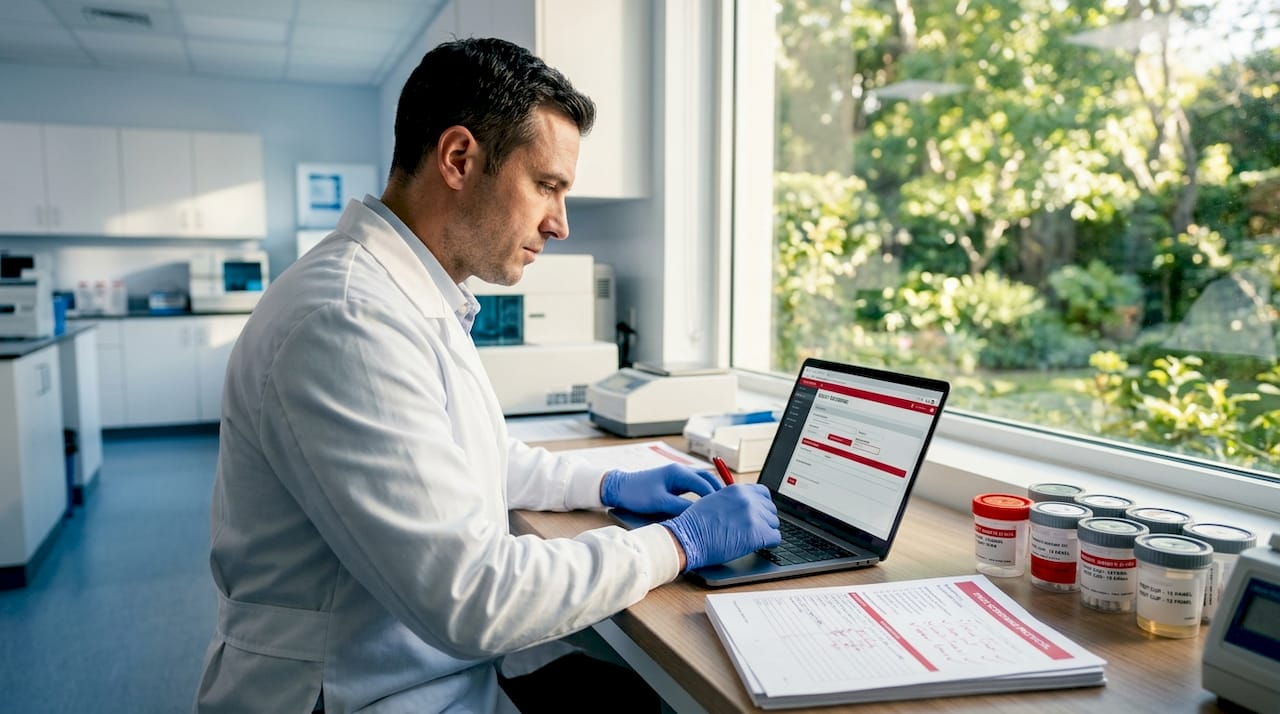
The Medical Review Officer is where legal defensibility lives. Employers that act on lab results before MRO verification expose themselves to wrongful termination claims. The MRO reviews the confirmed positive, contacts the donor to check for legitimate medical explanations, and only then certifies the result. Skipping or abbreviating this step because it feels slow is one of the most expensive mistakes a compliance program can make.
Chain of custody is equally unforgiving. A single missing signature on a chain-of-custody form, even when the test result is clinically accurate, can render a result legally indefensible. Auditors and attorneys look for these gaps first. The test result is almost secondary to the paper trail surrounding it.
Common compliance failures that undermine otherwise sound programs:
- Incomplete or unsigned chain-of-custody documentation
- Acting on positive screens before MRO sign-off
- Failure to document employee notification and acknowledgment
- Using non-certified laboratories for confirmatory testing
- Incorrect specimen handling or temperature verification at collection
Comparing drug testing methods under compliance standards
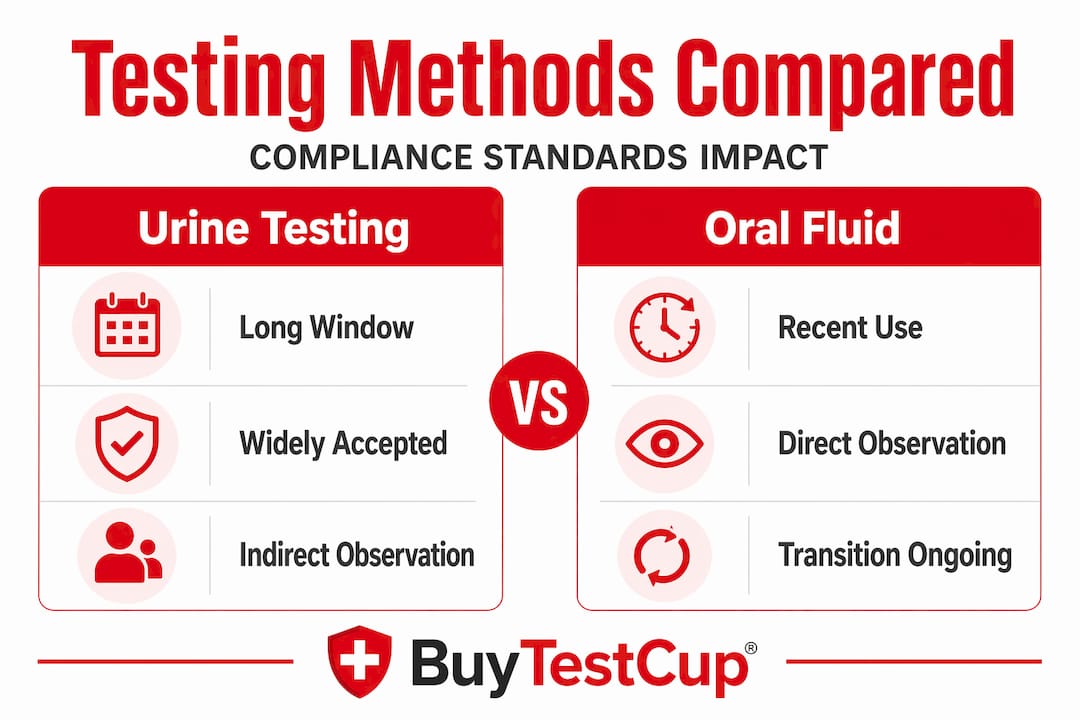
Choosing a testing method is not simply a matter of speed or cost. Compliance requirements shape which methods are legally acceptable in different contexts, and the wrong choice can invalidate your entire program. The table below compares the primary testing methods used in compliant workplace programs.
| Testing method | Specimen type | Detection window | Compliance use case | Key limitation |
|---|---|---|---|---|
| Immunoassay rapid test | Urine | 1 to 5 days | Pre-employment, reasonable suspicion | Requires confirmatory follow-up |
| GC-MS/LC-MS/MS lab test | Urine | 1 to 30 days (substance dependent) | DOT required confirmation | Slower turnaround |
| Oral fluid (saliva) | Oral fluid | 24 to 48 hours | DOT-authorized, recent-use detection | Limited certified labs in 2026 |
| Hair follicle testing | Hair | Up to 90 days | Non-DOT programs | Not accepted under federal DOT rules |
| Breath alcohol testing | Breath | 1 to 12 hours | DOT alcohol testing | Narrow detection window |
The DOT’s shift toward oral fluid testing reflects a compliance-driven demand for recent-use detection and direct-observation integrity. Urine collection carries privacy challenges, and supervised collection can create legal exposure without proper protocols. Oral fluid testing addresses some of these concerns but introduces its own compliance complexity, particularly the requirement to use only HHS-certified laboratories once the grace period ends.
Hair follicle testing offers the longest detection window but remains outside federal DOT program acceptance, making it suitable only for non-regulated employer programs. HR professionals who assume they can substitute hair testing for urine in a DOT-covered role are creating a compliance gap that could result in program decertification.
Pro Tip: If you manage a multi-modal transportation fleet covered by DOT, document your oral fluid transition plan now. Regulators want to see that you have assessed your laboratory options, identified certified providers, and mapped your timeline before the grace period closes.
Building a compliant drug testing program that holds up
The importance of drug testing compliance becomes most visible when a program is audited or challenged in court. Proactive program design is the only reliable defense. Compliance programs that incorporate ongoing risk assessments and documented continuous improvements face significantly lower regulatory penalties than static programs that rely on outdated policies.
A structured approach to program development follows this sequence:
- Draft a written drug and alcohol policy that specifies which positions are covered, which substances are tested, and under what circumstances testing occurs (pre-employment, random, post-accident, reasonable suspicion).
- Distribute and document employee acknowledgment. Every covered employee must sign a receipt. Missing employee acknowledgments are among the most common audit failures. No signature means no evidence of notice.
- Implement a defensible random selection process using a scientifically valid random number generator or third-party consortium that maintains selection records. Manual or informal selection methods create discrimination exposure.
- Establish MRO relationships in advance. You cannot locate an MRO after a positive result. Your program must identify the MRO, define their role, and document the referral process before any testing begins.
- Follow post-positive protocols precisely. DOT’s SAP referral and return-to-duty requirements are mandatory. Deviating from them, even out of operational necessity, creates liability.
- Conduct annual program audits against current regulatory requirements. Regulations change. A policy written in 2023 may be non-compliant by 2026 standards.
Beyond these structural elements, proactive compliance oversight now demands that regulators see evidence of enterprise-wide risk identification and documented gap remediation. Static binders on a shelf do not satisfy this standard. Living programs with audit trails do.
Training is often the weakest link. Supervisors who lack documented training in reasonable suspicion recognition cannot legally initiate reasonable suspicion testing. That gap alone has overturned adverse employment actions in arbitration. Build supervisor training into your annual calendar and document every session.
My perspective on what compliance programs actually get wrong
I have reviewed a significant number of drug testing programs across safety-sensitive industries, and the pattern is almost always the same. Organizations invest heavily in testing technology and almost nothing in process discipline. They purchase high-quality, CLIA-waived test cups and then hand collection duties to someone who has never been trained on chain-of-custody procedures. The test itself is sound. The program is not.
The second issue I see consistently is a reactive relationship with regulatory changes. The DOT oral fluid rule did not arrive without warning. Federal agencies publish advance notices, proposed rules, and public comment periods. Compliance teams that monitor federal drug testing requirements proactively are never caught flat-footed. Those who wait for HR bulletins from industry associations are always behind.
The payoff for doing this correctly is real, not theoretical. Organizations with disciplined, documented, regularly audited programs spend significantly less on litigation, retain safety records that support lower insurance premiums, and build a workplace culture where employees understand that testing is systematic and fair, not arbitrary. The cost of compliance is a fraction of the cost of one serious wrongful termination lawsuit.
My honest take: the professionals who dismiss drug testing compliance as administrative overhead are the ones who eventually call employment attorneys. The professionals who treat it as a risk management discipline with documented, auditable processes are the ones who sleep well when an inspector walks through the door.
— matthew
How Buytestcup supports your compliant testing program
Building and maintaining a compliant drug testing program requires more than policy documents. It requires reliable, regulation-grade supplies backed by accurate specifications. Buytestcup carries a full selection of multi-panel drug test cups designed to meet CLIA waiver standards, along with dip strips, oral fluid collectors, and specimen integrity kits that support documented, defensible collection procedures. Every product in the catalog is backed by clear regulatory specifications so your procurement decisions align with your program requirements. For teams building or updating their workflow, the drug screening workflow guide at Buytestcup walks through each procedural step to help you close documentation gaps before they become audit findings. Same-day shipping and bulk pricing make it practical to stay stocked without compromising your program’s consistency.
FAQ
What does compliance in drug testing actually mean?
Drug testing compliance means following all applicable federal, state, and industry-specific rules governing how tests are conducted, documented, and acted upon. It covers everything from specimen collection and chain-of-custody forms to MRO review and return-to-duty protocols.
Why do DOT employers still have to test for marijuana in 2026?
Marijuana remains prohibited under all DOT regulations regardless of federal rescheduling or state legalization. Medical Review Officers cannot reclassify a positive cannabis result as negative based on a state medical marijuana program, meaning a valid card provides no protection in DOT-covered roles.
What is the biggest compliance risk in a workplace drug testing program?
Documentation failures cause more compliance audit losses than testing errors. Missing chain-of-custody signatures, absent employee acknowledgments, and gaps in random selection records can make an otherwise accurate test result legally indefensible.
When is confirmatory testing required?
Confirmatory testing is required before any adverse employment action is taken on a positive screening result. Immunoassay screening accuracy ranges from 85% to 95%, while confirmatory GC-MS or LC-MS/MS testing reaches nearly 99.9% accuracy, which is why federal programs mandate it before the MRO can certify a positive result.
How often should a drug testing policy be reviewed?
Drug testing policies should be reviewed at least annually against current federal and state regulations. Given the 2026 DOT oral fluid rule changes and ongoing cannabis rescheduling discussions, compliance officers should treat policy review as a scheduled risk management activity, not a one-time setup task.