


Blog
What is rapid drug testing? 50% faster compliance results


Many compliance officers assume rapid drug testing sacrifice accuracy for speed. Modern rapid drug testing technology challenges that assumption by delivering reliable results in 5 to 10 minutes without compromising detection quality. This guide explains how rapid drug tests work, their compliance applications, and the practical criteria you need to select the right solutions for your organization.
Key takeaways
| Point | Details |
|---|---|
| Speed advantage | Rapid drug tests deliver results in 5 to 10 minutes, enabling immediate onsite decisions for compliance operations. |
| Sample options | Urine tests dominate with 80% usage; oral fluid provides non-invasive collection with reduced tampering risk. |
| Compliance trust | CLIA-waived tests meet simplified regulatory standards and are legally accepted for most compliance screening needs. |
| Efficiency gains | Multi-panel rapid tests screen up to 12 substances simultaneously, reducing total screening time by up to 50%. |
| Accuracy balance | Rapid tests provide strong initial screening accuracy but require laboratory confirmation for positive results. |
Introduction to rapid drug testing
Rapid drug testing is an on-site diagnostic screening method that detects the presence of drugs or their metabolites in biological samples within minutes. You use these tests to make timely compliance and operational decisions without waiting days for lab results. Rapid tests analyze samples like urine, saliva, or breath to identify substances including opioids, cocaine, amphetamines, marijuana, and benzodiazepines.
Results typically appear in 5 to 10 minutes. Urine-based rapid drug tests are the most widely used due to ease of sample collection and ability to detect a broad range of substances. Approximately 80% of rapid drug testing relies on urine samples because collection is straightforward and detection windows span several days for most drugs.
Common biological samples tested include:
- Urine: Broad detection range, 1 to 3 day detection window for most substances, easy collection but higher tampering risk
- Oral fluid (saliva): Non-invasive, observed collection reduces tampering, detects recent use within 24 to 48 hours
- Breath: Alcohol detection only, immediate results, no tampering concerns
Healthcare facilities and government agencies rely on rapid drug testing to support workplace safety, probation monitoring, pre-employment screening, and substance abuse treatment programs. The speed of rapid testing enables you to intervene immediately when positive results require action. For example, a 5 panel rapid drug test screens for the five most commonly abused substances, while a 10 panel rapid drug test cup expands coverage to include additional prescription and illicit drugs.
Rapid tests serve as initial screening tools. When a test indicates the presence of a substance, laboratory confirmation using gas chromatography-mass spectrometry (GC-MS) provides definitive results. This two-step approach balances speed with accuracy, allowing you to act quickly while maintaining compliance rigor.
Types of rapid drug tests and how they work
Most rapid drug tests use immunoassay technology. Immunoassays detect drug molecules by binding them to antibodies that produce a visible color change on a test strip or cassette. You interpret results by comparing test lines to control lines, with clear instructions provided on each device.
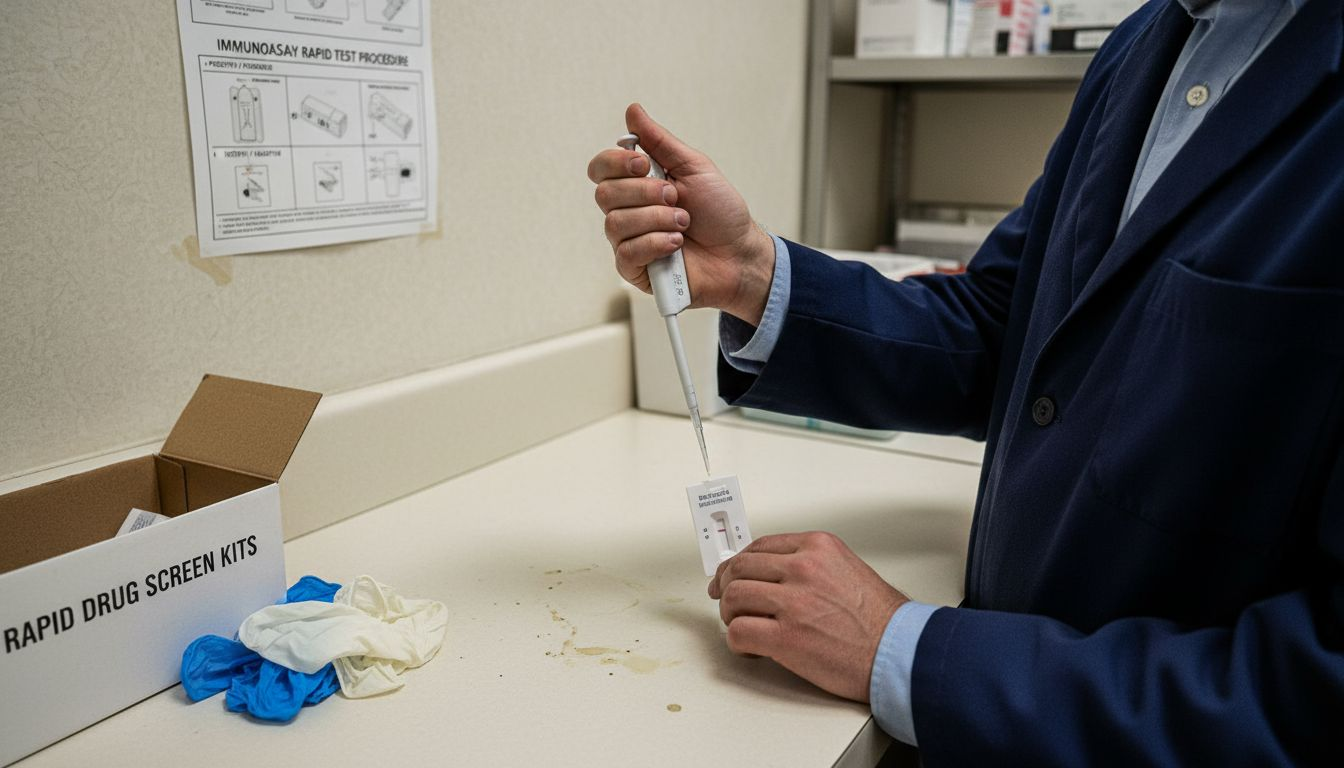
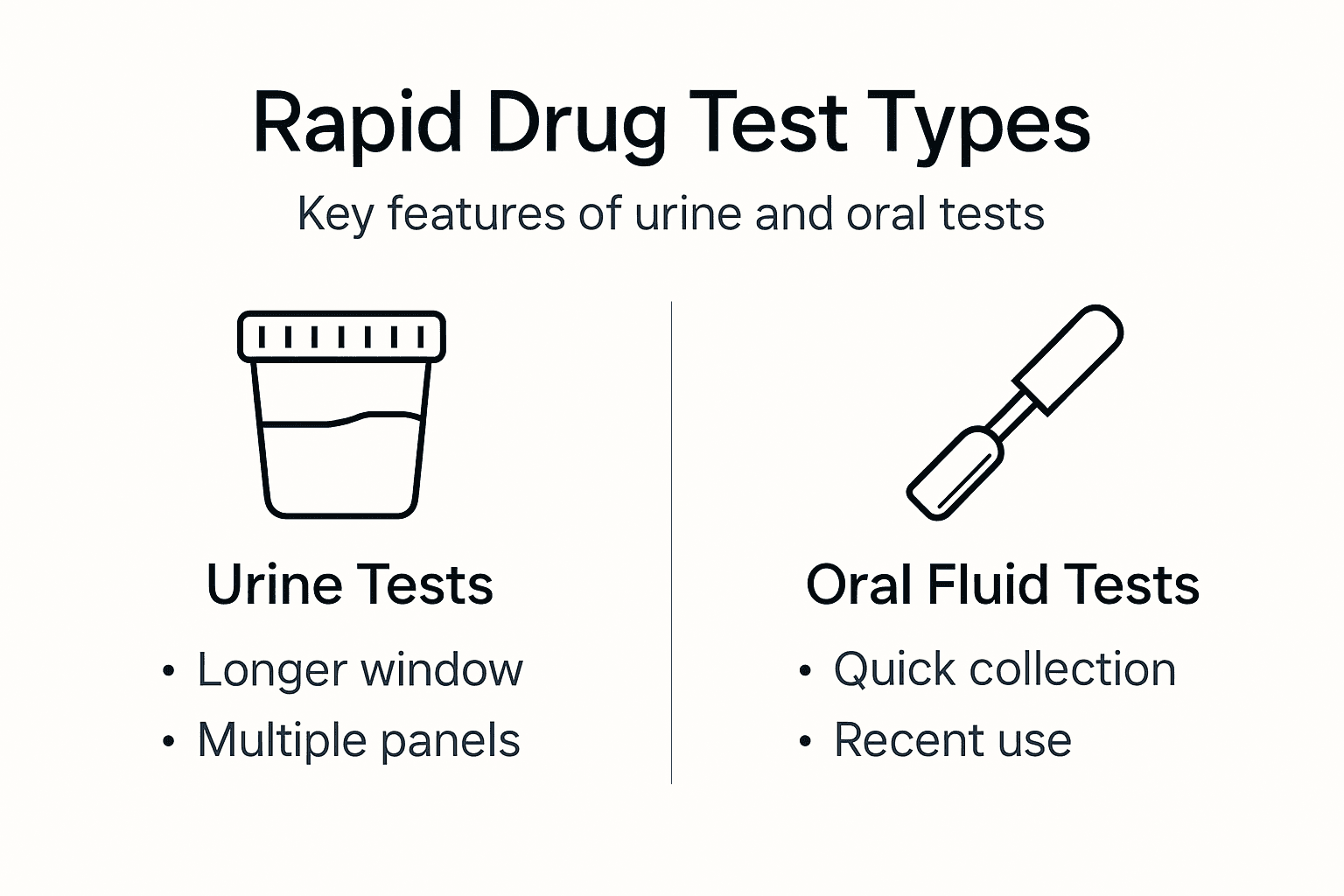
Urine tests remain the dominant sample type because they detect a wide range of drugs and metabolites over extended windows. Collection is simple, but urine samples carry higher tampering risks through dilution, substitution, or adulteration. You can mitigate these risks with observed collection, temperature checks, and adulterant detection strips.
Oral fluid tests collect saliva using a swab or collection device placed in the mouth. Rapid oral fluid drug tests provide comparable accuracy to urine tests for many drugs but offer advantages in non-invasive, observed sample collection which reduces tampering risks. Oral fluid testing typically achieves accuracy above 85% for detecting recent drug use within 24 to 48 hours. These tests work well when you need to verify very recent consumption, such as in post-accident investigations or reasonable suspicion scenarios.
Breath tests focus exclusively on alcohol detection. You use breath alcohol tests to screen for recent alcohol consumption, with results appearing in seconds. These devices measure blood alcohol concentration through exhaled breath and are simple to administer with minimal training.
| Sample Type | Accuracy | Invasiveness | Tampering Risk | Detection Window |
|---|---|---|---|---|
| Urine | 90%+ | Moderate | Higher | 1-3 days (most drugs) |
| Oral fluid | 85%+ | Low | Lower | 24-48 hours |
| Breath | 95%+ | Very low | Minimal | Immediate (alcohol only) |
Key advantages and considerations for each test type:
- Urine: Broad drug coverage, longer detection windows, cost-effective, but requires privacy for collection and faces tampering risks
- Oral fluid: Observed collection, non-invasive, detects recent use, but shorter detection windows and slightly higher cost
- Breath: Instant alcohol results, no privacy concerns, zero tampering risk, but limited to alcohol only
When you select drug test kits, consider your operational needs and compliance requirements. For example, if your program monitors ongoing compliance in a controlled environment, oral fluid tests offer strong deterrence. If you need broad substance detection over multiple days, urine tests provide comprehensive coverage. Specialized tests like the kratom urine test strip expand your capability to detect emerging substances not covered by standard panels.
Regulatory compliance and standards for rapid drug testing in the U.S.
Compliance with U.S. regulations ensures your rapid drug testing program meets legal and operational standards. Two key regulatory markers guide procurement: CLIA waiver status and FDA clearance.
A CLIA waiver indicates a test is simple enough to use outside traditional clinical laboratories under the Clinical Laboratory Improvement Amendments. Over 90% of rapid drug tests used for compliance purposes are CLIA-waived, meaning you can deploy them at point-of-care sites without complex lab oversight. CLIA-waived tests must demonstrate ease of use, minimal risk of error, and reliable performance through standardized validation.
FDA clearance confirms that a rapid drug test has undergone rigorous evaluation for safety and effectiveness. The FDA reviews clinical data, manufacturing processes, and quality controls before granting clearance. Tests with FDA clearance provide assurance that the device performs as claimed and meets federal quality standards. You should prioritize FDA-cleared tests to avoid legal challenges and ensure defensible results in compliance or legal proceedings.
Compliance requirements directly impact procurement decisions. Selecting CLIA-waived and FDA-cleared tests allows you to operate testing programs without obtaining laboratory certification, which reduces administrative burden and cost. Using non-compliant tests in regulated environments exposes your organization to legal liability, invalidated results, and potential sanctions from oversight bodies.
Key compliance criteria to verify before purchasing rapid drug tests:
- CLIA-waived status for simplified point-of-care use
- FDA clearance or approval confirming regulatory validation
- Manufacturer quality certifications and batch consistency records
- Clear instructions for use that meet regulatory guidelines
- Adequate shelf life and proper storage requirements to maintain test integrity
Pro Tip: Always check the CLIA status and FDA clearance before buying rapid tests to ensure regulatory compliance and operational acceptance. Verify this information directly on product packaging or the manufacturer’s documentation, not just vendor marketing materials.
When you select drug test kits for compliance, prioritize vendors who transparently provide regulatory credentials and quality assurance data. Establishing a drug testing program workflow that incorporates compliant test selection protects your organization and supports defensible compliance outcomes.
Accuracy, limitations, and common misconceptions
Understanding the performance characteristics of rapid drug tests helps you set realistic expectations and make informed procurement decisions. Sensitivity measures a test’s ability to correctly identify samples containing drugs, while specificity measures its ability to correctly identify drug-free samples. Many FDA-approved rapid drug tests achieve sensitivity and specificity above 90%, comparable to initial lab screening methods.
Rapid tests function as screening tools, not definitive diagnostic devices. They provide presumptive positive results that require laboratory confirmation using GC-MS or liquid chromatography-mass spectrometry (LC-MS). Confirmatory testing eliminates false positives caused by cross-reactivity with legal medications or dietary substances. For example, certain cold medicines can trigger false positives for amphetamines on rapid immunoassays, but confirmatory testing distinguishes these from illicit drug use.
Rapid drug tests have limitations such as lower capability to detect low-level or recent drug use compared to lab-based confirmatory methods. Detection thresholds are set to balance sensitivity with practicality. Very low drug concentrations may fall below these cutoffs, producing negative results even when trace amounts are present. Recent drug use, especially within hours of testing, may not yet produce detectable metabolite levels in urine or saliva.
Common misconceptions and the facts:
- Misconception: Rapid tests are always less accurate than laboratory tests. Fact: FDA-cleared rapid tests often match lab screening accuracy; the difference lies in confirmation capability, not initial detection.
- Misconception: Oral fluid tests are unreliable due to contamination. Fact: Properly collected oral fluid samples yield accuracy exceeding 85% and reduce tampering risks compared to urine.
- Misconception: A positive rapid test result is definitive proof of drug use. Fact: Rapid tests provide presumptive results; laboratory confirmation is required for legal or disciplinary actions.
- Misconception: Negative results guarantee no drug use. Fact: Detection windows, cutoff thresholds, and timing of use affect results; very recent or very low-level use may not be detected.
Pro Tip: For positive rapid test results, always follow up with laboratory confirmation to prevent false positives impacting compliance decisions. Confirmatory testing protects individuals from unjust consequences and strengthens the legal defensibility of your program.
When evaluating drug test strips accuracy, review manufacturer performance data and understand that rapid tests serve best as initial screening layers within a comprehensive testing strategy.
Comparison framework: choosing the right rapid drug test
Selecting the optimal rapid drug test requires balancing operational needs, compliance obligations, and cost considerations. Multi-panel tests detect multiple substances in one device, improving efficiency and reducing handling time. Single-panel tests focus on one drug class, offering targeted screening when you need to confirm suspicion of a specific substance.
Multi-panel drug test cups can test for up to 12 different substances simultaneously, improving efficiency for compliance officers managing large-scale screening. This capability reduces total screening time by up to 50% compared to administering multiple single-panel tests sequentially. Multi-panel tests streamline workflows and lower per-test costs when you need broad substance coverage.
Urine versus oral fluid tests each present distinct advantages. Urine tests offer longer detection windows, typically 1 to 3 days for most drugs, and detect a wider range of substances at lower cost per test. Oral fluid tests provide non-invasive, observed collection that minimizes tampering, with detection windows of 24 to 48 hours ideal for identifying recent use. Choose urine tests when you need comprehensive historical detection; choose oral fluid when you need tamper-resistant, immediate-use verification.
| Test Attribute | Multi-Panel Urine | Single-Panel Urine | Multi-Panel Oral Fluid | Breath Alcohol |
|---|---|---|---|---|
| Substances detected | Up to 12 | 1 | Up to 10 | Alcohol only |
| Detection window | 1-3 days | 1-3 days | 24-48 hours | Immediate |
| Tampering risk | Moderate | Moderate | Low | Minimal |
| Cost per test | Moderate | Low | Higher | Low |
| CLIA-waived | Yes | Yes | Yes | Yes |
| Efficiency gain | High (50%) | Low | Moderate | Very high |
Key procurement criteria to evaluate:
- Drug panel breadth: Match panel configuration to your compliance requirements and risk profile
- CLIA waiver status: Ensure point-of-care usability without laboratory certification
- Shelf life: Verify adequate expiration dates to avoid waste in low-volume programs
- Supply reliability: Choose vendors with consistent inventory and fast shipping to prevent program disruptions
- Quality control: Confirm batch testing and manufacturer certifications for consistent performance
Stepwise framework for choosing the right rapid drug test:
- Identify your compliance obligations and the specific substances you must detect based on regulations or organizational policy.
- Determine your testing volume and frequency to assess whether bulk purchasing or smaller orders suit your budget and storage capacity.
- Evaluate sample type preferences considering tampering risks, detection windows, and staff capability to administer tests.
- Select panel configuration matching your risk profile: multi-panel for broad screening efficiency, single-panel for targeted confirmation.
- Verify CLIA waiver and FDA clearance to ensure regulatory compliance and legal defensibility.
- Assess vendor reliability including inventory availability, shipping speed, quality assurance documentation, and customer support.
- Pilot test a small batch to confirm ease of use, staff acceptance, and operational fit before committing to large orders.
When you select drug test kits, use this framework to align your procurement with organizational goals. Resources like the multi-panel drug testing guide provide additional insights into optimizing panel selection for your specific compliance environment.
Practical implementation and integration into compliance programs
Successful rapid drug testing programs require more than just purchasing the right tests. You must integrate testing into workflows, train staff, and maintain quality control to achieve consistent compliance outcomes.
Onsite rapid testing accelerates intervention and decision-making. When you detect a presumptive positive result within minutes, you can immediately initiate follow-up actions such as temporary duty reassignment, referral for confirmatory testing, or activation of employee assistance programs. This speed improves compliance outcomes by reducing the window between detection and response.
Bulk ordering from trusted vendors ensures supply chain consistency and cost savings. Large orders typically qualify for free shipping and volume discounts, reducing per-test expenses. Reliable vendors maintain consistent inventory, preventing program disruptions from stockouts. Evaluate vendor quality control practices, including batch consistency testing and certifications, to ensure every test performs as expected.
Quality control procedures safeguard test reliability. Implement routine checks including:
- Verifying expiration dates and proper storage conditions before use
- Running control samples periodically to confirm test functionality
- Monitoring batch performance and reporting anomalies to vendors
- Documenting test administration, results, and follow-up actions for audit trails
Staff training minimizes errors and enhances program credibility. Train personnel on sample collection techniques, result interpretation, handling of presumptive positives, and confidentiality protocols. Well-trained staff reduce the risk of procedural errors that compromise test validity or violate privacy rights.
Best practices for integrating rapid drug testing into compliance programs:
- Establish clear written policies outlining when testing occurs, who administers tests, and how results are managed
- Designate trained staff responsible for test administration and quality oversight
- Maintain secure inventory management with temperature-controlled storage and access controls
- Integrate rapid testing into broader compliance workflows including confirmatory lab testing and case management
- Schedule periodic refresher training to update staff on new products, regulatory changes, and procedural improvements
- Conduct vendor audits to verify quality assurance and supply reliability
Pro Tip: Schedule periodic refresher training and vendor audits to sustain compliance program effectiveness. Regular training keeps staff current on best practices, and vendor audits ensure ongoing product quality and service reliability.
To ensure accurate drug screening, embed quality assurance into every step of your workflow. Review the drug testing program workflow to design processes that maximize efficiency and compliance. Understanding the key types of drug tests helps you select and implement the right mix of rapid and confirmatory testing methods.
Summary and recommendations
Rapid drug testing delivers results in 5 to 10 minutes, enabling timely compliance decisions without sacrificing detection quality. Immunoassay technology powers most rapid tests, analyzing urine, oral fluid, or breath samples to identify drug presence. Urine tests dominate due to broad detection and cost-effectiveness, while oral fluid tests reduce tampering risks through observed collection. Breath tests provide instant alcohol screening with minimal invasiveness.
Accuracy for FDA-approved rapid tests often exceeds 90% sensitivity and specificity, matching initial lab screening performance. However, rapid tests serve as presumptive screening tools requiring laboratory confirmation for positive results. This two-step approach balances speed with legal defensibility, protecting individuals from false positives while enabling swift intervention.
Compliance depends on selecting CLIA-waived, FDA-cleared tests that meet regulatory standards. Over 90% of rapid drug tests used in compliance contexts carry CLIA waivers, allowing point-of-care use without laboratory certification. Verifying these credentials before procurement protects your organization from legal liability and ensures operational acceptance.
Procurement checklist for compliance officers:
- Confirm CLIA-waived status for point-of-care deployment
- Verify FDA clearance to ensure regulatory validation and quality standards
- Select panel configuration matching your compliance requirements and risk profile
- Evaluate sample type based on detection windows, tampering risks, and operational needs
- Assess vendor reliability including inventory consistency, shipping speed, and quality assurance documentation
- Implement quality control procedures including batch monitoring, storage verification, and staff training
- Establish workflows integrating rapid screening with confirmatory lab testing for positive results
Balancing speed and accuracy requires thoughtful program design. Rapid tests provide immediate presumptive results that guide timely action, while confirmatory lab testing delivers definitive outcomes for legal or disciplinary decisions. Combining both layers ensures you act quickly without compromising compliance rigor.
Successful implementation depends on staff training, quality assurance, and vendor partnerships. Train personnel on proper collection techniques, result interpretation, and confidentiality protocols. Maintain quality control through batch testing, storage monitoring, and periodic vendor audits. Choose vendors who provide transparent regulatory credentials, consistent supply, and responsive support.
By selecting drug test kits that align with compliance obligations and operational realities, you build a defensible, efficient testing program. Thoughtful procurement and integration maximize the benefits of rapid drug testing while maintaining the accuracy and legal integrity essential for regulatory success.
Explore reliable rapid drug testing solutions today
Buy Test Cup offers a comprehensive range of rapid drug testing products designed to support compliance programs in government agencies and healthcare organizations. Our drug test cups include multi-panel options that screen up to 12 substances simultaneously, delivering the efficiency gains you need for large-scale operations.
Explore our multi-panel drug testing guide to understand how panel configuration impacts compliance outcomes. We provide CLIA-waived, FDA-cleared products backed by quality assurance and reliable inventory to prevent program disruptions. Whether you need urine test cups, oral swabs, or specimen collection kits, our catalog supports diverse testing requirements.
Visit our drug testing program workflow resources to integrate rapid testing seamlessly into your compliance operations. Take action today to enhance your drug testing program with trusted solutions that deliver speed, accuracy, and regulatory confidence.
FAQ
What is the typical turnaround time for rapid drug testing results?
Rapid drug tests typically provide results within 5 to 10 minutes, enabling timely onsite decision-making and compliance actions. This speed significantly reduces delays compared to lab-based testing, which can take several days. Immediate results allow you to initiate follow-up procedures quickly when presumptive positives require further action.
Are rapid drug tests as accurate as laboratory tests?
Many FDA-approved rapid drug tests exceed 90% sensitivity and specificity, matching initial lab screening accuracy. However, they are designed for initial screening, not definitive diagnosis. Lab-based confirmatory tests using GC-MS or LC-MS remain necessary for conclusive results and to reduce false positives before taking legal or disciplinary actions.
What does CLIA-waived mean for rapid drug tests?
CLIA-waived status allows certain rapid drug tests to be used safely outside traditional clinical laboratories under simplified regulations. This designation confirms the test is simple, poses minimal risk of error, and delivers reliable results without complex lab oversight. Over 90% of rapid drug tests for compliance are CLIA-waived, supporting trusted onsite usage in point-of-care settings.
How do I reduce risks of sample tampering in rapid drug testing?
Observed sample collection and choosing oral fluid tests can reduce tampering likelihood because collection is non-invasive and directly monitored. For urine tests, use temperature checks and adulterant detection strips to identify dilution or substitution attempts. Implement quality control protocols and staff training to detect and prevent specimen adulteration, ensuring test integrity and compliance program credibility.