


Blog
Why Bulk Drug Testing Matters for Compliance in 2026


TL;DR:
- Bulk drug testing involves large-scale procurement of compliant screening kits essential for maintaining workflow continuity, standardization, and regulatory adherence. It supports cost savings, reduces administrative burdens, and enhances public health outcomes by enabling reliable, consistent testing programs. Regular review and alignment with evolving substance risks and legal guidelines are vital for a defensible, effective bulk testing strategy.
Bulk drug testing is the practice of procuring and deploying large quantities of drug screening kits to meet organizational compliance, workplace safety, and public health objectives at scale. For government agencies, healthcare administrators, and employers, this approach is not optional. It is the operational backbone of any defensible, cost-controlled testing program. Organizations that treat drug testing as a one-off purchase rather than a managed supply strategy face gaps in availability, inconsistent panel coverage, and exposure to regulatory penalties. The 2026 HHS Mandatory Guidelines and Labcorp’s current program documentation both confirm that structured, standardized testing is the standard against which programs are measured.
Why bulk drug testing matters for operational efficiency
The most immediate advantage of bulk procurement is supply continuity. When a federal contractor, hospital system, or municipal employer runs out of test kits mid-cycle, the entire program stalls. Random testing windows close. Compliance documentation falls behind. The operational benefits of bulk purchasing include consistent availability, standardized panel products, and reduced per-unit costs that compound across large workforces.
Standardization is the underappreciated benefit here. When every testing site within a hospital network or government agency uses the same multi-panel cup with the same analyte configuration, training is simpler, chain-of-custody documentation is uniform, and audit trails hold up under scrutiny. A patchwork of different products from different vendors introduces variability that regulators and legal teams notice immediately.
Scalability matters as much as cost. A county health department managing 500 employees tests differently than a federal agency managing 50,000. Bulk procurement allows both to build inventory buffers, schedule testing cycles predictably, and avoid the administrative cost of emergency reorders. The logistics savings alone justify the strategy before you factor in per-unit price reductions.
- Supply continuity: No testing delays due to stockouts or shipping backlogs
- Panel standardization: Uniform analyte coverage across all testing sites
- Training efficiency: Single product type reduces staff error and documentation inconsistency
- Audit readiness: Consistent product records support chain-of-custody defensibility
- Budget predictability: Volume pricing allows accurate annual cost forecasting
Pro Tip: When placing bulk orders, align your procurement cycle with federal panel update schedules. The HHS Mandatory Guidelines are reviewed annually, and ordering before a panel revision can leave you with non-compliant inventory.
How does bulk testing support regulatory compliance?
Federal Register 2026 guidelines specify the mandatory analytes, cutoffs, and testing procedures that certified laboratories and Medical Review Officers must follow for federal workplace drug testing programs. The 2026 cycle confirmed no changes to panels or cutoffs from 2025, which gives procurement teams a stable baseline. But that stability is not permanent, and organizations that buy inconsistent or non-certified products risk using test cups that do not meet authorized analyte requirements.
The compliance stakes are direct. Using a non-authorized panel in a federally mandated program exposes the organization to legal challenge, disqualification of test results, and potential contract penalties. Bulk procurement from a supplier that stocks CLIA-waived, federally aligned panels removes this risk by design.
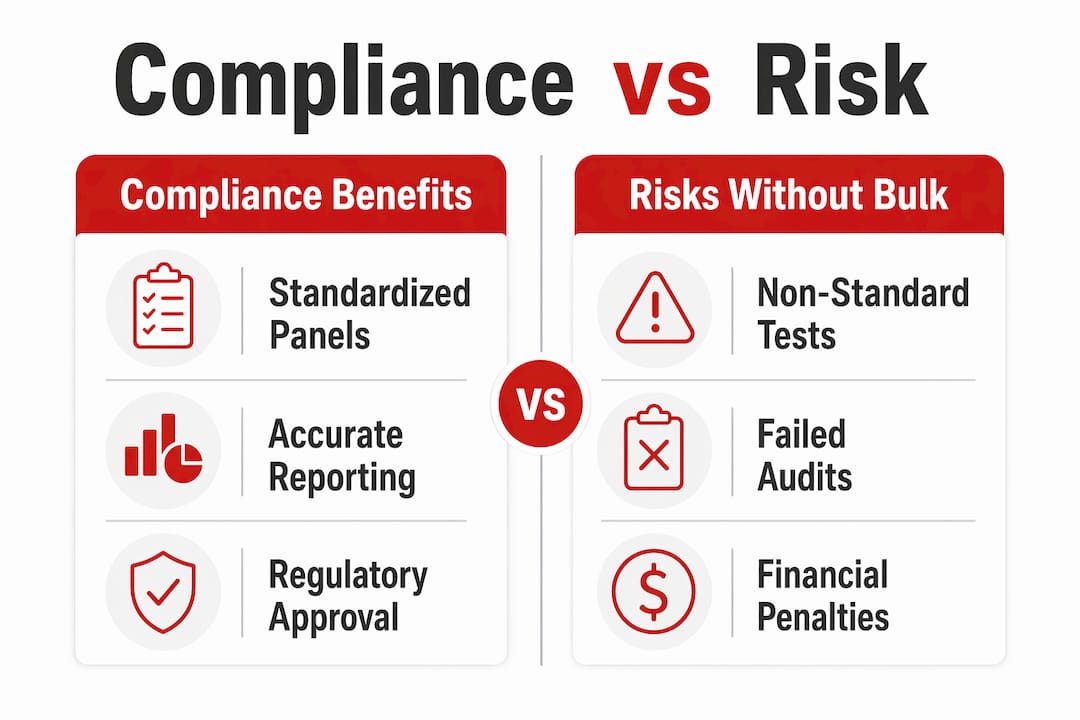
| Compliance factor | Bulk testing advantage | Risk without bulk standardization |
|---|---|---|
| Analyte coverage | Uniform panels across all sites | Mixed panels create audit gaps |
| CLIA waiver status | Verified at point of purchase | Individual orders may lack documentation |
| Chain-of-custody records | Consistent product codes simplify records | Multiple SKUs complicate documentation |
| MRO defensibility | Standardized results are easier to defend | Inconsistent products invite legal challenge |
| Panel update response | Single vendor update covers all inventory | Fragmented supply requires multiple updates |
Regulatory compliance also requires that bulk procurement strategies integrate standardization as a non-negotiable feature. Buying in volume from a single compliant source is not just a cost decision. It is a legal defense strategy. Organizations that treat procurement as purely transactional miss the compliance architecture that bulk standardization provides.
State-level mandates add another layer. Many states have adopted drug testing policies for Medicaid providers, public safety employees, and licensed healthcare workers that reference specific panel configurations. Bulk procurement aligned with both federal HHS guidelines and applicable state requirements gives administrators a single defensible supply chain rather than a fragmented one.
What financial impacts come from bulk drug testing programs?
The cost argument for bulk drug testing is straightforward but often undersold. Per-unit price reductions from volume purchasing are the obvious benefit. The less obvious benefit is the elimination of emergency ordering costs, administrative time spent on fragmented procurement, and the indirect cost of program interruptions.

A 2026 JAMA Network Open study on Medicaid urine drug testing policy offers a precise illustration of how testing volume and cost interact. Limiting reimbursement for urine drug testing led to a reduction of 1.70 tests per 1,000 beneficiaries monthly and saved $14.8 million over seven months, with no negative impact on treatment outcomes or overdose rates. The finding is not an argument against testing. It is an argument for testing the right patients at the right frequency with the right rationale. Bulk procurement supports exactly this kind of disciplined, policy-aligned approach by making high-volume, targeted testing financially sustainable.
| Cost category | Without bulk procurement | With bulk procurement |
|---|---|---|
| Per-unit test cost | Higher at retail or small-order pricing | Reduced through volume discounts |
| Emergency reorder cost | Frequent, unpredictable | Eliminated through inventory planning |
| Administrative overhead | Multiple vendors, invoices, and SKUs | Single vendor, consolidated billing |
| Program interruption cost | Testing gaps create compliance exposure | Continuous supply prevents gaps |
| Staff training cost | Higher with inconsistent products | Lower with standardized single product |
Budget predictability is the financial benefit that administrators value most but discuss least. When a testing program operates on a fixed annual budget, bulk procurement converts variable per-test costs into a predictable line item. That predictability supports grant applications, legislative budget requests, and contract renewals. It also removes the pressure of mid-year emergency purchases that blow procurement budgets and require administrative justification.
What public health outcomes does bulk drug testing improve?
Workplace drug testing programs improve safety, enhance productivity, reduce absenteeism, lower healthcare costs, and support regulatory obligations. These are not aspirational claims. They are documented outcomes from Labcorp’s 2026 program analysis, which draws on data from thousands of employer programs across industries.
Substance misuse increases absenteeism and workplace accidents directly. Drug testing programs reduce these risks by creating a deterrent effect, identifying at-risk employees before incidents occur, and supporting referral to treatment programs. The public health value compounds when testing is embedded in a broader employee assistance framework rather than used purely as a punitive tool.
The opioid crisis has made this point concrete. Employers in construction, transportation, and healthcare have used bulk testing programs to monitor workforce substance use trends, identify early signals of opioid misuse, and connect employees with treatment resources. Without the supply reliability that bulk procurement provides, these programs cannot maintain the testing frequency needed to generate meaningful data.
“Integrating bulk drug testing within a comprehensive safety culture, rather than using it solely as a punitive measure, yields better retention, safety outcomes, and credibility.” — Workplace Drug and Alcohol Testing: Complete 2026 Guide
Random testing is a specific application where bulk supply matters most. Random drug testing discourages misuse proactively and protects workplace safety without prior notice. For random programs to function, kits must be available on demand. A stockout on the day a random selection is triggered defeats the entire deterrent purpose. Bulk inventory is not a convenience for random programs. It is a structural requirement.
The broader public health argument connects to workforce productivity and healthcare system costs. Employees in substance-free workplaces generate fewer workers’ compensation claims, require fewer emergency healthcare interventions, and maintain higher productivity levels. For government agencies and healthcare systems that self-insure or operate under budget caps, these downstream savings are material.
What I’ve learned about bulk testing programs that most guides skip
After years of working with government procurement offices and healthcare compliance teams, the pattern I see most often is not negligence. It is complacency. Organizations set up a bulk testing program, select a panel, and then leave it untouched for three or four years while the substance landscape and regulatory framework shift around them.
Effective bulk drug testing programs require ongoing panel reviews to stay current with evolving substance risks and legal requirements. Fentanyl analogs, synthetic cannabinoids, and emerging stimulants are not always covered by legacy panels. An organization running a five-panel cup from 2021 on a 2026 workforce is testing for the wrong things. The program looks compliant on paper but has real blind spots.
The trust question is also more nuanced than most compliance guides acknowledge. Employers often fear that drug testing will erode employee trust. The research from Labcorp is clear: framing testing as a safety and productivity tool embedded in a holistic support program mitigates this concern. The organizations that get this right communicate the purpose of testing explicitly, pair it with employee assistance resources, and apply it consistently across all levels of the workforce. The ones that get it wrong use testing selectively or punitively, which is where trust actually breaks down.
My practical advice is to treat bulk procurement as a program design decision, not a purchasing decision. The panel you select, the supplier you choose, and the frequency you set are all compliance architecture choices. Reviewing your bulk purchasing compliance strategies annually alongside your legal counsel and HR leadership is not excessive. It is the minimum standard for a defensible program in 2026.
— matthew
How Buytestcup supports your bulk drug testing program
Buytestcup stocks a full catalog of multi-panel drug test cups, dip strips, oral swabs, and specimen collection kits designed for the procurement volumes that government agencies, healthcare systems, and large employers require. Every product in the catalog is CLIA waived and aligned with current federal panel standards, so your supply chain is compliant from the moment the order ships. The platform offers free bulk shipping on large orders and same-day shipping options for urgent needs. Explore the drug test cups catalog for volume pricing on multi-panel configurations, or review the compliance workflow guide to align your procurement strategy with your program requirements.
FAQ
What is bulk drug testing?
Bulk drug testing refers to the large-scale procurement and deployment of drug screening kits, such as urine test cups, dip strips, or oral swabs, to support ongoing compliance, workplace safety, or public health programs. It is distinct from pharmaceutical bulk drug (API) manufacturing and applies specifically to organizational testing supply strategies.
Why is standardized panel selection critical in bulk procurement?
The 2026 HHS Mandatory Guidelines specify approved analytes and cutoffs for federal workplace programs, and using non-authorized panels can invalidate test results and expose organizations to legal challenge. Standardizing on a single compliant panel across all bulk orders eliminates this risk.
How does bulk testing reduce costs without cutting program quality?
Volume purchasing lowers per-unit costs, eliminates emergency reorder expenses, and consolidates administrative overhead into a single vendor relationship. The 2026 JAMA Network Open Medicaid study confirmed that policy-aligned testing reduces expenditures without negative clinical outcomes, demonstrating that disciplined procurement and program quality are not in conflict.
Does random drug testing require bulk supply?
Random testing programs require kits to be available on demand, since testing is triggered without advance notice. A stockout during a random selection window defeats the deterrent purpose of the program entirely, making bulk inventory a structural requirement rather than a convenience.
How often should bulk testing panels be reviewed?
Program reviews aligned with legal and substance use changes should occur at least annually. Emerging substances like fentanyl analogs and synthetic cannabinoids may not appear on legacy panels, creating coverage gaps that undermine both safety outcomes and regulatory defensibility.