


Blog
How to Validate Test Accuracy: A Lab Professional’s Guide


TL;DR:
- Test accuracy validation involves demonstrating through documented, evidence-based laboratory investigations that a measurement method meets required standards for precision, trueness, selectivity, and sensitivity. This process is essential and mandatory for laboratories and regulatory agencies, forming the foundation of defensible results across various testing environments. Proper validation relies on established guidelines like CLSI, FDA, and ISO 15189, emphasizing pre-defined acceptance criteria, site verification, continuous quality control, and meticulous documentation to ensure ongoing method reliability.
Test accuracy validation is defined as documented, evidence-based laboratory investigation that demonstrates a measurement method performs with the precision, trueness, selectivity, and sensitivity required for its intended use. For testing laboratories and regulatory agencies, this process is not optional. It is the foundation of defensible results. Whether you work in clinical diagnostics, forensic toxicology, or compliance drug screening, knowing how to validate test accuracy determines whether your data holds up under scrutiny. Standards like ISO 15189:2022, FDA guidance documents, and CLSI EP protocols set the framework. This guide integrates current best practices to give you a working methodology.
How to validate test accuracy: core components and criteria
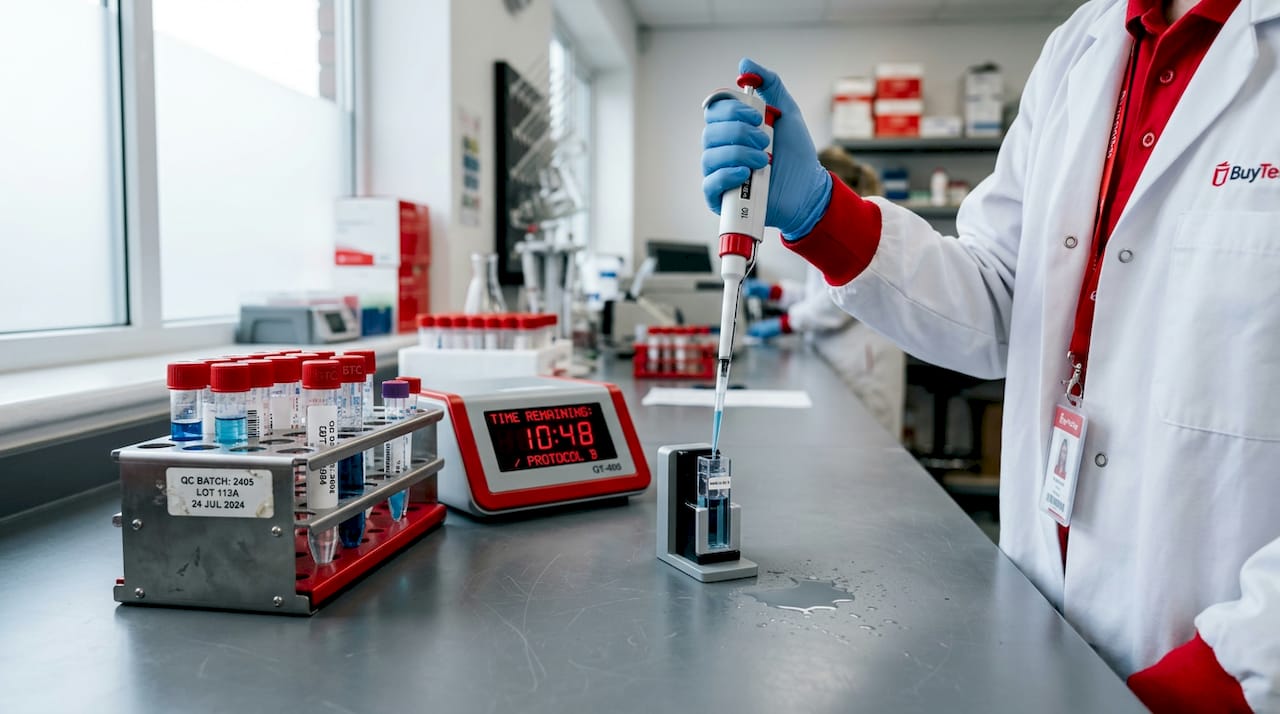
Validation of analytical testing methods is defined by evidence-based investigations demonstrating precision, accuracy, selectivity, and sensitivity fit for intended use, as outlined in FDA 2025 guidance. That definition tells you exactly what your validation plan must address before a single patient or compliance sample is processed.
The four performance parameters you must assess are:
- Precision: The degree of agreement among repeated measurements under defined conditions. Precision is split into repeatability (within-run) and reproducibility (between-run or between-site). Poor precision inflates uncertainty and undermines every downstream result.
- Trueness (bias): How close the mean of your measurements is to the accepted reference value. Trueness failures are systematic. They do not average out over time, which makes them more dangerous than random imprecision.
- Selectivity: The method’s ability to measure the target analyte without interference from other substances in the matrix. In drug testing, cross-reactivity with structurally similar compounds is the primary selectivity threat.
- Sensitivity: The lowest concentration the method can reliably detect and quantify. In regulatory drug screening, sensitivity directly determines whether cutoff concentrations are clinically or legally meaningful.
One distinction that labs frequently blur is the difference between validation and verification. Validation establishes performance characteristics from scratch, typically by the manufacturer or a reference laboratory. Verification confirms that those established claims hold true at your specific site, with your instruments and reagents. Regulatory standards including FDA and ISO 15189 treat these as separate obligations, not interchangeable activities.
Pro Tip: When writing your validation plan, map each performance parameter to a specific acceptance criterion before you run a single experiment. Defining pass/fail thresholds in advance prevents post-hoc rationalization of borderline data.
Which standardized guidelines support test accuracy validation?
The laboratory testing field has several well-established protocols that structure how you assess test accuracy. Knowing which document applies to your situation saves time and prevents regulatory gaps.
- CLSI EP05-A3 governs the establishment of within-site precision for measurement procedures. It specifies the experimental design, sample requirements, and statistical analysis needed to characterize imprecision at a single laboratory location.
- CLSI EP15-A3 is the end-user verification standard. CLSI EP05-A3 and EP15-A3 together cover precision establishment and site-specific claim verification tailored for clinical labs. EP15-A3 is what your lab uses to confirm that a manufacturer’s stated precision and bias claims are achievable on your platform.
- QUADAS-3 applies when you are evaluating published diagnostic test accuracy studies rather than running your own bench experiments. QUADAS-3 assesses risk of bias and applicability at the accuracy estimate level, improving interpretation of accuracy variations across studies. It replaces the older “Flow and Timing” domain with an “Analysis” domain, which better captures modern study designs including AI-based diagnostic tools.
- ISO 15189:2022 structures the entire quality management system around continuous validity assurance. It mandates internal quality control (IQC) and external quality assessment (EQA) as ongoing obligations, not one-time checkboxes.
- FDA guidance documents (including the 2025 tobacco product testing guidance) set the regulatory submission standard for analytical method validation in product testing contexts.
The table below maps each standard to its primary application context:
| Standard | Primary use | Key output |
|---|---|---|
| CLSI EP05-A3 | Precision establishment | Within-site imprecision data |
| CLSI EP15-A3 | End-user verification | Confirmed manufacturer claims |
| QUADAS-3 | Study quality appraisal | Bias and applicability ratings |
| ISO 15189:2022 | Lab quality management | Continuous IQC/EQA compliance |
| FDA analytical guidance | Regulatory submissions | Documented method suitability |
How to implement a step-by-step validation workflow
A structured workflow prevents the most common validation failure: collecting data without a plan and then trying to interpret it retroactively. The following sequence applies to most laboratory settings, from clinical chemistry to drug screening compliance programs.
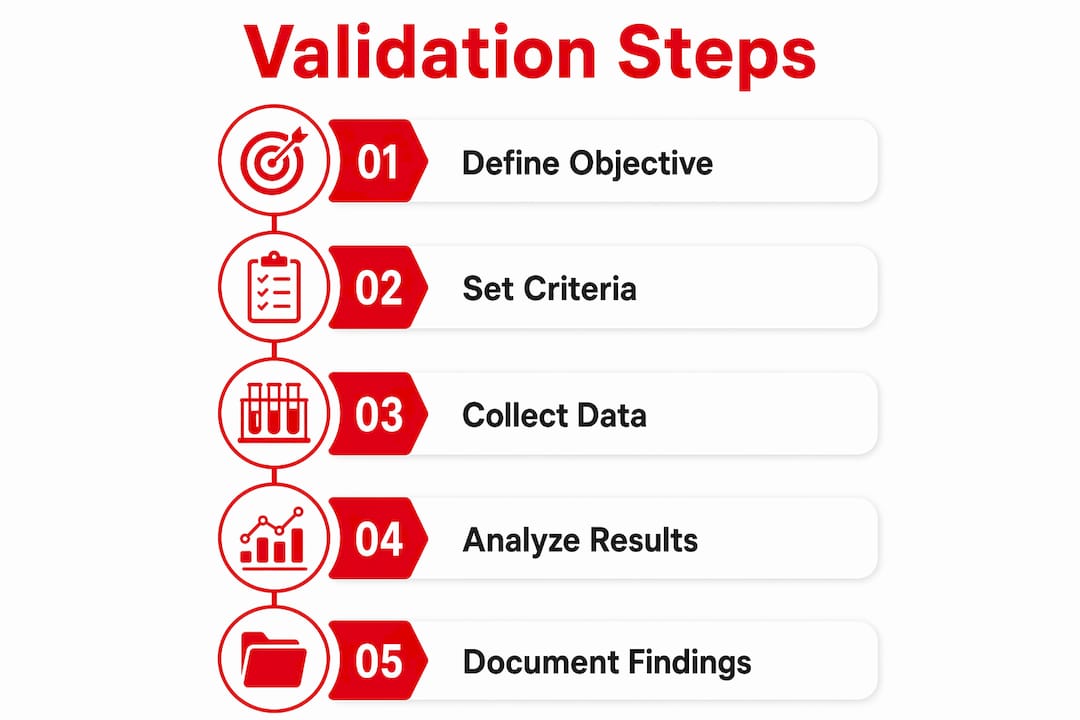
- Define scope and acceptance criteria. Specify the analyte, matrix, concentration range, and intended use before selecting materials. Write numeric acceptance criteria for each performance parameter. This step is non-negotiable for regulatory submissions.
- Select appropriate samples and controls. Use materials that closely mimic the patient or specimen matrix. Spiked samples at concentrations spanning the analytical range, including near-cutoff levels, are required for meaningful sensitivity and selectivity data. Avoid using only high-concentration controls that never challenge the method’s lower limits.
- Execute precision experiments. Run replicate measurements across multiple days, operators, and reagent lots if possible. EP05-A3 recommends a minimum of 20 days of data collection for robust within-site precision estimates. Shorter studies produce wider confidence intervals and weaker regulatory arguments.
- Assess trueness against a reference. Compare your method’s mean result against a certified reference material, a reference method, or a proficiency testing target value. Document the calculated bias and compare it against your pre-defined acceptance criterion.
- Implement IQC from day one. ISO 15189:2022 mandates continuous monitoring of examination result validity using IQC and EQA with materials closely resembling patient samples. IQC is not a post-validation add-on. It is the mechanism that tells you whether your validated performance is still holding.
- Participate in external quality assessment. EQA programs provide an independent check on your results by comparing your performance against peer laboratories. Consistent EQA failures signal systematic bias that internal controls may not detect.
- Investigate failures formally. When IQC or EQA results fall outside acceptance limits, open a formal investigation. Document the root cause, corrective action, and outcome. CLSI EP15-A3 verification protocols focus on detecting performance failures at end-user lab sites and advocate failure investigations over silent adjustments. Recalibrating without investigation is not a corrective action. It is a cover-up.
- Maintain complete documentation. Every experiment, result, deviation, and corrective action must be recorded in a format that supports regulatory review. Undocumented validation is legally equivalent to no validation.
Pro Tip: Run your trueness assessment using at least three concentration levels: one near the lower limit of quantitation, one at the clinical or regulatory decision point, and one near the upper limit of your reportable range. Single-point bias checks miss concentration-dependent errors.
What are common pitfalls in validating test accuracy?
Even experienced laboratories make predictable errors in test accuracy validation. Recognizing these pitfalls before they occur is more efficient than correcting them after a regulatory audit.
- Overfitting to the test dataset. In model-based and AI-assisted testing, using a test set only once prevents overfitting to the test data. Repeated evaluation on the same dataset converts it into a training set, producing artificially inflated accuracy estimates that do not generalize to real samples. The same logic applies to bench validation: do not tune your method parameters using the same samples you use to assess performance.
- Accepting manufacturer claims without site verification. A manufacturer’s package insert describes performance under their controlled conditions. Your lab’s instruments, water quality, operator technique, and reagent storage conditions are different. Accepting published claims without running EP15-A3 verification is a compliance risk and a patient safety risk.
- Ignoring matrix effects. Using aqueous standards or inappropriate control materials to validate a method intended for urine, serum, or oral fluid introduces matrix-related bias that your validation data will not detect. The control material must behave like the real sample.
- Lacking a gold standard reference. When a gold standard reference is unavailable or imperfect, latent class models or Bayesian approaches are necessary for diagnostic test accuracy validation. Many laboratories simply skip the trueness assessment when a reference is unavailable. That is the wrong response. Advanced statistical methods exist specifically for this situation.
- Treating validation as a one-time event. Initial validation establishes a performance baseline. It does not guarantee that performance remains stable over months or years. Reagent lot changes, instrument maintenance, and personnel turnover all introduce variation that only continuous IQC and periodic re-verification will catch.
“Verification is an ongoing acceptance gate that requires failure investigations rather than silent redefinition of performance through repetitive recalibration, preserving scientific integrity in laboratory testing.” — CLSI EP15 user verification directives
The most dangerous pitfall is false confidence. A lab that completed validation two years ago and has not run structured IQC since then does not have a validated method. It has a method that was once validated.
What I’ve learned from watching labs get validation wrong
After years of working with laboratory professionals across clinical, forensic, and compliance testing environments, one pattern stands out: most validation failures are not technical. They are procedural. The science is well understood. The CLSI documents are clear. The ISO 15189:2022 requirements are explicit. What goes wrong is that laboratories treat validation as a documentation exercise rather than a scientific one.
I have seen labs produce validation reports that are technically complete but scientifically hollow. Every box is checked, every form is signed, and the acceptance criteria are met because the criteria were written after the data was collected. That is not validation. That is paperwork.
The tools that genuinely improve rigor are the ones that force you to commit before you measure. QUADAS-3’s updated signaling questions and risk assessments at the estimate level enhance rigor and interpretability in diagnostic test accuracy validation studies. The discipline of pre-specifying your acceptance criteria, your sample selection rationale, and your statistical analysis plan before running experiments is what separates defensible validation from regulatory theater.
My strongest recommendation is to treat your IQC material selection as seriously as your initial validation design. Routine IQC materials should closely mimic patient sample matrix and stability to effectively detect clinically relevant drift. A lab that uses stabilized aqueous controls for a urine-based drug screening method is not monitoring the right thing. The control passes, the method drifts, and the error reaches the result before anyone notices.
Validation is not a project with a completion date. It is a continuous commitment to knowing whether your method is still doing what you proved it could do.
— matthew
Quality supplies that support accurate, validated drug testing
Validation protocols and quality control systems are only as reliable as the consumables feeding them. At Buytestcup, the product catalog is built for laboratories and compliance programs that cannot afford upstream variability. Consistent specimen collection is where accuracy validation begins, and inconsistent cups or strips introduce pre-analytical error that no statistical method can correct after the fact. Buytestcup’s drug test cups and testing strips are designed to support the kind of repeatable, matrix-consistent sample collection that validation protocols require. For labs building or auditing their drug testing accuracy practices, starting with reliable, CLIA-compliant consumables is the logical first step before any precision or trueness study begins.
FAQ
What does it mean to validate test accuracy?
Validating test accuracy means producing documented laboratory evidence that a measurement method performs with the precision, trueness, selectivity, and sensitivity required for its intended use, as defined by FDA guidance and ISO 15189:2022. It is distinct from verification, which confirms those established claims at a specific end-user site.
What is the difference between CLSI EP05-A3 and EP15-A3?
CLSI EP05-A3 establishes within-site precision from scratch, while EP15-A3 guides end-user laboratories in verifying that a manufacturer’s precision and bias claims are achievable on their specific instruments and reagents. EP05-A3 is for characterization; EP15-A3 is for confirmation.
How do you validate test accuracy without a gold standard?
When no error-free reference method exists, latent class models and Bayesian statistical approaches allow accuracy estimation from real-world data without a perfect comparator. These methods are recognized in the diagnostic accuracy literature as the appropriate solution for imperfect reference conditions.
How often should test accuracy be re-validated?
Initial validation establishes a performance baseline, but continuous IQC and EQA aligned with ISO 15189:2022 are required to detect drift and clinically significant changes in performance over time. Formal re-verification is triggered by reagent lot changes, instrument repairs, or sustained IQC failures.
What is QUADAS-3 used for in test accuracy validation?
QUADAS-3 is a structured appraisal tool used to evaluate risk of bias and applicability in published diagnostic test accuracy studies. It operates at the accuracy estimate level, making it useful for systematic reviews and regulatory assessments of existing test performance data rather than bench-level validation experiments.