


Blog
How to Ensure CLIA Compliance in Your Lab


TL;DR:
- Losing CLIA certification halts testing, incurs penalties, and risks patient outcomes, emphasizing daily compliance.
- Proper documentation, regular staff oversight, and adherence to certificate-specific rules are vital to maintaining validated operations.
Losing your CLIA certification does not just generate paperwork. It halts testing, triggers financial penalties, and puts patient outcomes at risk. Knowing how to ensure CLIA compliance is the difference between a lab that operates with confidence and one that scrambles before every inspection. CLIA compliance guidelines exist to protect test accuracy, protect patients, and protect your facility. Yet many lab managers treat compliance as a periodic event rather than a daily discipline. This article walks you through the foundational requirements, the step-by-step process, the common failure points, and the monitoring practices that keep your lab inspection-ready every single day.
How to ensure CLIA compliance: foundational requirements
Before you can build a compliance program, you need to know exactly which certificate governs your lab and what it demands. CLIA issues three main certificate types, and the rules attached to each are not interchangeable.
| Certificate type | Who it applies to | Key obligation |
|---|---|---|
| Certificate of Waiver | Labs performing only FDA-cleared waived tests | Follow manufacturer instructions exactly; no modifications |
| Certificate of Compliance | Labs performing moderate or high-complexity testing | Meet all CLIA personnel and QA standards; subject to CMS survey |
| Certificate of Accreditation | Labs seeking third-party accreditation | Meet standards of an approved accreditation organization |
Getting the certificate right is step one. Step two is understanding what keeps it valid. The Certificate of Waiver must be renewed every two years, and any lapse in renewal halts testing immediately. This is not a grace-period situation. CMS will not allow you to continue operations while you catch up on paperwork.
Documentation forms the backbone of any CLIA-compliant operation. The following records must be current, accessible to staff, and ready for an inspector to review at any moment:
- Written procedure manuals covering specimen acceptability, test performance steps, and reference ranges. The D5401 deficiency code is one of the most frequently cited violations, and it comes down to incomplete procedure manuals.
- Personnel qualification records documenting education, training, and competency assessments for every testing staff member.
- Laboratory director credentials and documented oversight activities, not just a name on a form.
- CLIA certificate copies and fee payment receipts, including records from the pay.gov platform.
- Proficiency testing enrollment confirmations and result reports for all regulated analytes.
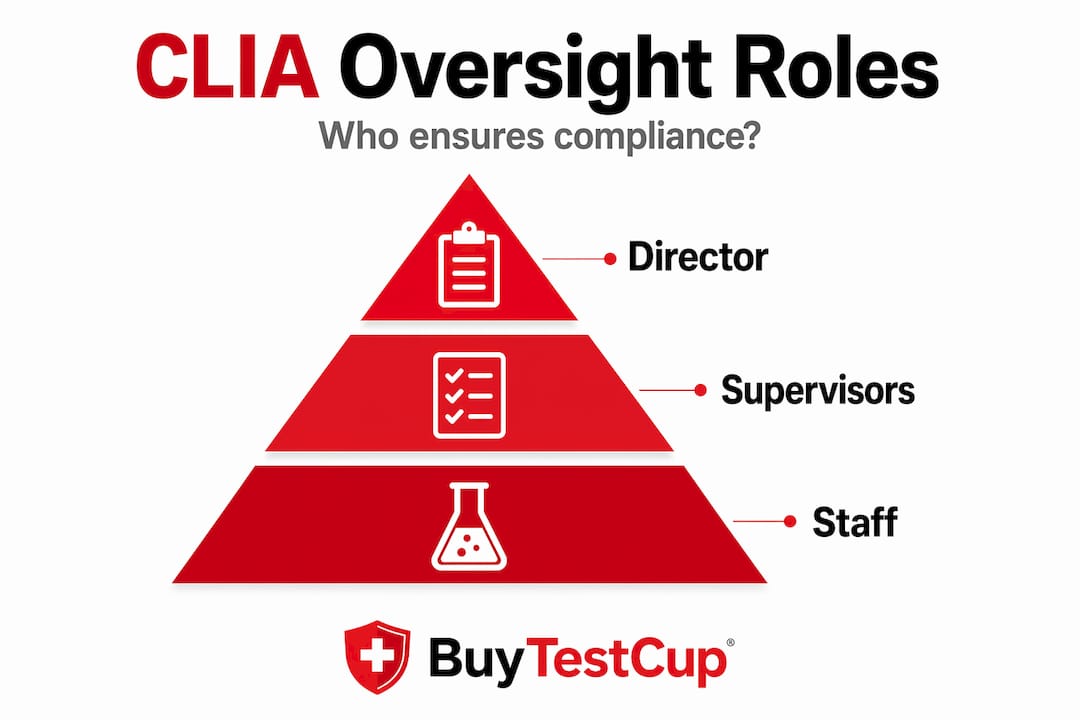
The laboratory director role deserves special attention. New 2025 regulations require the lab director to visit the facility in person at least every six months, with a minimum of four months between visits. A signature is no longer sufficient. CMS expects documented evidence of active participation in oversight.
Step-by-step process for building and maintaining compliance
With your foundational documents in order, you can move to the operational side of compliance. Here is a practical sequence that works whether you are starting from scratch or tightening up an existing program.
-
Submit or renew your CLIA certificate using Form CMS-116. Complete the form accurately, reflecting your actual test menu. If your test menu changes, your certificate category may need to change too.
-
Pay fees online via pay.gov. As of May 2026, all CLIA fees must be paid online. Paper checks are no longer accepted. Keep your lab’s email address current in the CMS system so you receive payment confirmations and renewal notices.
-
Restrict your test menu to your certificate level. If you hold a Certificate of Waiver, you can only run FDA-waived tests exactly as the manufacturer specifies. Modifying a waived test, even slightly, invalidates the waiver and subjects you to higher-complexity standards without the corresponding certificate.
-
Write and maintain standard operating procedures for every test you perform. SOPs should cover pre-analytic, analytic, and post-analytic steps. Review them annually at minimum, and update them any time a manufacturer updates their instructions. Keep version-controlled SOPs in a format staff can access during testing.
-
Enroll in an approved proficiency testing program. For every specialty and analyte requiring PT, treat PT samples exactly as you would patient specimens. Rotating who handles them or rushing through them to meet a deadline will generate results that do not reflect your lab’s true performance.
-
Schedule and document laboratory director visits. Do not wait for a survey to discover your director’s visit log is incomplete. Create a calendar with visit dates, document what was reviewed, and file evidence of active participation, such as meeting notes, staff training sign-off sheets, or corrective action reviews.
-
Implement an error reporting and corrective action system. When something goes wrong, whether a PT failure or a quality control outlier, you need a structured response. Document the root cause, the corrective action taken, and evidence that the action worked. This is not optional. 42 CFR 493.1282 requires detailed documentation preventing recurrence.
Pro Tip: Create a CLIA compliance calendar at the start of each year. Mark renewal deadlines, PT submission windows, director visit minimums, SOP review dates, and competency assessment deadlines. When compliance tasks are scheduled like any other lab workflow, they stop falling through the cracks.
Common pitfalls that lead to citations and shutdowns

Even well-managed labs get cited. The reason is almost always one of a handful of recurring problems, not exotic regulatory violations. Knowing where other labs fail gives you a roadmap for what to watch.
Running tests outside your certificate scope is the fastest path to serious sanctions. If a Certificate of Waiver lab performs a test that is not on the FDA-waived list, CMS can impose immediate jeopardy sanctions. The risk of modification is real even when the intent is to get a more accurate result. When in doubt, look up the test on the FDA database before running it.
Missing fee payments and renewal deadlines seems preventable, yet it remains a common reason labs lose testing authority. With the mandatory transition to online payments, labs that were accustomed to mailing checks need to update their processes now. A lapsed certificate means your testing results are legally invalid during that period.
Inadequate corrective action documentation is among the most cited deficiencies CMS inspectors find. Participating in PT alone is not enough. When a PT failure occurs, inspectors expect to see a documented investigation, a corrective action with clear accountability, and evidence of effectiveness. “We retrained staff” with no supporting records is not acceptable documentation.
Compliance is not a destination you arrive at after an inspection. It is a continuous process, and the labs that understand this build the kind of culture where staff feel empowered to report errors. That openness is what turns a potential citation into a documented improvement rather than a shutdown.
Insufficient laboratory director oversight documentation is the area where new 2025 regulations are catching labs off-guard. Directors who historically signed a few documents per year now need to demonstrate active oversight with records that go beyond signatures. If your director is remote or part-time, build a structured visit protocol now.
Failure to maintain a sanctions risk log leaves labs without a real-time picture of where they stand. A proactive log tracks open deficiencies, assigned owners, target resolution dates, and closure evidence. It gives leadership visibility before an inspector shows up.
Continuous monitoring and internal audits
Passing one inspection does not mean you are set until the next one. The best labs treat compliance verification as an ongoing cycle, not an episodic review. The comparison below shows how reactive labs differ from proactive ones in their approach.
| Practice area | Reactive lab | Proactive lab |
|---|---|---|
| SOP updates | Updated only after a citation | Reviewed annually, updated immediately when needed |
| PT failures | Addressed after inspector review | Root cause documented within 30 days, retraining logged |
| Director visits | Scheduled when survey notice arrives | Calendared at start of year with documented evidence |
| Competency assessments | Done when asked | Scheduled per hire and annually per staff member |
| Fee payments | Paid when reminder arrives | Automated or calendared in advance |
Lab management software can maintain version control on SOPs, automate competency assessment reminders, and preserve audit trails that inspectors can review directly. However, automation introduces its own challenge: labs sometimes assume the software handles compliance, and human oversight decreases. Technology supports compliance. It does not replace the judgment of your compliance officer.
Internal audits work best when they mirror the actual CMS survey process. Use the CMS CLIA checklist as your audit tool. Walk through each section the way a surveyor would. Document your findings, assign corrective actions, and verify closure before the actual inspection window.
Pro Tip: For tests that do not have a formal PT program, you are still required to verify accuracy twice annually using alternative methods. Document those verifications explicitly. This requirement is often missed because labs assume the absence of a PT program means the requirement does not apply.
For labs that want to strengthen their drug test accuracy across every workflow step, integrating compliance checks into the daily testing process is far more effective than a last-minute audit sprint.
My take on compliance in fast-moving labs
I’ve seen labs with outstanding equipment and sharp staff still get cited because leadership treated compliance as the compliance officer’s problem. That’s the core mistake. When the lab director signs off on an oversight record without actually reviewing anything, and when staff hesitate to flag a quality control failure because they’re not sure how it’ll be received, the documentation starts to drift from reality. That drift is exactly what inspectors are trained to find.
What I’ve learned is that the labs with the cleanest inspection records are the ones where compliance is woven into the workflow, not bolted on at the end. They don’t scramble before a survey. They run internal audits on a schedule. Their staff knows what an SOP looks like and where to find it. And when something goes wrong, the first instinct is to document it and fix it, not to minimize it.
Automation helps, but I’ve also seen labs become over-reliant on software to the point where nobody fully understands the regulatory requirements underneath. Know the regulations first. Then use technology to manage the execution.
Compliance is genuinely an opportunity to build a better lab. The documentation requirements exist because they prevent errors. The oversight requirements exist because labs need active leadership. When you see those requirements that way, they stop feeling like a burden and start feeling like a quality framework that protects both patients and your facility.
— matthew
How Buytestcup supports your compliant testing workflow
Maintaining CLIA compliance starts with using the right supplies. At Buytestcup, every product in the catalog is selected with accuracy and regulatory fit in mind. The drug test cups available through the platform are FDA-cleared and CLIA-waived, which means they meet the testing restrictions that Certificate of Waiver labs must follow. Using supplies that fall outside those specifications is one of the fastest ways to generate a compliance citation.
Beyond product selection, Buytestcup offers workflow resources to help labs run tighter operations. The drug screening workflow guide walks through best practices for every stage of the testing process. Labs can also explore the testing strips category for CLIA-compliant strip-based panels. For bulk orders with same-day shipping options, Buytestcup is built to serve the operational pace of clinical and compliance-focused labs.
FAQ
What are the main CLIA certificate types?
CLIA issues three certificate types: Certificate of Waiver for FDA-waived tests only, Certificate of Compliance for moderate and high-complexity testing subject to CMS surveys, and Certificate of Accreditation for labs meeting third-party accreditation standards. Each carries distinct personnel, documentation, and quality standards.
How often does a CLIA Certificate of Waiver need to be renewed?
A Certificate of Waiver must be renewed every two years. Failure to renew on time halts testing operations, and any results produced during a lapsed certificate period are legally invalid.
What happens when a lab fails proficiency testing?
A PT failure does not trigger an automatic shutdown, but it does require a documented root cause analysis, a corrective action plan, and evidence that the action prevented recurrence. CMS expects this documentation to be on file and accessible during inspections.
How do labs pay CLIA fees in 2026?
As of May 2026, all CLIA certification and survey fees must be paid online through the pay.gov platform. Paper check payments are no longer accepted, and labs must maintain a valid email address in the CMS system to receive fee notices and confirmations.
What documentation is required for laboratory director oversight?
Under 2025 CLIA regulations, laboratory directors must conduct in-person visits at least every six months with a minimum of four months between visits. Documentation must show active participation in oversight activities, not just a signature on a form.