


Blog
Why Test for Synthetic Drugs: A 2026 Clinical Guide

TL;DR:
- Testing for synthetic drugs is essential because standard immunoassays often miss these rapidly mutating substances, creating dangerous diagnostic gaps. Accurate detection relies on advanced laboratory methods like LC-MS and HRAM, which provide definitive identification and support effective public health and clinical responses. Ongoing updates to testing panels and strong interdisciplinary collaboration are crucial to mitigating overdose risks and enhancing harm reduction efforts.
Testing for synthetic drugs is the process of detecting novel, chemically diverse substances that standard immunoassay panels routinely miss, creating dangerous gaps in clinical diagnosis, workplace compliance, and public health surveillance. Synthetic drugs, formally classified as new psychoactive substances (NPS), include synthetic cannabinoids, fentanyl analogs, and cathinones that are engineered to mimic controlled substances while evading detection. Standard toxicology screening often misses these compounds entirely because assay panels are built around known drug structures, not the rapidly mutating analogs flooding illicit markets. For healthcare professionals, policymakers, and educators, understanding why test for synthetic drugs is not an academic exercise. It is a prerequisite for accurate clinical decisions, effective regulation, and harm reduction that actually works.
Why test for synthetic drugs in clinical and public health settings
The core reason to test specifically for synthetic drugs is that a negative result on a standard urine drug screen does not mean a patient is drug-free. Negative UDS results cannot reliably exclude acute poisoning by synthetic or novel drugs due to assay coverage gaps and detection limits. That finding has direct consequences in emergency departments where clinicians may dismiss overdose presentations because the tox screen came back clean. The importance of testing synthetic drugs lies precisely in this gap: the patient is symptomatic, the screen is negative, and without a confirmatory method, the exposure goes unidentified.
Synthetic drug testing benefits extend beyond the bedside. Accurate detection data feeds into early warning systems, informs scheduling decisions by regulatory agencies, and shapes harm reduction messaging at the community level. When forensic labs cannot identify a substance circulating in a local drug supply, public health agencies cannot warn users, clinicians cannot prepare antidote protocols, and policymakers cannot act on evidence. Testing is the foundation every downstream response depends on.
What are synthetic drugs and how do they differ from traditional drugs?
Synthetic drugs are laboratory-manufactured compounds designed to replicate the psychoactive effects of controlled substances while maintaining enough structural novelty to avoid existing legal definitions and immunoassay detection. The category includes:
- Synthetic cannabinoids (e.g., JWH-018, AB-FUBINACA): bind to cannabinoid receptors with far greater potency than THC, producing seizures and cardiac events not seen with cannabis
- Synthetic opioids (e.g., fentanyl analogs like carfentanil, nitazenes): active at nanogram concentrations, making standard opioid panels miss them entirely
- Synthetic cathinones (“bath salts,” e.g., mephedrone, MDPV): stimulant compounds structurally related to amphetamines but not detected by amphetamine assays
- Benzodiazepine analogs (e.g., etizolam, clonazolam): not included in standard benzo panels, causing missed sedative toxicity
The critical difference from classical drugs is metabolic and structural. Traditional drugs like heroin or cocaine have well-characterized metabolites that immunoassay antibodies are calibrated to detect. Synthetic analogs are modified at the molecular level, producing different metabolites at different concentrations, which means the antibody simply does not bind. Understanding synthetic drug dangers requires recognizing that each structural modification is, in effect, a new detection problem.
Pro Tip: When a patient presents with clinical signs of intoxication but a negative standard screen, request a specific NPS panel or LC-MS confirmation before ruling out synthetic drug exposure. The negative result is presumptive, not definitive.

Why do standard drug tests often fail to detect synthetic drugs?
Standard urine drug screens use immunoassay technology calibrated to detect specific drug classes at defined cutoff concentrations. The assay works by competitive binding: if the target drug or its metabolite is present above the cutoff, the test signals positive. The problem with synthetic drugs is structural novelty. A fentanyl analog modified at two positions may not bind the fentanyl antibody at all, producing a false negative even at a lethal dose.
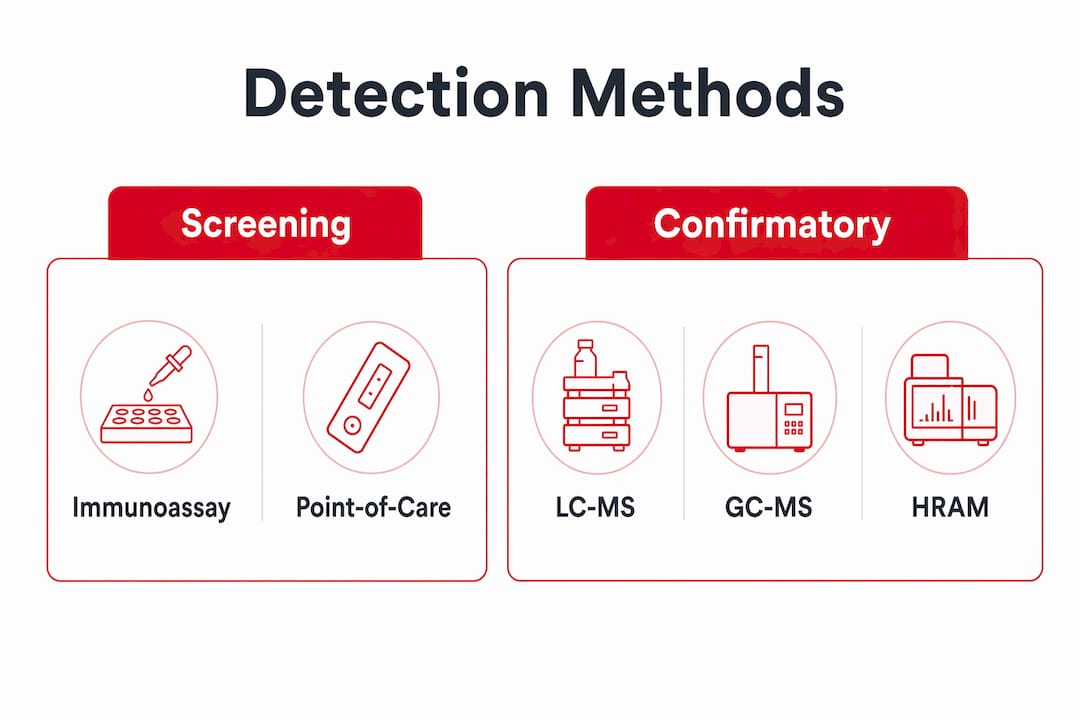
| Testing method | Detection of synthetic drugs | Speed | Confirmatory value |
|---|---|---|---|
| Immunoassay (urine) | Low to moderate | Minutes | Presumptive only |
| Point-of-care strips | Variable, often low | Minutes | Presumptive only |
| LC-MS (liquid chromatography-mass spectrometry) | High | Hours | Definitive |
| GC-MS (gas chromatography-mass spectrometry) | High | Hours | Definitive |
| HRAM (high-resolution accurate mass) | Very high | Hours | Definitive |
Immunoassay-based screening must be treated as presumptive. Both false negatives and false positives occur with synthetic drugs, and a negative result cannot reliably exclude exposure when NPS are suspected. This is not a flaw in the technology so much as a fundamental mismatch: immunoassays were designed for a drug market that no longer exists.
Point-of-care strips present a similar challenge. First-generation xylazine test strips detect high-concentration samples more reliably but show low sensitivity at lower doses, meaning a strip can miss a clinically significant exposure. Speed is their advantage. Accuracy at the margins is not.
Pro Tip: When reviewing drug testing methods for your institution, consult a drug testing methods comparison resource to understand where immunoassay panels end and confirmatory analysis must begin.
What laboratory methods improve synthetic drug detection?
Modern toxicology labs address the detection gap through tiered workflows that combine rapid presumptive screening with definitive confirmatory analysis. The sequence matters because it balances speed with accuracy.
- Presumptive screening: Immunoassay panels or point-of-care strips provide a rapid first pass. Results guide clinical management while confirmatory testing proceeds.
- Targeted LC-MS panels: Liquid chromatography-mass spectrometry identifies specific synthetic compounds by molecular weight and fragmentation pattern. Labs update these panels as new analogs emerge.
- Untargeted HRAM analysis: High-resolution accurate mass spectrometry scans for any compound in a sample without requiring prior knowledge of what is present. This is the method of choice when a completely unknown substance is suspected.
- Wastewater and population-level monitoring: LC-MS methods applied to wastewater samples detect synthetic cannabinoids and NPS at the community level, providing early warning before clinical cases accumulate.
UK toxicology labs use immunoassay screening followed by confirmatory LC-MS, GC-MS, or HRAM analysis to accurately identify NPS and reduce misclassification risks. This tiered workflow addresses the unknown potencies and complex analog structures that make synthetic drugs so difficult to characterize. The UK model is now referenced internationally as a benchmark for NPS detection.
Synthetic cannabinoids metabolize into structurally similar analytes, requiring highly sensitive LC-MS methods with advanced chromatographic resolution to accurately distinguish analogs and prevent misidentification. That level of resolution is not available at the point of care. It requires laboratory infrastructure, trained analysts, and continuously updated reference libraries. Institutions that rely solely on rapid strips for synthetic drug detection are operating with a significant blind spot.
The practical implication for policymakers funding toxicology capacity: a lab that cannot run LC-MS cannot reliably detect the synthetic drugs currently driving overdose mortality. Capital investment in instrumentation is not optional. It is the minimum requirement for a functional detection system.
How does synthetic drug testing support public health surveillance and policy?
Synthetic drug testing is the primary data source for every effective public health response to NPS. Without confirmed identification of circulating substances, the following functions break down:
- Early warning systems: The UNODC Early Warning Advisory compiles forensic data from 130+ countries to support coordinated international responses to NPS. That network depends entirely on member labs producing confirmed identification data, not presumptive screen results.
- Regulatory scheduling: Drug control agencies schedule substances based on forensic evidence. A substance that is never confirmed in a lab sample cannot be scheduled, meaning it remains legal and uncontrolled regardless of the harm it causes.
- Clinical protocol development: Antidote selection, supportive care protocols, and poison control guidance all require knowing what substance the patient was exposed to. Confirmed testing data drives those decisions.
- Harm reduction messaging: Community-based programs can only warn users about specific substances if those substances have been identified. Vague alerts about “unknown synthetic drugs” have limited behavioral impact.
National systems must coordinate laboratory findings into actionable alerts to keep pace with synthetic drug trends. The challenge is speed. A new synthetic opioid can move from first appearance in a forensic sample to widespread street distribution in weeks. Testing infrastructure that takes months to update its panels cannot provide the early warning that prevents deaths. International forensic collaboration and early warning systems supported by comprehensive synthetic drug testing enable proactive harm mitigation and policy adaptation. Brazil’s partnership with UNODC and INCB on forensic training is a concrete example of how testing capacity translates directly into policy readiness.
What are best practices for healthcare professionals and policymakers?
Improving synthetic drug detection requires both technical and institutional changes. The following practices reflect current evidence and international best practice:
- Treat all presumptive negative immunoassay results as inconclusive when synthetic drug exposure is clinically suspected. Order confirmatory LC-MS or GC-MS analysis before discharging or clearing a patient.
- Implement tiered testing protocols that specify when to escalate from screening to confirmation. A written protocol prevents individual clinicians from making ad hoc decisions that miss exposures.
- Update testing panels at least annually, or whenever a new NPS is confirmed in your region. Testing panels and methods must evolve continuously, as synthetic drug compositions change faster than regulatory scheduling.
- Invest in toxicology laboratory capacity. Institutions that outsource all confirmatory testing face turnaround delays that compromise clinical decisions and surveillance timelines.
- Communicate test limitations clearly to all stakeholders. Clinicians, employers, and policymakers who do not understand the difference between a presumptive screen and a confirmed result will misinterpret negative findings.
Pro Tip: When selecting multi-panel test cups for institutional screening programs, verify which specific synthetic drug analytes are included in the panel. “Multi-panel” does not automatically mean NPS coverage.
The detection gap no one talks about enough
I have spent years watching institutions make the same mistake: they invest in drug testing infrastructure, run regular screens, and then treat a negative result as a clean bill of health. The problem is that the synthetic drug market has fundamentally changed what a negative result means. It no longer means the person is drug-free. It means the substances they used were not on the panel.
The field is not short on technology. LC-MS instruments exist. HRAM platforms exist. The gap is institutional: labs that have not updated their reference libraries in two years, clinicians who do not know to request a confirmatory test, and policymakers who fund testing programs without funding the method validation that keeps those programs accurate. The UK’s tiered NPS workflow did not emerge from a single policy decision. It emerged from years of forensic data showing that immunoassay alone was producing dangerously misleading results.
The most underappreciated recommendation I can offer is this: build relationships between your clinical toxicology team and your public health surveillance unit. The data those labs generate should be flowing directly into early warning systems, not sitting in a database no one queries. Interdisciplinary collaboration between clinicians, toxicologists, and policymakers is not a soft recommendation. It is the mechanism by which testing data becomes harm reduction.
— matthew
How Buytestcup supports your synthetic drug testing program
Buytestcup supplies the drug testing infrastructure that healthcare institutions, government agencies, and harm reduction programs depend on for accurate, compliant screening. The catalog includes drug test cups with multi-panel configurations and adulterant detection built in, as well as point-of-care test strips suited for rapid presumptive screening before confirmatory analysis. All products are CLIA waived and available for bulk ordering with same-day shipping options. For organizations building or updating a synthetic drug detection workflow, Buytestcup’s drug testing program guide outlines how to integrate presumptive and confirmatory testing into a compliant, evidence-based protocol.
FAQ
What are synthetic drugs in clinical terms?
Synthetic drugs, formally called new psychoactive substances (NPS), are laboratory-manufactured compounds designed to mimic controlled substances while evading standard immunoassay detection. They include synthetic cannabinoids, fentanyl analogs, cathinones, and benzodiazepine analogs.
Why do standard urine drug screens miss synthetic drugs?
Standard immunoassay panels are calibrated to detect specific drug structures and their known metabolites. Synthetic analogs are modified at the molecular level, so the assay antibody does not bind them, producing a false-negative result even when the patient has been exposed.
What confirmatory method is most reliable for synthetic drug detection?
LC-MS (liquid chromatography-mass spectrometry) and HRAM (high-resolution accurate mass) spectrometry are the gold standard confirmatory methods. UK toxicology labs use these methods after immunoassay screening to accurately identify NPS and reduce misclassification.
How does synthetic drug testing support harm reduction programs?
Confirmed identification of circulating synthetic substances allows harm reduction programs to issue specific warnings, guide clinical antidote protocols, and inform community outreach. Testing data is the foundation of drug testing’s role in any effective harm reduction strategy.
How often should testing panels be updated to cover new synthetic drugs?
Testing panels require continuous updates because synthetic drug compositions change faster than regulatory scheduling cycles. At minimum, panels should be reviewed annually and updated whenever a new NPS is confirmed circulating in the local or regional drug supply.