


Blog
Bulk drug test purchasing: Compliance tips and smart strategies


TL;DR:
- Procurement officers face intense pressure to ensure drug testing programs remain compliant, cost-effective, and supply chain resilient. Understanding regulatory requirements, product options, and contract strategies is crucial to making confident bulk purchasing decisions that uphold compliance and operational efficiency. Regular vendor oversight and leveraging cooperative purchasing frameworks help prevent compliance drift and secure reliable, cost-efficient supply arrangements.
Procurement officers managing drug testing programs operate under intense pressure. Every contract decision carries compliance risk, budget scrutiny, and supply chain exposure all at once. A single non-compliant vendor or an improperly certified lab can trigger regulatory violations that threaten your entire testing program. Real-world contracts put the scale in perspective: Nebraska awarded a state contract for 460,000 drug test kitsawd.pdf) at $1.00 per unit through the MMCAP cooperative, illustrating just how significant both the volume and the precision of these procurement decisions can be. This guide walks you through the compliance requirements, product options, contract strategy, and vendor vetting steps you need to make confident, defensible bulk purchasing decisions.
Key Takeaways
| Point | Details |
|---|---|
| Check lab certifications | Always verify your vendor uses up-to-date HHS-certified labs to ensure regulatory compliance. |
| Match test type to use case | DOT programs demand lab-based tests, while instant cups suit non-regulated screening needs. |
| Benchmark and negotiate pricing | Use public contract data to inform negotiations and secure volume-based discounts for bulk drug test kits. |
| Prioritize contract flexibility | Include vendor replacement and strict service requirements in contracts to reduce procurement risk. |
| Set up ongoing reviews | Regularly audit supplier compliance and testing quality to avoid costly disruptions. |
Key compliance criteria for bulk drug testing solutions
Before you issue a single purchase order, you need a clear picture of the regulatory environment your testing program operates within. Compliance requirements are not uniform. They vary by program type, funding source, and the population being tested. Getting this wrong creates liability, not just paperwork.
Federal agencies conducting workplace drug testing are required to use HHS-certified labs for all testing activity, with the list of certified labs updated monthly in the Federal Register. That monthly update matters more than many procurement officers realize. A lab that was certified at contract signing may lose certification mid-contract, and if your program continues sending specimens there, you’re out of compliance regardless of the paper trail.
For programs governed by the Department of Transportation, the requirements are even more prescriptive. DOT-regulated testing mandates the use of HHS-certified labs, the Federal Custody and Control Form (CCF), split specimen collection, and full compliance with 49 CFR Part 40 procedures. These are not optional best practices. They are hard requirements, and your testing supply chain must support every one of them.
Understanding drug testing compliance also means understanding what is explicitly prohibited. Instrumented Initial Test Facilities (IITFs) cannot be used for DOT-regulated programs. Instant on-site test cups, no matter how accurate or cost-effective, are not acceptable substitutes in DOT contexts. Many procurement officers conflate general drug testing standards with DOT-specific ones, which creates gaps.
Here is a quick summary of core compliance checkpoints every procurement officer should verify before contracting:
- Confirm the testing program type (DOT-regulated, federal non-DOT, or state-level non-regulated)
- Verify that your laboratory vendor holds current HHS certification
- Confirm that the Federal Custody and Control Form is used for all DOT collections
- Ensure split specimen collection procedures are built into collection site protocols
- Check that IITFs are not proposed for any regulated program positions
Key regulatory insight: Non-DOT programs have more flexibility, including the option to use CLIA-waived on-site test cups. DOT programs do not have that flexibility. Understanding the line between these two program types is one of the most important distinctions in drug testing procurement.
Reviewing drug testing standards before finalizing any contract scope ensures your specifications align with the actual regulatory requirements, not just general industry norms.
Evaluating product types: Lab-based vs. instant drug tests
Once you understand your compliance landscape, the next decision is product selection. The choice between lab-based testing and instant on-site test cups shapes your cost structure, turnaround time, and regulatory validity. Neither option is universally superior. The right choice depends on what your program demands.
Lab-based testing involves sending collected specimens to an HHS-certified laboratory for analysis. Results typically take 24 to 72 hours. This method offers the highest level of legal defensibility, making it the required approach for DOT and most federal workplace programs. Lab-based tests also support Medical Review Officer (MRO) review, which is mandatory in regulated programs. The tradeoff is cost and time. Lab processing fees, courier logistics, and specimen storage add up quickly at high volumes.
Instant drug test cups (also called point-of-care tests) deliver results in minutes, right at the collection site. For non-DOT programs such as pre-employment screening in non-safety-sensitive roles, probation monitoring, or substance abuse treatment programs, these cups offer real advantages. They’re faster, cheaper per unit, and require far less administrative overhead. CLIA-waived instant test cups are accepted in many non-regulated contexts.
The important boundary, as reinforced by DOT program guidelines, is that on-site cups are explicitly prohibited for DOT-regulated testing. Many agencies manage both regulated and non-regulated populations simultaneously, which means you may need to source both product types and establish clear internal protocols for which test applies to which employee group.
SAMHSA guidance reinforces that while commercial suppliers emphasize legitimate cost savings via bulk instant kits, federal regulations prioritize certified laboratory services for any regulated program. The cost savings from instant cups are real, but only valid when applied to the right population.
| Feature | Lab-based tests | Instant test cups |
|---|---|---|
| Result turnaround | 24 to 72 hours | 2 to 5 minutes |
| DOT compliance | Required | Prohibited |
| Non-DOT use | Acceptable | Acceptable (CLIA-waived) |
| Unit cost (bulk) | Higher | Lower |
| MRO review | Mandatory | Not required |
| Chain of custody | Full CCF required | Simplified or internal |
| Legal defensibility | Highest | Adequate for non-regulated |
Pro Tip: If your agency manages both DOT and non-DOT employees, create separate procurement line items for each product type with different specifications, certifications, and protocols. Mixing the two in a single product line is a common source of compliance errors.
When evaluating your bulk drug test supplies options, always request product documentation that specifies whether a given test cup carries CLIA waiver status and which drug panels it covers. Matching the panel to your program’s required analytes is just as important as the test format itself.
Cost, volume, and contract structure: Getting value in bulk deals
Product type determines your baseline costs, but the contract structure is where you can generate serious savings or lock yourself into a costly arrangement. Getting this right requires understanding what the market actually bears and what protections belong in every government or healthcare agency contract.

The Nebraska MMCAP contractawd.pdf) remains one of the clearest public benchmarks available. At $1.00 per unit for 460,000 test kits, it demonstrates what aggressive cooperative purchasing can accomplish. Not every agency will reach that price point, but it gives you a defensible reference when negotiating with vendors who propose significantly higher per-unit rates.
Cooperative purchasing agreements, such as MMCAP, GSA Schedule contracts, and state-run cooperative frameworks, allow agencies to piggyback on already-negotiated terms. This saves procurement time and often unlocks volume pricing that individual agencies could never reach on their own. If your agency is not already exploring cooperative purchasing for drug testing supplies, that is the fastest way to close the price gap.
Here is a step-by-step approach to structuring a high-value bulk drug test contract:
- Establish your annual volume estimate. Use prior-year usage data plus any expected program growth. Underestimating volume leaves money on the table. Overestimating creates storage and expiration problems.
- Define tiered pricing thresholds. Negotiate unit price reductions at defined order quantities (for example, different pricing at 10,000, 50,000, and 100,000 units). Lock those tiers into the contract.
- Set shipping and delivery service levels. Specify maximum delivery windows, require same-day or next-day shipping for urgent orders, and define penalties for late deliveries.
- Include a vendor replacement clause. DOT employer guidelines support the right to replace vendors who fall out of compliance. Make this an explicit contractual right, not just an implied one.
- Require ongoing compliance documentation. The vendor must supply updated lab certification records at defined intervals, not just at contract initiation.
| Volume tier | Typical unit price range | Notes |
|---|---|---|
| Under 5,000 units | $2.50 to $4.00 | Standard commercial pricing |
| 5,000 to 25,000 units | $1.75 to $2.50 | Small agency bulk pricing |
| 25,000 to 100,000 units | $1.25 to $1.75 | Government contract range |
| 100,000 and above | $1.00 to $1.25 | Cooperative/state contract level |
Pro Tip: Always request a price hold period of at least 12 months in your contract. Supply chain disruptions can cause vendors to push price increases mid-contract. A firm price hold protects your budget and ensures supply continuity for programs with annual appropriations.
The bulk savings benefits available to agencies go well beyond unit price. Free shipping thresholds, dedicated account support, and guaranteed stock availability for priority government accounts are all negotiable terms worth including in your request for proposal (RFP).
Checklist for vendor selection and quality assurance
Contracts protect you on paper. Vendor selection determines what actually happens in practice. Agencies that skip thorough due diligence often discover quality and compliance problems after the contract is signed, which is the worst time to find out your supplier cannot deliver.
Here is a practical vendor evaluation checklist tailored for bulk drug testing procurement:
- Verify current lab certification status. The certified labs list is updated monthly in the Federal Register. Require vendors to provide written confirmation of certification within the past 30 days, not just a certificate from the time of application.
- Request compliance documentation specific to your program type. If you run a DOT program, ask for documentation confirming CCF compatibility, split specimen capability, and 49 CFR Part 40 adherence.
- Evaluate service responsiveness. Contact the vendor’s support team with a technical question before signing. Response time and quality of answer reveal a lot about what you’ll get post-contract.
- Conduct a pilot order before full deployment. Order a small batch, test it against your collection site protocols, and verify that results are consistent and documentation is complete before committing to full volume.
- Review expiration date management practices. High-volume purchases can create expiration risks if the vendor ships product with short shelf life. Specify minimum remaining shelf life (typically 12 months) in your contract.
- Assess storage and logistics infrastructure. Vendors with distributed warehouses can fulfill emergency orders faster. Ask specifically about warehouse locations and emergency fulfillment capabilities.
Understanding why bulk drug testing is the right approach also means understanding that reliability is not a one-time achievement. It requires ongoing monitoring.
Beyond initial selection, set a calendar for periodic vendor reviews. Quarterly check-ins on certification status, product quality reports, and delivery performance data keep small issues from becoming program-threatening problems. Agencies with strong reliable compliance supplies relationships build those relationships intentionally, not by default.
- Schedule quarterly vendor compliance reviews as a standing calendar item
- Audit a random sample of test results each month for documentation completeness
- Track delivery performance against contract SLAs and document any misses
- Maintain a short list of backup suppliers in case your primary vendor fails to perform
Where bulk drug test purchasing breaks down: What we see in real-world agency contracts
We work with government agencies and healthcare procurement teams regularly, and the pattern of failure is remarkably consistent. It rarely starts with a bad vendor. It starts with a good contract that nobody monitors after it’s signed.
The most common breakdown we see is compliance drift. An agency does everything right at the start: they verify lab certifications, they specify CCF forms, they negotiate reasonable pricing. Then six months in, nobody has checked whether the lab’s certification was renewed. The vendor hasn’t flagged it. The agency hasn’t asked. And suddenly you have a program that has been operating out of compliance for two quarters, with results that may not hold up to scrutiny.
The second pattern is over-reliance on price as the primary vendor selection criterion. We understand budget pressure. But procurement officers who evaluate vendors almost entirely on unit cost frequently end up with suppliers who cut corners on documentation, ship product with short shelf life, or become unresponsive when problems arise. A vendor offering $0.10 less per unit while delivering incomplete compliance documentation is not a bargain.
There is also a structural problem in how many agencies scope their contracts. They specify the product and the price but leave service levels vague. “Timely delivery” is not a service level. “Delivery within three business days of order confirmation, with a replacement shipment at no charge for any order delivered late” is a service level. The difference matters when your testing program has a hard deadline and your supplier misses it.
The essential role of compliance in drug testing is not just regulatory. It is operational. Agencies that treat compliance monitoring as a continuous activity, not an annual checkbox, consistently outperform those that rely on the contract alone to manage vendor behavior.
Our strongest advice: build the vendor review cadence into the contract itself. Make it a contractual obligation for the vendor to submit updated certification documentation on a defined schedule. Make it a defined internal responsibility for a named staff member to review it. That single structural change eliminates the majority of compliance drift problems we see.
Streamline your agency’s bulk drug testing supply process
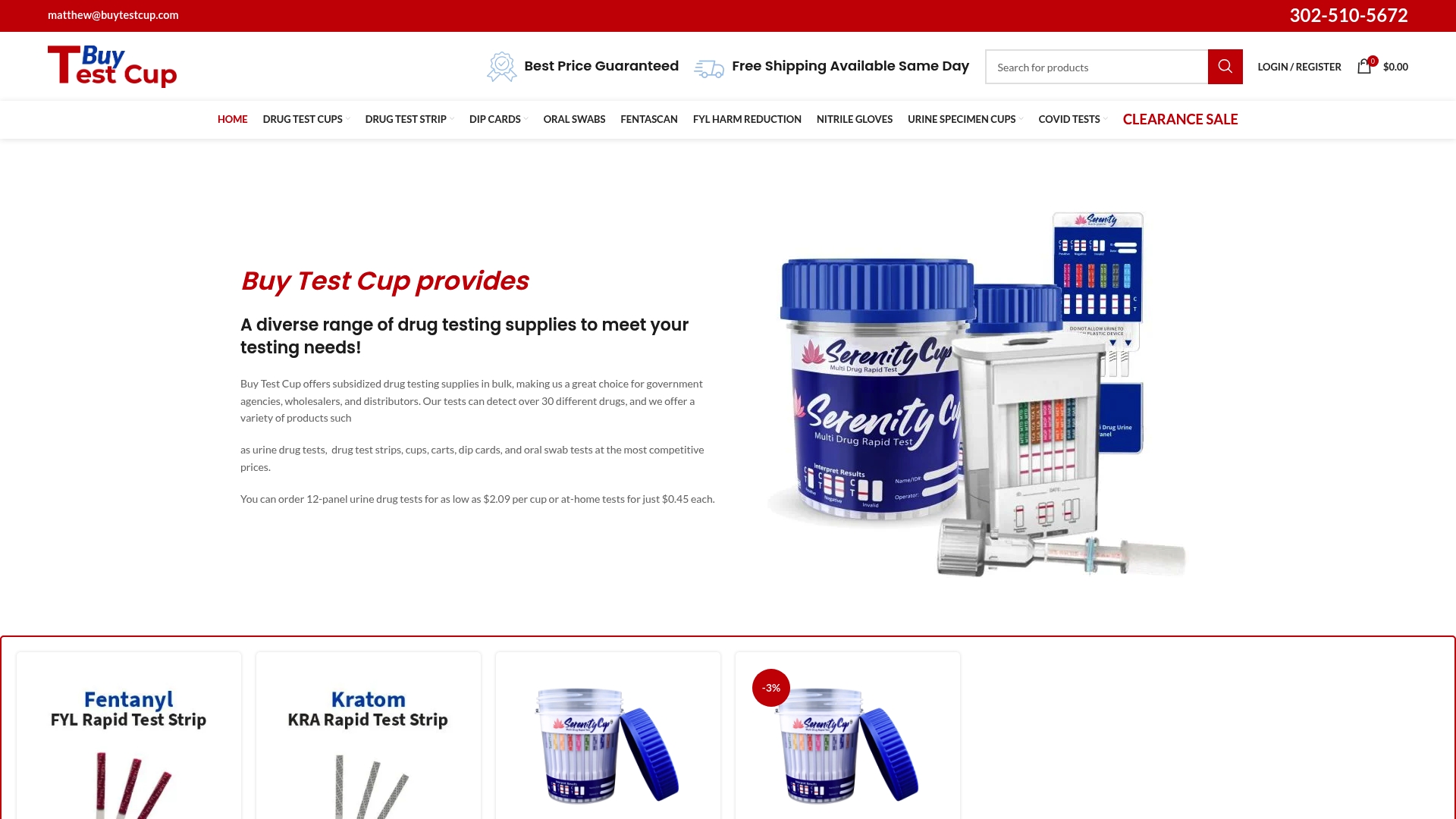
Putting these frameworks into practice is significantly easier when your supplier is already equipped to support government and healthcare procurement workflows. At Buy Test Cup, we specialize in exactly this kind of bulk supply relationship. Our catalog of drug test cups includes CLIA-waived multi-panel options suited for non-DOT programs, with same-day shipping and free bulk shipping on large orders. For agencies building or refining a drug testing program, we provide compliance documentation support and product guidance to match the right kit to your program requirements. Products like our 12 Panel PCP Cup offer broad panel coverage in a single cost-effective unit, ideal for high-volume non-DOT screening environments. Contact our government accounts team to discuss volume pricing, RFP support, and supply continuity planning.
Frequently asked questions
What defines a compliant drug test kit for federal contracts?
A compliant kit for federal contracts must route specimens through a current HHS-certified lab, with certification status verified monthly via the Federal Register. On-site instant cups alone do not meet federal compliance requirements for regulated workplace programs.
Can instant drug test cups be used for DOT-regulated testing?
No. DOT prohibits instant test cups and requires lab-based testing with split specimen collection, use of the Federal Custody and Control Form, and compliance with 49 CFR Part 40. Instant cups are only appropriate for non-regulated testing populations.
How can agencies secure the lowest pricing when buying drug tests in bulk?
The most effective approach is cooperative purchasing through state or federal frameworks, which can deliver pricing as low as $1.00awd.pdf) per unit at high volumes, as demonstrated by the Nebraska MMCAP contract.
What should a procurement contract include for reliable service?
A solid contract should specify delivery timelines, support response standards, required lab certification updates, and an explicit vendor replacement clause that activates when a supplier falls out of compliance or fails to meet service levels.