


Blog
CLIA-Waived Tests: Compliance, Quality, and Best Practices


TL;DR:
- CLIA-waived tests are simple, low-risk, and legally require strict adherence to manufacturer instructions.
- Non-compliance risks include protocol deviations, expired kits, and inadequate staff training leading to citations.
- Rigorous documentation, regular audits, and staff training are essential for maintaining waived testing compliance and quality.
CLIA-Waived Tests: Compliance, Quality, and Best Practices
81% of CLIA-certified labs hold a Certificate of Waiver, which makes waived testing the dominant model in point-of-care drug screening. That popularity, though, has a hidden cost: many compliance officers and clinic managers mistakenly treat “waived” as a synonym for “no strings attached.” The reality is more demanding. Missteps ranging from a single protocol deviation to skipping a quality control step can trigger inspections, fines, or complete certificate revocation. This guide breaks down what CLIA-waived status actually means, the compliance rules that govern it, the mistakes most likely to get your organization cited, and the daily practices that keep your program airtight.
Key Takeaways
| Point | Details |
|---|---|
| Strict protocol adherence | Only use CLIA-waived tests exactly as specified by the manufacturer to remain compliant. |
| Understand compliance risks | Deviating from protocols can trigger heavy penalties and loss of waiver status. |
| Ongoing QC is essential | Regular internal quality checks and training protect your organization from errors and citations. |
| Stay updated | Regularly check FDA databases to ensure your drug test’s waived status hasn’t changed. |
What are CLIA-waived tests and why do they matter?
The Clinical Laboratory Improvement Amendments (CLIA) of 1988 established federal standards for laboratory testing on human specimens. CMS (Centers for Medicare and Medicaid Services) administers the program, and every facility that performs lab testing must hold an active CLIA certificate. Tests are sorted into three complexity tiers: waived, moderate complexity, and high complexity. Understanding which tier your test falls under is not optional. It determines the regulatory burden placed on your facility.
Waived tests occupy the lowest regulatory tier because the FDA has determined they are simple to perform and carry minimal risk of producing an incorrect result when used correctly. Think of them as the most forgiving tier, not the most flexible. Characteristics that earn a test its waived status include straightforward operating procedures, easy-to-read results, and a low likelihood that a testing error would harm a patient. Rapid immunoassay urine drug test cups are a textbook example. They require no specialized equipment, generate a visual result in minutes, and can be operated by staff without advanced laboratory training.
For workplace drug testing, substance abuse programs, and clinic-based screening, these qualities are enormously valuable. Speed matters. Cost matters. The ability to deliver a result at the point of care without shipping specimens to a reference lab is a genuine operational advantage. That practical appeal explains the dominance of waived testing across industries.
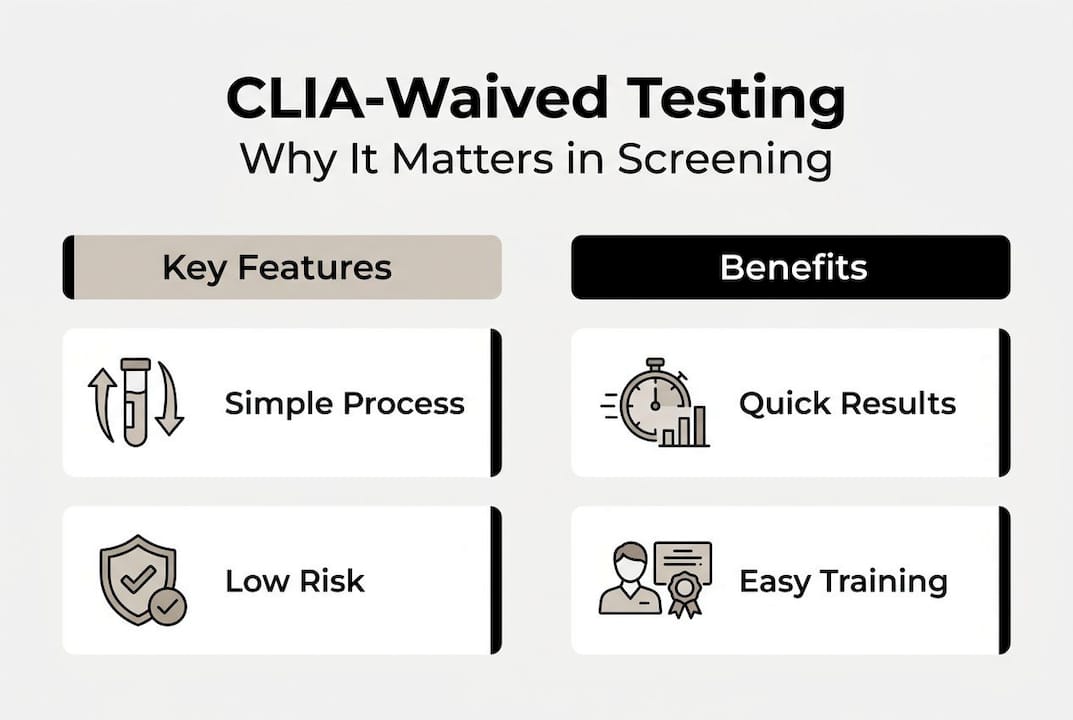
Here is how the three complexity tiers compare:
| Feature | Waived | Moderate complexity | High complexity |
|---|---|---|---|
| Inspector oversight | Complaint-based | Routine surveys | Routine surveys |
| Staff qualification requirements | Minimal | Defined education/training | Advanced education/training |
| Proficiency testing required | No | Yes | Yes |
| QC documentation | Per manufacturer | Mandated protocols | Mandated protocols |
| Certificate cost | $180 (2-year) | Higher fees apply | Higher fees apply |
The waived certificate exempts labs from routine inspections, but that exemption is conditional. Labs must use FDA-approved specimen types, follow the manufacturer’s quality control procedures, and operate strictly within the approved test protocol. Veer outside those boundaries, and the exemption evaporates.
Among the most widely used waived products are CLIA-waived drug test panels that screen for 15 or more substances simultaneously. These multi-panel cups give compliance officers a cost-efficient and legally defensible screening option, provided the testing program follows every rule attached to waived status.
Key benefits of waived tests at a glance:
- Results in 5 minutes or less at the point of care
- No specialized lab equipment required
- Lower certificate fees compared to moderate or high complexity
- Accessible to trained non-laboratory personnel
- Broad panel options covering opioids, stimulants, benzodiazepines, and more
The CDC supports waived testing programs through educational materials, including its “Ready? Set? Test!” resource, which helps facilities understand good practices for waived testing. Accessing those materials is a smart starting point for any team managing a new or growing drug screening program.
Key compliance rules for CLIA-waived drug testing
Waived status comes with a clearly defined set of rules, and the threshold for violating them is lower than most people realize. The central compliance requirement is deceptively simple: follow the manufacturer’s instructions exactly. Every step, every specimen type, every timing window, and every QC procedure described in the package insert carries legal weight.
Here is what that means in practice:
- Use only FDA-approved specimen types. If the test is validated for urine, you cannot switch to oral fluid without triggering a higher complexity classification.
- Adhere strictly to incubation times. Reading a result one minute early or late is a deviation. Deviations create liability.
- Perform quality control as instructed. Most waived test manufacturers specify using positive and negative controls. Skipping this step is a compliance error.
- Document everything. Even though waived labs are not required to maintain certain records under federal minimums, documentation is your best protection during a complaint-based inspection.
- Keep staff trained on the current package insert. Manufacturers update instructions. A test kit purchased today may have slightly different procedural language than the one you used six months ago.
Any deviation from manufacturer instructions automatically converts the test to high complexity, meaning your facility would need to meet a completely different and far more demanding set of CLIA standards without being certified to do so. That gap is exactly what triggers enforcement actions.
Although waived labs are not subject to routine surveys, CMS can and does inspect them when a complaint is filed. A disgruntled employee, an abnormal result that leads to a disputed termination, or a patient complaint is enough to open an investigation. At that point, your documentation is the only thing standing between your organization and a citation.
“The ‘waived’ label means simplified compliance, not zero compliance. Every step your team skips is a step toward a citation you could have easily avoided.”
A real-world example worth noting: clinics have been cited for using unapproved collection devices and for delegating testing to staff who had no familiarity with the package insert. In both cases, the citation was avoidable with basic training and a written protocol. Using a 6-panel CLIA-waived test or a CLIA-waived fentanyl test does not substitute for a documented workflow that your staff follows consistently.
Pro Tip: Laminate the package insert for each test type your lab uses and post it at the testing station. Staff should not have to hunt for the instructions when they are running a test under time pressure.
Common mistakes and compliance risks to avoid
Even well-intentioned organizations fall into predictable traps. The compliance risks associated with CLIA-waived drug testing are real, and the consequences go well beyond a written warning.
The most common errors that get organizations cited:
- Using non-FDA-approved specimen types. Substituting a different matrix (saliva instead of urine, for example) when the test is validated only for urine is one of the most common and most serious errors.
- Skipping quality control steps. Omitting the positive and negative control runs specified by the manufacturer invalidates results and creates a documentation gap.
- Modifying test reading windows. Reading results outside the manufacturer’s specified time frame produces unreliable data and constitutes a protocol deviation.
- Failing to maintain a test log. No log means no defense during an inspection.
- Using expired test kits. Expired reagents compromise accuracy and represent a deviation from the manufacturer’s approved conditions.
- Inadequate staff training. Staff who cannot name the steps in the package insert are a liability risk, regardless of how many tests they have run.
Non-compliance consequences include formal citations, revocation of your CLIA certificate, financial penalties, and loss of Medicare billing privileges. A clinic that loses Medicare billing over a lab compliance issue does not just absorb a fine. It faces a revenue disruption that can take months to resolve. One documented case involved a clinic cited for operating outside the scope of its waiver by modifying specimen collection procedures without authorization. The resulting investigation required a corrective action plan and cost the facility significantly in both time and administrative resources.
Statistic to take seriously: An overwhelming majority of waived testing failures stem from procedural errors, not product defects. The test is rarely the problem. The process is.

Self-audits are your most practical defense. Set a quarterly calendar reminder to review your testing log, verify staff training records, check kit expiration dates, and confirm that your current package insert matches the version on file. Using a 13-panel CLIA-waived cup with a clearly structured QC protocol reduces the surface area for errors at every step.
Pro Tip: Assign one person per shift as the QC lead for drug testing. Accountability tied to a specific role rather than a general “everyone is responsible” expectation dramatically reduces compliance gaps.
Quality control, best practices, and ongoing responsibilities
Knowing the risks, the natural next question is: what does a reliable, repeatable quality control routine actually look like for a waived drug testing program?
The foundation is the package insert. Every FDA-cleared waived test comes with one, and it specifies every element of a valid QC routine including control frequency, acceptable result ranges, and storage requirements. Following it is not optional. It is your compliance baseline.
The CDC’s educational program “Ready? Set? Test!” offers structured guidance on QC practices for waived testing facilities. The program covers staff training, result documentation, and quality assessment approaches even though routine proficiency testing is not federally mandated for waived labs. The CDC explicitly encourages waived labs to voluntarily participate in quality assessment activities to catch systematic errors before they affect patient care or compliance outcomes.
One area that catches organizations off guard is EUA (Emergency Use Authorization) status. During public health emergencies, some tests receive temporary FDA authorization at the waived level. Once the emergency period ends, those tests may be reclassified. You can check current waived status through the FDA CLIA-waived analytes database before purchasing or deploying any test. This is a step many purchasing teams skip, and it creates exposure.
For multi-panel CLIA-waived options that screen for opioids, fentanyl analogs, and other substances, the QC routine becomes even more important because you are managing multiple analytes simultaneously.
A practical QC checklist your team can use per testing session:
- Confirm test kit is within its expiration date
- Check storage conditions (temperature log for the storage area)
- Verify specimen collection followed approved procedures
- Run positive and negative controls per the package insert
- Read results within the manufacturer-specified window
- Document all results, controls, and any anomalies in the test log
- Retain documentation for the period specified by your state or organizational policy
| QC activity | Frequency | Responsible party |
|---|---|---|
| Positive/negative control runs | Each batch or per insert | QC lead |
| Expiration date check | Before each session | Collector |
| Storage temperature log | Daily | Designated staff |
| Staff training review | Quarterly | Compliance officer |
| Package insert version check | At each new kit lot | QC lead |
| Test log audit | Monthly | Compliance officer |
Building this table into your standard operating procedure transforms a compliance burden into a routine that staff complete automatically.
Our take: Why ‘easy’ CLIA-waived testing demands more vigilance than you think
Here is the uncomfortable truth that years of working in compliance-oriented drug testing reveals: the “waived” label sometimes creates more risk than it reduces. When something is labeled easy, people stop paying attention. They stop double-checking. They assume the system is forgiving enough to absorb a skipped step here or a modified procedure there. It is not.
The organizations we see struggling with CLIA-waived compliance are rarely the ones who did not know the rules. They are the ones who knew the rules but trusted informal habits over documented processes. The QC run that got skipped because the clinic was short-staffed. The expired kit that “still works fine.” The staff member who has run hundreds of tests and no longer reads the insert.
Rigorous training and brief, structured check-ins cost almost nothing compared to the administrative, financial, and reputational fallout of a compliance citation. Keeping a fentanyl panel compliance workflow tightly documented and regularly audited is not bureaucratic overhead. It is the difference between a routine inspection outcome and a corrective action nightmare. Treat waived testing like the regulated medical activity it is, not like an afterthought.
Get compliant with proven CLIA-waived drug test solutions
If you are ready to put these best practices into action, the right supplies and resources make the process significantly more manageable. Buy Test Cup offers a wide selection of CLIA-waived drug test cups designed to meet the needs of clinics, workplaces, government agencies, and substance abuse programs. Every product in the catalog is sourced for regulatory compliance, with multi-panel options covering today’s most critical substances including fentanyl analogs. Pair your product selection with our specimen collection guide to ensure your collection process meets CLIA standards, and use the drug testing supplies checklist to confirm your team has everything in place before your next testing cycle.
Frequently asked questions
What makes a test CLIA-waived?
A test is CLIA-waived if the FDA has determined it is simple enough for non-laboratory personnel to run with minimal risk of an incorrect result. Labs using these tests must follow approved procedures and use only FDA-approved specimen types.
Can you modify procedures for a CLIA-waived test?
No. Any modification to manufacturer instructions immediately reclassifies the test as high complexity, subjecting your facility to a full set of CLIA standards it may not be certified to meet.
Do CLIA-waived labs need to do proficiency testing?
Federal rules do not require proficiency testing for waived labs, but the CDC strongly encourages quality assessment participation and adherence to manufacturer-recommended QC steps to prevent systemic errors.
Where can I check if my drug test is currently CLIA-waived?
You can verify current waived status using the FDA CLIA-waived analytes database before purchasing or deploying any test, especially for tests that received temporary EUA authorization during a public health emergency.