


Blog
What is pre-employment drug screening? Complete guide 2026


Pre-employment drug screening often gets dismissed as a simple checkbox in hiring, but it’s far more nuanced than many HR professionals realize. The process involves complex legal considerations, evolving state regulations around substances like marijuana, and sophisticated testing methodologies that can make or break your compliance efforts. This guide cuts through the confusion to deliver actionable insights on testing methods, legal challenges, and best practices that help you build safer workplaces while navigating the regulatory landscape confidently.
Key takeaways
| Point | Details |
|---|---|
| Pre-employment screening timing | Tests occur after conditional offer but before final hire to ensure safety and compliance. |
| Multiple testing methods exist | Urine, saliva, hair, and blood tests offer different detection windows from hours to 90 days. |
| Legal landscape varies widely | State marijuana laws and federal DOT mandates create complex compliance requirements. |
| MRO review prevents errors | Medical Review Officers verify results and distinguish legitimate prescriptions from illicit use. |
| Comprehensive policies reduce risk | Transparent communication and consistent application protect against discrimination claims. |
Understanding pre-employment drug screening: purpose and scope
Pre-employment drug screening is a test conducted on job applicants after a conditional offer but before final hiring to identify recent substance use that could compromise workplace safety. The primary objective centers on protecting employee health, reducing accident rates, and meeting regulatory requirements in industries like transportation, healthcare, and construction. Most employers test for the NIDA-5 panel, which includes THC, cocaine, opioids, amphetamines, and PCP, though some expand panels based on specific industry risks.
The screening process serves multiple strategic purposes beyond simple compliance. Organizations use it to establish baseline expectations for substance-free workplaces, deter applicants with active substance use disorders from safety-sensitive positions, and create documentation that supports workers’ compensation and liability defenses. The timing matters because testing occurs only after extending a conditional offer, which protects employers from discrimination claims while allowing candidates to withdraw if they anticipate failing.
Understanding what these tests detect helps set realistic expectations. Screening identifies metabolites indicating recent use, not current impairment or addiction. Detection windows vary dramatically by substance and testing method:
- THC metabolites persist 3 to 30 days in urine depending on usage frequency
- Cocaine typically shows up for 2 to 4 days after last use
- Opioids remain detectable for 1 to 3 days in most cases
- Amphetamines can be identified for 1 to 4 days post-use
- PCP may appear in tests up to 8 days after consumption
This workplace drug screening overview helps HR teams align testing strategies with organizational safety goals while respecting applicant rights and privacy protections.
Common testing methods and interpreting results
Urine testing dominates pre-employment screening because it balances cost, reliability, and detection window effectively. The primary methodologies include urine (3 to 30 days), saliva (24 to 48 hours), hair follicle (up to 90 days), and blood (immediate), each offering distinct advantages for different screening scenarios. Urine tests detect multiple drug classes simultaneously through multi-panel cups that deliver results in minutes, making them ideal for high-volume hiring.
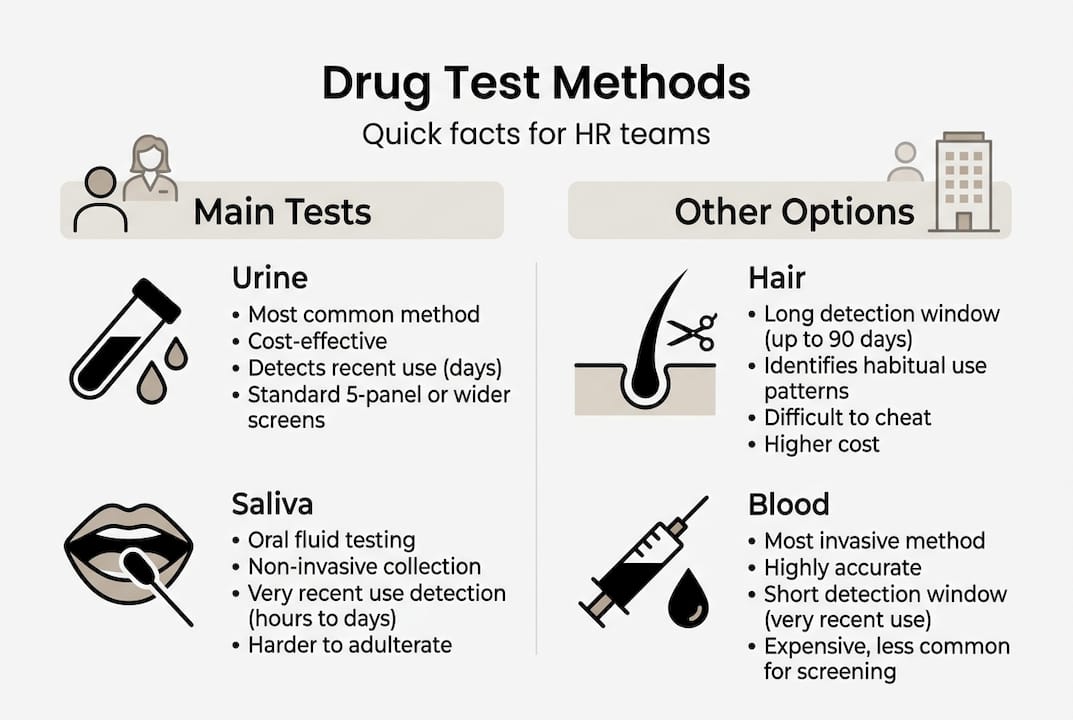
Saliva testing captures very recent use, typically within the past 24 to 48 hours, which makes it valuable for post-accident or reasonable suspicion scenarios but less useful for pre-employment screening where you want broader detection. The non-invasive collection process reduces privacy concerns and tampering opportunities compared to urine samples. However, the shorter detection window means applicants who abstain for just a few days before testing can pass despite regular use.
Hair follicle analysis provides the longest detection window, identifying substance use patterns over approximately 90 days. This method proves particularly valuable for positions requiring extensive background checks or where long-term substance abuse patterns matter more than recent use. The higher cost and longer turnaround time limit widespread adoption, and hair testing cannot detect very recent use since drugs take time to incorporate into growing hair strands.
Blood testing offers the most accurate measure of current impairment but remains rare in pre-employment contexts due to invasiveness, cost, and the need for medical personnel. Most employers reserve blood tests for post-accident investigations where proving active impairment at the time of incident matters legally.
The laboratory confirmation process adds critical accuracy. Initial immunoassay screens flag potential positives quickly but can produce false results. Samples testing positive undergo gas chromatography-mass spectrometry (GC-MS) confirmation to verify the specific substance and concentration. Chain of custody documentation tracks every sample transfer, creating an unbroken legal record from collection through analysis. Medical Review Officers (MROs) then review confirmed positives to identify legitimate medical explanations like prescription medications before reporting final results to employers.
Pro Tip: Always require MRO review even for point-of-care tests to distinguish legitimate prescription use from illicit substances and reduce false positive rates significantly.
Comparison of testing methods
| Method | Detection Window | Invasiveness | Cost | Best Use Case |
|---|---|---|---|---|
| Urine | 3 to 30 days | Moderate | Low | Standard pre-employment screening |
| Saliva | 24 to 48 hours | Low | Low | Recent use detection |
| Hair | Up to 90 days | Low | High | Long-term pattern analysis |
| Blood | Hours | High | High | Post-accident impairment proof |
These examples of workplace drug tests demonstrate how different industries select methods based on regulatory requirements and operational risks.
Legal and practical challenges in pre-employment drug screening
Marijuana legalization creates the most significant compliance challenge for HR professionals today. Marijuana positivity rates remain high but detection does not prove current impairment, and some states now restrict or prohibit pre-employment cannabis testing entirely. New York, Nevada, and New Jersey have enacted laws preventing most employers from rejecting applicants based solely on positive marijuana tests, though exceptions exist for safety-sensitive positions and federal contractors.

False positives and negatives represent another persistent challenge. Poppy seed consumption can trigger opioid positives, while certain over-the-counter medications cross-react with amphetamine tests. Applicants attempting to cheat tests use dilution, substitution, or adulterants, which is why supervised collection and temperature verification matter. Even with precautions, no test achieves perfect accuracy, which is why MRO review proves essential for distinguishing legitimate medical use from illicit consumption.
Privacy protections add layers of complexity. The Americans with Disabilities Act (ADA) prohibits discrimination against individuals in recovery from substance use disorders, though employers can still reject current illegal drug users. HIPAA requires strict confidentiality around test results and medical information. Employers must:
- Obtain written consent before testing
- Store results separately from personnel files
- Limit access to results on a need-to-know basis
- Provide applicants opportunity to explain positive results
- Avoid discussing medical conditions unless job-related and necessary
Federal regulations impose additional requirements on certain industries. DOT mandates rigorous testing in safety-sensitive roles with uniform policy application, requiring specific drug panels, MRO review, and random testing programs for covered positions. Pipeline operators, aviation personnel, commercial drivers, and railroad workers all fall under DOT jurisdiction regardless of state marijuana laws.
“Employers must navigate the tension between state marijuana legalization and federal prohibition, especially in safety-sensitive roles where impairment poses significant risks. Consistent policy application and MRO verification provide the strongest legal defense against discrimination claims.”
The employee drug testing checklist helps ensure your program meets all legal requirements, while drug testing policies explained offers detailed guidance on crafting compliant workplace policies that balance safety with employee rights.
Best practices for implementing effective pre-employment drug screening programs
Successful programs follow a systematic process that protects sample integrity and legal defensibility. Consent, photo ID verification, supervised collection, chain of custody documentation, and MRO review are essential steps that create an unbroken legal record from applicant notification through final result reporting. Each step serves a specific purpose in preventing tampering and ensuring accuracy.
The complete workflow should include:
- Provide written policy to applicants during the offer stage, clearly explaining substances tested, consequences of positive results, and their right to explain medical prescriptions.
- Obtain signed consent forms acknowledging the testing requirement and authorizing result disclosure to the employer.
- Verify applicant identity using government-issued photo identification to prevent substitution attempts.
- Conduct observed or supervised collection following standardized protocols, checking sample temperature and appearance immediately.
- Document complete chain of custody with signatures, dates, and times for every transfer from collection site to laboratory.
- Send samples to certified laboratories using tamper-evident packaging and secure transport methods.
- Require MRO review of all positive results before reporting to HR, allowing applicants to provide legitimate medical explanations.
- Make hiring decisions based on verified final results, applying policies consistently across all candidates.
Transparent communication prevents misunderstandings and legal challenges. Clearly explain your policy during interviews, include testing requirements in offer letters, and give applicants reasonable time to complete testing. Train hiring managers and supervisors on reasonable suspicion indicators and proper documentation practices. Never single out specific applicants for testing based on protected characteristics.
Choosing the right testing method requires balancing detection needs, budget constraints, and legal environment. Urine testing works well for most general hiring, while hair testing suits executive positions or roles with extensive background requirements. Consider your industry’s specific risks when selecting panels. Transportation companies might expand beyond NIDA-5 to include synthetic opioids like fentanyl, which poses growing workplace safety concerns.
Ongoing testing programs provide stronger deterrence than pre-employment screening alone. Random testing, post-accident protocols, and reasonable suspicion procedures create continuous accountability. However, these programs require careful policy development to avoid discrimination claims and privacy violations.
Integrating testing with supportive resources demonstrates organizational commitment to employee wellbeing beyond simple enforcement. Offer Employee Assistance Programs (EAPs) that provide confidential counseling and treatment referrals for substance use disorders. This approach reduces stigma, encourages early intervention, and can improve retention when valued employees seek help.
Pro Tip: Maintain separate vendors for collection and laboratory analysis to create independent verification and reduce conflicts of interest that could compromise result credibility in legal disputes.
The drug testing program workflow provides step-by-step implementation guidance, while workplace drug testing safety compliance addresses industry-specific regulatory requirements that affect program design.
Discover trusted drug screening solutions for your workplace
Implementing the best practices outlined above becomes simpler with reliable testing supplies designed for workplace screening programs. Our drug test cups offer multi-panel configurations that detect the most common substances efficiently, while drug test strips provide flexible options for customized screening approaches. Each product meets CLIA waiver standards and includes built-in adulterant detection to identify tampering attempts.
Access our comprehensive drug testing program workflow guide to ensure every step from consent to result reporting follows legal requirements and industry best practices. The detailed protocols help you maintain chain of custody documentation and implement supervised collection procedures that stand up to legal scrutiny.
Pro Tip: Using certified testing supplies combined with documented workflow adherence creates powerful legal defense capabilities if hiring decisions face discrimination challenges or workers’ compensation disputes.
Frequently asked questions
What drugs are commonly tested in pre-employment screenings?
Most employers test for the NIDA-5 panel including THC, cocaine, opioids, amphetamines, and PCP. Some organizations expand panels to include benzodiazepines, barbiturates, or synthetic opioids like fentanyl based on industry-specific risks. Testing panels vary by employer needs and applicable regulatory requirements.
How do legal changes affect pre-employment drug screening policies?
Some states now limit or prohibit pre-employment marijuana testing, requiring policy updates to maintain compliance. Federal DOT regulations still mandate testing regardless of state laws for safety-sensitive transportation positions. Employers must balance evolving legalization trends with workplace safety obligations and federal contractor requirements.
What steps ensure sample integrity during testing?
Supervised collection with photo ID verification prevents substitution and tampering attempts effectively. Complete chain of custody documentation tracks samples from collection through laboratory analysis with signatures at every transfer point. MRO review verifies results and distinguishes legitimate prescription medications from illicit use before reporting to employers.
Can applicants challenge positive test results?
Yes, applicants have the right to request retesting of their original sample at their own expense. The MRO review process allows candidates to provide documentation of legitimate prescription medications that could explain positive results. Employers should maintain samples for reasonable periods to accommodate retest requests and potential legal challenges.
How long should employers wait for test results before making hiring decisions?
Most urine test results return within 24 to 48 hours for negative screens, while positive results requiring confirmation testing may take 3 to 5 business days. Hair and blood tests typically require 5 to 10 days for complete analysis. Communicate expected timelines to applicants and avoid making final hiring decisions until receiving verified results from the MRO.