


Blog
How to Select Drug Test Kits for Compliance Needs


Selecting drug test kits for an American government agency is rarely simple. Federal laws like the Drug-Free Workplace Act set one standard, while state requirements can change everything from which substances must be tested to how records are kept. Sorting out these governing regulations before purchasing kits is crucial for avoiding compliance issues and ensuring your workforce screening aligns with current laws. This guide helps you make sense of regulatory demands and choose kits that actually fit your agency’s legal and operational needs.
Step 1: Assess testing requirements based on regulations
Your agency operates within a complex web of federal and state regulations that directly determine which drug tests you need, how you conduct them, and what substances you’re screening for. Understanding these requirements before selecting test kits saves time, prevents compliance violations, and ensures your program meets legal standards.
Start by identifying the governing regulations that apply to your specific agency and operations. Federal laws like the Drug-Free Workplace Act and Department of Transportation rules mandate testing in certain sectors, but state laws vary significantly on which drugs are covered, testing procedures, and documentation requirements. Your compliance team likely knows these regulations, but it’s worth documenting them clearly for your procurement process.
Break down your regulatory landscape into these key areas:
- Federal mandates specific to your agency or sector
- State law variations where your agency operates
- Substance coverage requirements (which drugs must be tested)
- Testing procedures (how samples are collected and analyzed)
- Documentation and chain of custody standards
- Reporting timelines for results
Next, map your specific testing scenarios. Are you screening new hires, conducting random tests on existing employees, or investigating suspected use? Each scenario may have different regulatory requirements. A pre-employment screen under federal guidelines differs from post-accident testing under Department of Transportation rules, for example.
Consider also whether your agency follows international standards. The UNODC and WHO prevention standards emphasize tailoring drug testing protocols to your local legal context while ensuring compliance with human rights standards. This means your test kit selection must align not just with regulations, but with broader prevention and harm-reduction strategies your organization supports.
Document these requirements in writing before you evaluate test kits. This becomes your compliance checklist when comparing products. A panel of five drug compounds meets federal needs, but your state regulations might require testing for additional substances. Only by clarifying this upfront can you select kits that truly match your compliance obligations rather than over-buying or under-screening.
When you understand how to ensure accurate drug screening for compliance, you can verify that your selected kits actually deliver the testing your regulations demand.
Document all applicable federal and state regulations before selecting test kits. This prevents costly compliance gaps and ensures your procurement aligns with legal requirements.
Pro tip: Contact your state’s workplace safety or human resources regulatory office to request a written summary of current drug testing requirements for government agencies. Having an official document eliminates ambiguity and protects your agency if regulations are ever questioned.
Step 2: Compare available drug test kit types and features
Now that you understand your regulatory requirements, you need to evaluate which test kit types actually match those needs. Different specimen types detect drugs over different timeframes, with varying levels of invasiveness and accuracy. Selecting the right kit type directly impacts your program’s effectiveness and compliance.
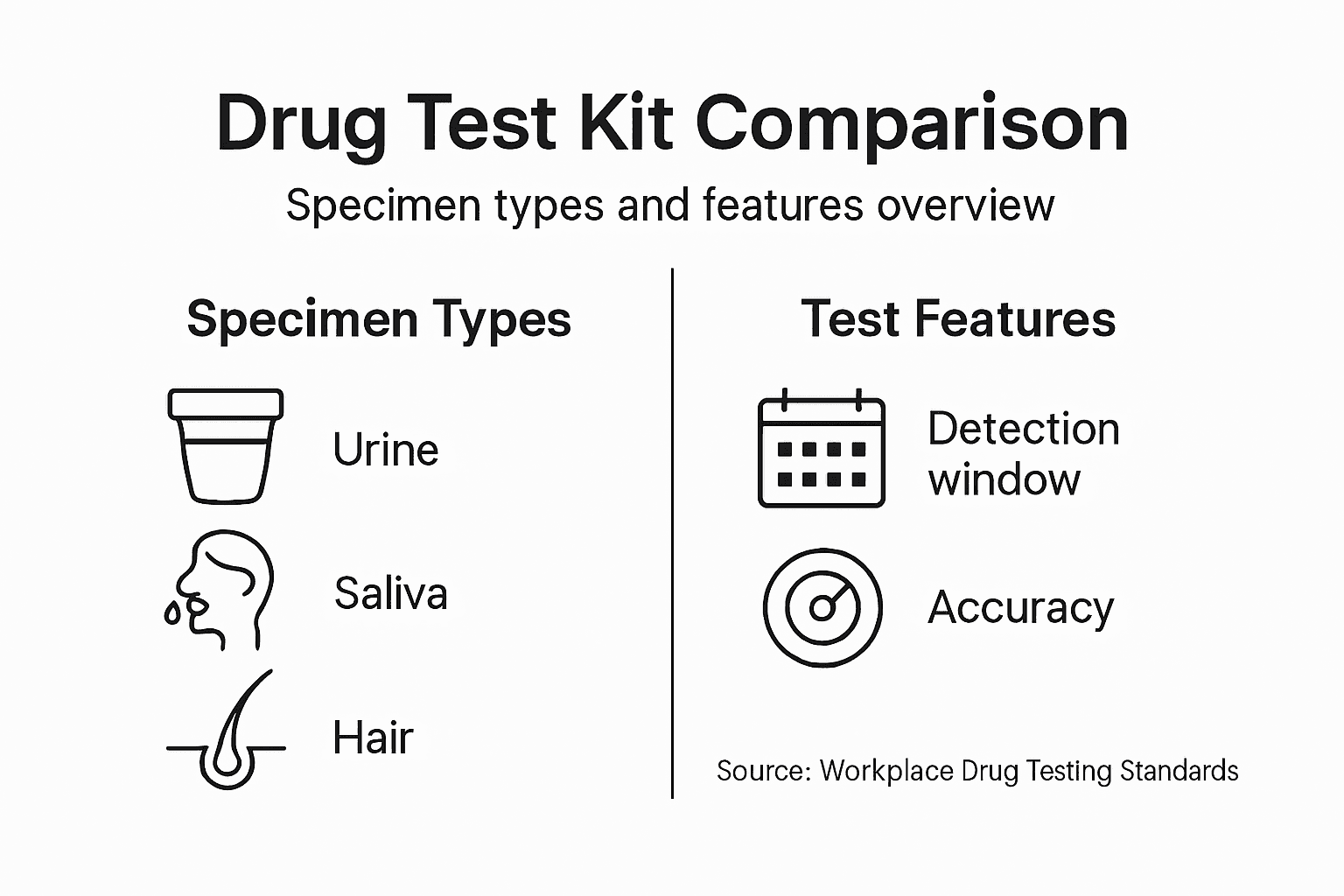
Start by understanding the main specimen types available and what each one detects:
- Urine tests detect recent drug use and are the most common choice for workplace compliance
- Hair tests reveal longer-term drug use patterns, typically spanning 90 days or more
- Saliva tests provide rapid detection with minimal invasiveness and less than 24-hour detection windows
- Blood tests offer high accuracy but are invasive and detect very recent use
- Sweat tests monitor substance use continuously over extended periods
Each specimen type has distinct detection windows and limitations. Urine tests work well for standard compliance screening but can be susceptible to adulteration attempts. Hair testing provides historical information but cannot pinpoint exact use timing. Saliva and sweat tests are less invasive alternatives, making them valuable for specific scenarios where employee relations matter.
Here’s a quick reference for major specimen types used in drug testing:
| Specimen Type | Detection Window | Advantages | Typical Use Case |
|---|---|---|---|
| Urine | 1-3 days | Widely accepted, low cost | Workplace screening |
| Hair | 90+ days | Long history, hard to cheat | Historical drug use checks |
| Saliva | <24 hours | Non-invasive, rapid results | Post-incident testing |
| Blood | Hours | High accuracy, detects recent use | Confirmatory lab tests |
| Sweat | Days to weeks | Continuous monitoring | Probation or long-term programs |
Beyond specimen type, compare the testing methodology each kit uses. Presumptive tests like colorimetric assays deliver rapid results and lower costs, but they can produce false positives or negatives. Confirmatory tests provide definitive identification through more advanced analysis, though they require lab processing and take longer. Your compliance needs determine which balance of speed and accuracy works best.
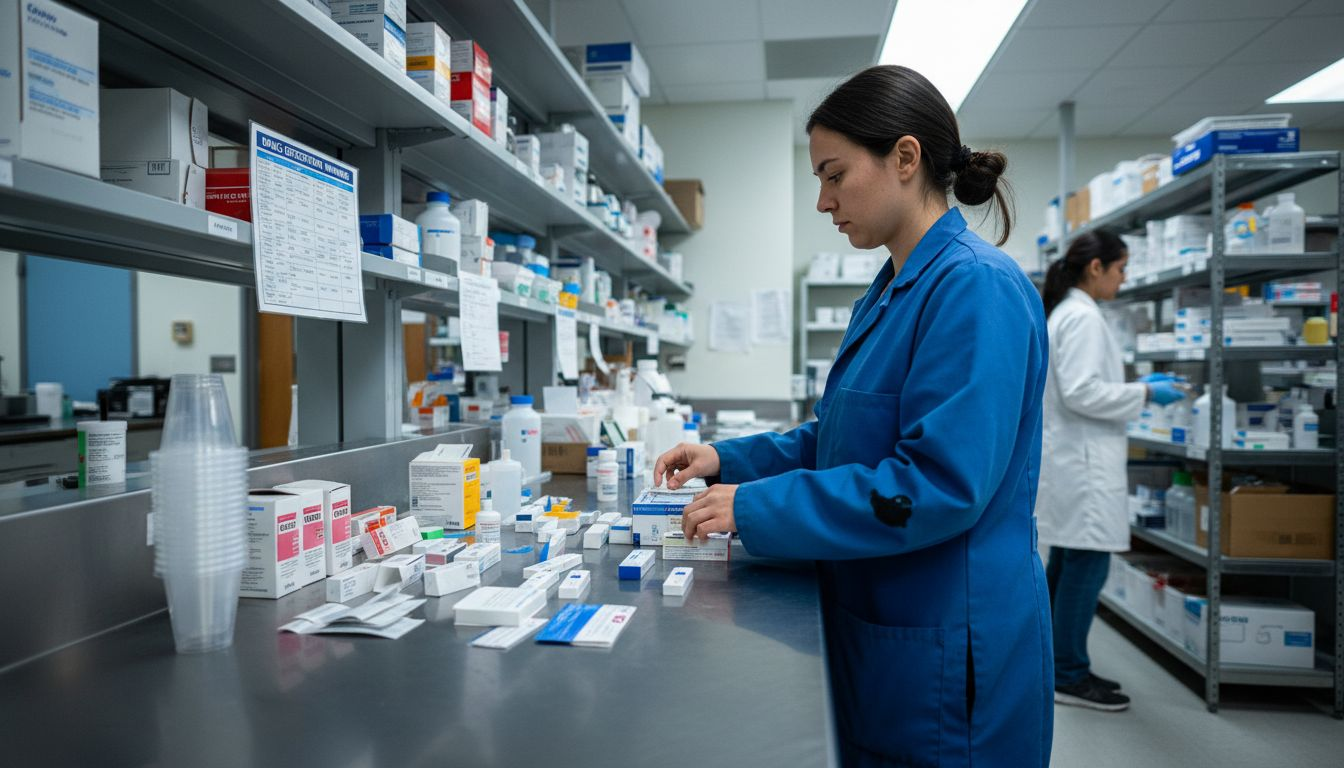
For government agencies, consider what your workforce and testing scenarios demand. A new hire screening program might use urine-based kits with presumptive testing for quick results. Random testing on safety-sensitive positions might benefit from multi-panel drug testing for compliance success, which covers broader substance panels in a single test.
Create a comparison matrix listing your top contender kits alongside their detection windows, accuracy rates, costs, and regulatory approvals. This visual tool helps your team make consistent, defensible choices across your testing program.
Different test kit types serve different compliance goals. Match your specimen type and methodology to your specific testing scenarios and regulatory requirements.
Pro tip: Request sample kits from your top three candidates and conduct a small pilot test with your team. Hands-on experience with collection procedures, result clarity, and ease of use reveals practical factors that specifications alone cannot capture.
Step 3: Evaluate supplier reliability and compliance standards
Your test kit selection depends heavily on the supplier providing them. A manufacturer with strong quality management systems and regulatory compliance ensures your kits perform reliably and meet all legal requirements. Evaluating suppliers upfront prevents costly failures and protects your agency’s compliance posture.
Start by verifying the supplier’s regulatory compliance credentials. Check whether they hold required licenses and registrations for manufacturing and distributing drug testing products. Under the Drug Supply Chain Security Act, pharmaceutical suppliers must maintain traceability and integrity through documented partnerships with licensed, registered trading partners. Your test kit supplier should meet similar standards in their industry.
Assess the supplier’s quality management systems and certifications. Look for evidence of systematic quality control, including testing protocols, documentation practices, and performance monitoring. Request information about their auditing processes and any third-party certifications they hold. Reputable suppliers welcome these questions and provide detailed documentation.
Evaluate supplier reliability across several key areas:
- Regulatory approvals (FDA approvals, CLIA waiver status, state certifications)
- Manufacturing standards (ISO certifications, GMP compliance, quality assurance programs)
- Product traceability (batch numbers, expiration dates, chain of custody documentation)
- Performance history (accuracy rates, customer reviews, complaint resolution)
- Customer support (technical assistance, training, bulk order capabilities)
- Delivery reliability (consistent shipping timelines, inventory availability)
Request supplier audit results and quality documentation. Ask whether they’ve undergone independent audits and if they can provide summaries of findings. This demonstrates commitment to compliance and helps you understand their operational standards. Don’t accept vague assurances; demand specific evidence.
The following table summarizes key supplier reliability factors for government agencies:
| Reliability Factor | Why It Matters | What To Look For |
|---|---|---|
| Regulatory Approvals | Ensures legal compliance | FDA, CLIA, state certification |
| Product Traceability | Tracks batches and expiry | Lot numbers, chain of custody docs |
| Quality Management | Consistent kit performance | ISO, GMP, audit reports |
| Customer Support | Resolves issues quickly | Training, tech help, quick responses |
Contact existing government customers using the supplier’s products. Direct feedback from agencies with similar compliance needs reveals real-world performance and reliability. Ask about their experiences with accuracy, customer service, and consistency across bulk orders.
When evaluating suppliers, ensure you understand how to ensure accurate drug screening for compliance through their quality systems and certifications.
A reliable supplier with strong compliance standards protects your agency from regulatory violations, product failures, and legal liability. Invest time in thorough evaluation upfront.
Pro tip: Request a written compliance guarantee from your supplier that includes accuracy rates, batch testing documentation, and their process for handling defective kits or customer issues. This creates legal protection and clarifies expectations before you place bulk orders.
Step 4: Verify kit accuracy with sample testing
Before committing to bulk purchases, you need to validate that your chosen test kits deliver accurate results in real-world conditions. Sample testing with positive and negative controls reveals whether kits perform as manufacturers claim and identifies potential issues before they affect your compliance program.
Start by conducting a controlled validation using your own laboratory or working with a qualified testing partner. This step protects your agency by confirming kit accuracy before deployment. Order sample quantities from your top candidates and establish a testing protocol that mirrors your actual use scenarios.
Design your sample testing protocol around these elements:
- Test with negative control samples (clean specimens with no drugs present) to verify the kit produces negative results correctly
- Test with positive control samples (specimens containing known drugs at documented concentrations) to confirm detection capability
- Run tests with multiple batches from your supplier to ensure consistency across production runs
- Document all results including timing, clarity of results, and any ambiguous readings
- Compare results against reference standards or professional lab confirmatory testing
Remember that drug analysis typically uses both presumptive and confirmatory approaches. Presumptive tests like your sample drug test kits provide rapid screening, but confirmatory testing through methods like gas chromatography-mass spectrometry validates results. Your sample testing should identify whether you need confirmatory backup for borderline or unclear readings.
Test across your full range of expected substances based on your regulatory requirements from Step 1. Don’t just test for marijuana or common drugs. If your regulations require testing for synthetic drugs or prescription medications, verify those specifically with your samples.
Document any issues you encounter. Weak color development, unclear result lines, expired reagents, or inconsistent readings all indicate quality problems. Share these findings with your supplier and ask how they address quality assurance. If they dismiss your concerns or cannot explain quality variations, reconsider your selection.
A robust drug screening workflow incorporates sample validation into your procurement process, catching accuracy issues before they impact your program.
Accurate sample testing before bulk purchase prevents deploying unreliable kits across your entire compliance program. Invest the time to validate thoroughly.
Pro tip: Keep detailed records of your sample testing results, including photos of kit results and notes on any issues observed. These records demonstrate your due diligence if regulators ever audit your kit selection process and provide baseline comparisons if you switch suppliers later.
Ensure Compliance with Trusted Drug Test Kits from Buy Test Cup
Selecting drug test kits that meet strict regulatory standards can feel overwhelming. The article highlights key challenges like navigating federal and state compliance, verifying kit accuracy, and choosing the right specimen types to avoid costly compliance gaps. You need reliable suppliers who provide clear quality certifications and a broad range of testing products tailored to your specific government agency requirements.
At Buy Test Cup, we understand these pain points and offer a comprehensive selection of drug testing supplies designed for accuracy and regulatory compliance. Whether you require multi-panel drug test cups, oral swabs, or adulterant detection kits, our products come with proper certifications and come from trusted manufacturers committed to quality and traceability. Take control of your compliance program with our competitive pricing, same-day shipping, and expert customer support.
Explore our full catalog at Buy Test Cup now and find the perfect kits that match your legal and procedural requirements. Don’t wait until compliance issues arise — act today to secure reliable testing solutions with fast delivery for your agency’s peace of mind.
Frequently Asked Questions
What factors should I consider when assessing my drug testing requirements for compliance?
Understanding your drug testing requirements starts with evaluating federal and state regulations that apply to your agency. Document the specific mandates regarding which substances you must test for and the required procedures. Create a compliance checklist that outlines these regulations before selecting test kits.
How do I choose the right type of drug test kit for my needs?
Select a drug test kit based on the specimen type that aligns with your testing goals. Consider options like urine, hair, saliva, blood, or sweat tests, knowing each has different detection windows and purposes. For example, urine tests are typically used for compliance screening within 1-3 days of use.
How can I verify the accuracy of drug test kits before making a bulk purchase?
To verify accuracy, conduct controlled sample testing using known negative and positive controls. This will allow you to confirm that the kits perform as advertised in real-world conditions. Aim to complete this validation process before placing a bulk order, potentially saving costs associated with unreliable testing.
Why is it important to evaluate supplier reliability when selecting drug test kits?
Evaluating supplier reliability ensures that the test kits you choose meet regulatory compliance and performance standards. Look for suppliers with strong quality management systems and relevant certifications to prevent costly failures. Conduct a thorough assessment of their compliance credentials and customer support capabilities.
How do I document regulatory requirements for drug testing in my agency?
Begin by identifying and listing all applicable federal and state regulations pertinent to your agency’s operations. Documentation should include details on substances to be tested, testing procedures, and reporting timelines. Keep this as a reference throughout your procurement process to ensure compliance with drug testing standards.